Too Hot: Australia’s big heat breaking records

BOMcolours

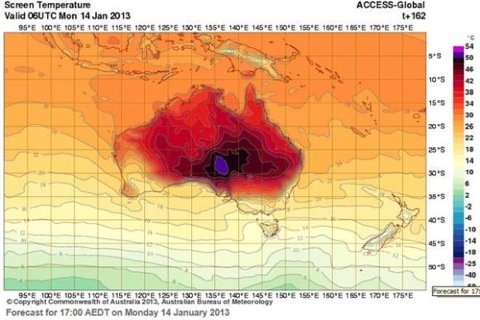
Australia is gripped by a massive heatwave, records are tumbling and fires are burning across the continent. I’m not going to attempt a comprehensive post on the subject — events are moving too fast — but I would like to note a few things. The Bureau of Meteorology forecast chart above (courtesy of Watching The Deniers) for next Monday has forced BOM to add new colours to the hot end of the range, to allow for forecast temperatures over 52ºC — well above the previous national record high of 50.7ºC. Meanwhile the current heatwave has already set a new record for the number of consecutive days where the national average temperature has exceeded 39ºC — now running at seven days, with the heat forecast to continue. That’s the average temperature for the whole of the continent, which is no small place. The previous record was four consecutive days, set in 1973.

The Sydney Morning Herald has a good summary of the records being broken here. See also: Jeff Masters, Climate Progress, New Scientist and the Guardian.

NASA’s Earth Observatory provides this overview of the fires in Tasmania over the weekend that caused chaos and destruction in the normally cool state — Hobart hit an all time high temperature of 41.8ºC, a full degree above its previous record.
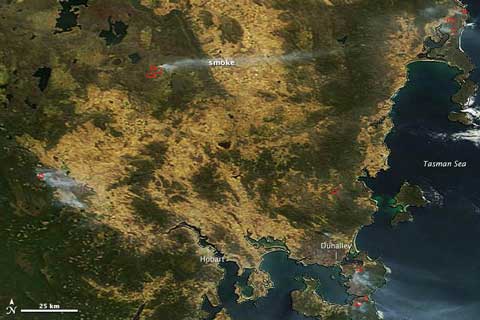
Tasmania EO 2013007

Fire danger in parts of New South Wales has been classified as catastrophic, and this NASA Worldview image for Jan 8th appears to show smoke from fires in southern NSW streaming out to the east and over the sea towards New Zealand.

Ben Cubby at the SMH pulls together reactions from the scientific community under the headline “Get used to record breaking heat”, and one quote struck me rather forcefully:

“Those of us who spend our days trawling – and contributing to – the scientific literature on climate change are becoming increasingly gloomy about the future of human civilisation,’’ said Liz Hanna, convener of the human health division at the Australian National University’s Climate Change Adaptation Network.

As George Monbiot notes in the Guardian today, in a column excoriating Australian opposition leader Tony Abbott for his climate denial:

Australia’s new weather demands a new politics; a politics capable of responding to an existential threat.

My comment? That’s what the whole bloody world needs.

[The Specials]

Domestic solar PV: practical for NZ?

This is a guest post by Jason Kemp of DialogCRM. It originally appeared at Jason’s blog last week, but I thought it deserved an airing here because it directly addresses many of the issues HT’s readers have been keen to discuss. With luck, this won’t be last time Jason’s work pops up at Hot Topic

Many NZ consumers will be wondering if solar power for the home is a practical option. In simple terms despite New Zealand having mostly renewable energy our power costs to the home have continued to climb in the past few years despite low inflation. In real terms power costs have pretty much doubled for me in the last 4 years and some of that is due to changing power use but most of it comes from cost increases made by the lines companies and the electricity retailers.

According to one source: Andrew Booth of Solar City re intelligent roof tiles

“The price of power in New Zealand is more than 70% higher than in Australia and the United States. There is very little point switching power companies in the face of such high prices. Homeowners would be far better off switching to solar.”

I suspect having an unprofitable aluminium smelter sucking up huge amounts of power at a huge discount and a government hell bent on selling shares in power companies ( that we already own – double dipping anyone?) complicates the math on why NZ power costs are extortionate but having high power costs should incentivise us to investigate alternatives – shouldn’t it? Continue reading “Domestic solar PV: practical for NZ?”

Climate Show New Year podcast special: where it’s at and where it’s going

Here’s the podcast you’ve all been waiting for — The Climate Show New Year special. Glenn and Gareth review the big climate stories of 2012, discuss at the big picture post Doha, and peek into their transcontinental Skype-powered crystal ball to prognosticate on the next 12 months. The three sections were recorded shortly before Christmas for Glenn’s New Year Things You Need To Know for 2013 summer series on Radio Live. The first two aired last week – the final section will be broadcast on Wednesday, so consider this an exclusive preview.

Climate Show Podcast special

PS: My reference to CO2 at 400 ppm in 2013 should have been qualified with where it will happen — which is northern hemisphere, high (Arctic) latitudes.

A Celtic New Year: lilt or lament?

[youtube]qUTMgobBiqg[/youtube]

Mr Morrison invites us all to come on home, and have a Celtic new year — which is always a good thing, as I can testify, being a Celt of many generations standing. While I wait for the ham to subside and the cabernet merlot to wash out of the system ((Tomorrow, of course.)), I’ll point you to the thoughts of George Monbiot, who is less than impressed with the old year:

It was the year of living dangerously. In 2012 governments turned their backs on the living planet, demonstrating that no chronic problem, however grave, will take priority over an immediate concern, however trivial. I believe there has been no worse year for the natural world in the past half-century.

Nor do the efforts of the British government bring him much cheer:

Continue reading “A Celtic New Year: lilt or lament?”

The year the earth bit back: top climate stories of 2012

2012Amidst the blizzard of year-end roundups, here’s one you have to read in full — a joint effort put together by a diverse group of bloggers and scientists: Angela Fritz, Eli Rabett, Emilee Pierce, Greg Laden, Joe Romm, John Abraham, Laurence Lewis, Leo Hickman, Michael Mann, Michael Tobis, Paul Douglas, Scott Mandia, Scott Brophy, Stephan Lewandowsky, Tenney Naumer and yours truly. Lead author Greg Laden explains:

A group of us, all interested in climate science, put together a list of the most notable, often, most worrying, climate-related stories of the year, along with a few links that will allow you to explore the stories in more detail. We did not try to make this a “top ten” list, because it is rather silly to fit the news, or the science, or the stuff the Earth does in a given year into an arbitrary number of events. (What if we had 12 fingers, and “10” was equal to 6+6? Then there would always be 12 things, not 10, on everyone’s list. Makes no sense.) We ended up with 18 items, but note that some of these things are related to each other in a way that would allow us to lump them or split them in different ways. See this post by Joe Romm for a more integrated approach to the year’s events. Also, see what Jeff Masters did here. We only included one non-climate (but related) item to illustrate the larger number of social, cultural, and political things that happened this year. For instance, because of some of the things on this list, Americans are more likely than they were in previous years to accept the possibility that science has something to say about the Earth’s climate and the changes we have experienced or that may be in the future; journalists are starting to take a new look at their own misplaced “objective” stance as well. Also, more politicians are starting to run for office on a pro-science pro-environment platform than has been the case for quite some time.

A failing of this list is that although non-US based people contributed, and it is somewhat global in its scope, it is a bit American based. This is partly because a few of the big stories happened here this year, but also, because the underlying theme really is the realisation that climate change is not something of the future, but rather, something of the present, and key lessons learned in that important area of study happened in the American West (fires) the South and Midwest (droughts, crop failures, closing of river ways) and Northeast (Sandy). But many of the items listed here were indeed global, such as extreme heat and extreme cold caused by meteorological changes linked to warming, and of course, drought is widespread.

Continue reading “The year the earth bit back: top climate stories of 2012”