The year the earth bit back: top climate stories of 2012

2012Amidst the blizzard of year-end roundups, here’s one you have to read in full — a joint effort put together by a diverse group of bloggers and scientists: Angela Fritz, Eli Rabett, Emilee Pierce, Greg Laden, Joe Romm, John Abraham, Laurence Lewis, Leo Hickman, Michael Mann, Michael Tobis, Paul Douglas, Scott Mandia, Scott Brophy, Stephan Lewandowsky, Tenney Naumer and yours truly. Lead author Greg Laden explains:

A group of us, all interested in climate science, put together a list of the most notable, often, most worrying, climate-related stories of the year, along with a few links that will allow you to explore the stories in more detail. We did not try to make this a “top ten” list, because it is rather silly to fit the news, or the science, or the stuff the Earth does in a given year into an arbitrary number of events. (What if we had 12 fingers, and “10” was equal to 6+6? Then there would always be 12 things, not 10, on everyone’s list. Makes no sense.) We ended up with 18 items, but note that some of these things are related to each other in a way that would allow us to lump them or split them in different ways. See this post by Joe Romm for a more integrated approach to the year’s events. Also, see what Jeff Masters did here. We only included one non-climate (but related) item to illustrate the larger number of social, cultural, and political things that happened this year. For instance, because of some of the things on this list, Americans are more likely than they were in previous years to accept the possibility that science has something to say about the Earth’s climate and the changes we have experienced or that may be in the future; journalists are starting to take a new look at their own misplaced “objective” stance as well. Also, more politicians are starting to run for office on a pro-science pro-environment platform than has been the case for quite some time.

A failing of this list is that although non-US based people contributed, and it is somewhat global in its scope, it is a bit American based. This is partly because a few of the big stories happened here this year, but also, because the underlying theme really is the realisation that climate change is not something of the future, but rather, something of the present, and key lessons learned in that important area of study happened in the American West (fires) the South and Midwest (droughts, crop failures, closing of river ways) and Northeast (Sandy). But many of the items listed here were indeed global, such as extreme heat and extreme cold caused by meteorological changes linked to warming, and of course, drought is widespread.

Continue reading “The year the earth bit back: top climate stories of 2012”

New Zealand’s double dealing and special pleading over the second Kyoto period: part the second

USD or NZD? so confusing!

Is Tim Groser a Kyoto pariah? Or a Kyoto visonary? A global emissions reduction emissary or is he tar-sanded with a Canadian brush? I once more try to make sense of New Zealand’s double dealing and special pleading over the Kyoto Protocol second commitment period and the Doha hooha. This time with the aid of Tim Groser, who has written an opinion editorial in the Herald.

Tim Groser, New Zealand’s most forthright Minister for Climate Changes, contributed a shocker of an Op Ed to the NZ Herald this week. When I first read it, I wrote down my responses to what seemed the most misleading claims. The headline shocker is that either Tim Groser is so out of touch with his portfolio that he has no idea what the current price of carbon in New Zealand, or he is so incompetent that he can’t tell US dollars from NZ dollars.

But there are shockers for all of us.

Continue reading “New Zealand’s double dealing and special pleading over the second Kyoto period: part the second”

New Zealand’s double dealing and special pleading over Kyoto 2: part the first

Net emissions to 2020
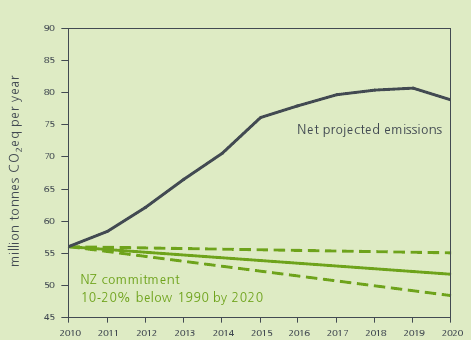
The 2020 target and Net emissions to 2020

Is Tim Groser a Kyoto pariah? Or a Kyoto visonary? A global emissions reduction emissary or is he tar-sanded with a Canadian brush? I try to make sense of New Zealand’s double dealing and special pleading over the Kyoto Protocol second commitment period and the Doha climate change talks hooha.

I am very confused about New Zealand’s climate change policy since the Doha international climate change talks (COP18) and New Zealand’s announcement that it would opt out of a second period of the Kyoto Protocol back on 9 November 2012.

The Kyoto opt-out has been described as a shambles and a disgrace and as a lose-lose decision that shuts New Zealand out of the international carbon markets. Tim Groser’s Herald Op Ed today just confuses me more.

So I have a question for all Hot Topic readers.

If Minister of Climate Change Tim Groser is serious about New Zealand’s 2020 greenhouse gas target, why would he forego formally lodging the 2020 target into the existing Kyoto Protocol framework (where the national institutions and arrangements are already up and running), in favour of pledging to meet the target on a voluntary basis in terms of a yet to be negotiated treaty?

Continue reading “New Zealand’s double dealing and special pleading over Kyoto 2: part the first”

NZ’s climate policy omnishambles – gerry brownlee’s anti-carbon tax

Gerry Brownlee, formerly a minister of energy and fossil fuel, and currently the Minister for Transport and for bulldozing democracy, heritage and social order in Christchurch, today announced that petrol duty will be increasing by 3 cents a litre annually for the next 3 years to fund new roads.

Specifically mentioned are the Rangiriri and Tamahere-Cambridge sections of the Waikato Expressway, the Mackays to Peka Peka section of the Wellington Northern Corridor and the four-laning of the Groynes to Sawyers Arms (Johns Road) section of the Western Corridor in Christchurch.

The reason given for this policy is that the funding is needed for the Roads of National Significance programme and some upper North Island transport projects. I guess that means more spaghetti motorway in Auckland.

This is crazy policy.

The first level of craziness of the petrol duty hike is that it will affect the benefit-cost analysis (BCA) of each Roads of National Significance (RONS) project. Projects like Transmission Gully Expressway, have already been justified to hearings before the Environment Protection Authority on very marginal benefit/cost ratios. Julie-Anne Genter of the Greens said the benefit/cost ratio of Transmission Gully was 0.6. The RONS don’t even break even in BCA terms.

Now with the added petrol duty, the marginal benefit/cost ratio would be even worse. However, I bet that won’t make Gerry Brownlee or Steven Joyce any less obsessed with them.

The second level of craziness with the petrol duty increase is the Government’s complete failure to understand carbon pricing (which is what a petrol duty is) and to anchor their transport, energy and infrastructure policy with effective carbon pricing.

I have no problem with the price of petrol or diesel increasing. Road transport has many externalities that are not priced. It is “elephant in the room” obvious that the most important unpriced externality of liquid fossil fuels is global warming. And not a lack of four-lane expressways.

“But we have an emissions trading scheme!” I hear some one say. “Surely, road transport fuels are included in the NZETS?”

Yes we sort of have an emissions trading scheme which includes liquid fossil fuels which sort of prices carbon. But NZ carbon prices have crashed 72% in 2012.

According to estimates by the Energy and Data part of Steven Joyce’s mega-ministry MoBIE, in the three months ended on 30 September 2012, the NZ emissions trading scheme probably accounted for 0.93 cents out of the regular petrol price of $2.09 per litre.

So we may describe New Zealand’s petrol pricing policy as having two mutually conflicting parts. The price includes a component for revenue gathering for unneeded four-lane RONS expressways (3 cents/litre). The price also includes a component for the NZETS carbon price (0.93 cents/litre).

And the four-lane expressways part exceeds the carbon-pricing ETS part by a factor of 3.

This is the complete opposite of effective carbon pricing. Brownlees’s petrol duty, to coin an expression, is an anti-carbon tax. What a shambles!

NZ climate policy shambles, and other summer reading

It’s summer down south, and New Zealand’s politicians have embarked on their summer break. It’s summer in Waipara too, and with yesterday topping 30ºC and today heading in the same direction, your blogger has immediate climate concerns of an irrigation and vine management nature to attend to. So, with apologies for what may turn out to be less frequent posting over the next few weeks, here’s a quick round-up of stuff worth reading.

The NZ government will be relieved to be heading to the beaches after being battered by a hail of criticism for their climate policies over the last week. Brian Fallow, the NZ Herald‘s economics editor, was especially direct in his dissection of NZ’s climate policy settings post-Doha:

The Government’s climate change policy is a shambles and a disgrace. Unless, that is, you are happy for the costs of the inevitable adjustment to a low-carbon future to be needlessly increased and pushed onto the young, in which case it is doing a great job.

Gareth Morgan joined in, calling for the government to come clean about what its policies really mean:

Continue reading “NZ climate policy shambles, and other summer reading”