The Doha Gateway: Look on my works, ye mighty, and despair

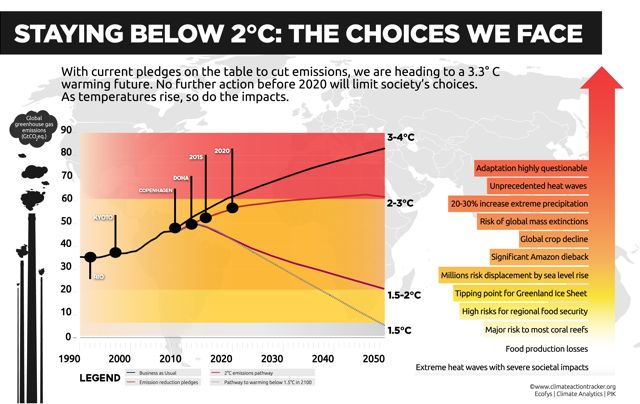
Where we are, where we should be and the consequences. Climate Action Tracker’s graphic on our future choices.

And so. Another set of climate talks done, this year dusted with Doha sand and labeled the “Doha Gateway”.  I’m not sure what they’re a gateway to,  certainly no immediate improvement to the climate. The final hours were bizarre, to say the least.  We began the day on Saturday with a text much improved from the day before, but with some major issues outstanding.  Ministers wrangled behind closed doors for most of the day, changing bits of text here and there.

We were preparing for Russia who, with Kazakhstan, Belarus and the Ukraine, were set to continue the talks way into Saturday night.   They were holding out in the informals, furious about the discussions on hot air.

Hot air

The “Russian factor” is one those of us who’ve been involved for a few years are all too familiar with. Just when you think there’s general agreement, in come the Russians who manage to drag the talks on for hours.

“Hot air” has been major problem with the Kyoto Protocol for years.  Somehow, the Russians managed to get the Kyoto negotiators to agree to a baseline of 1990, before the collapse of the former Soviet Union, which meant millions of tonnes of carbon credits ended up in the hands of Eastern European countries, bringing them a handy income, and other countries an easy and cheap option to do nothing at home and buy cheap hot air.  Russia has 6Gt of hot air – that’s how much it’s been cheating the atmosphere.

In Durban and Doha, New Zealand has sided with this team against the wish of the rest of the world to make sure that this “hot air” didn’t get carried over into Kyoto’s second commitment period (CP2).

Continue reading “The Doha Gateway: Look on my works, ye mighty, and despair”
The Climate Show #31: Doha! Doha! Doha!

[youtube]z9t7cFjOo_Q[/youtube]

It’s the run up to Christmas, and the annual ritual repeats. Diplomats gather in Doha to discuss and debate action on climate change, so Glenn and Gareth talk to their correspondent on the spot, New Zealand climate media strategist Cindy Baxter to find out what’s happening in the oil kingdom’s echoing halls. At the Fall AGU meeting in San Francisco, NOAA has published its 2012 Arctic Report Card (grim reading, it has to be said). Plus Gareth talks about truffles as a bellwether for Europe’s changing climate, and the boys get all enthusiastic about nanophotonics and steampunk.

Watch The Climate Show on our Youtube channel, subscribe to the podcast via iTunes, listen to us via Stitcher on your smartphone or listen direct/download from the link below the fold.

Follow The Climate Show at The Climate Show web site, and on Facebook and Twitter.

Continue reading “The Climate Show #31: Doha! Doha! Doha!”

2° be or not 2° be: the choices we face

Time to walk away from the goal of limiting warming to 2degC?

There’s been much talk in recent weeks about the 2degC global warming limit: agreed in Copenhagen, confirmed in Cancun. It has been questioned by many, including Kevin Anderson in a post on this blog, and by US Climate Envoy Todd Stern.

The scientists I’m working with in Doha, from the Climate Action Tracker, gave a press conference last Friday to outline what they think about this “goal” (I put it in quotes because I am a little tired of people saying it’s a “goal”.  A goal is something you strive for, but personally I’d rather we didn’t reach it).

But despite what Kevin Anderson and others are saying, these guys, from Climate Analytics, the Pik Potsdam Institute and Ecofys, have done probably the most substantive data crunching and modeling on this issue, the most definitive to date on the subject. Indeed, they did the core work on UNEP’s three Emissions Gap reports.

Their topline is that physically, technically and economically, it’s absolutely feasible. And without having to jump through crazy CCS or bio-energy hoops or any other such negative emissions.
Continue reading “2° be or not 2° be: the choices we face”

Doha notes: Random thoughts from the Middle East

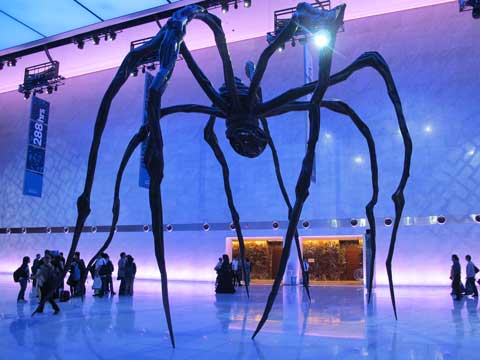
Shelob

Shelob/Maman lurks over Doha delegates.

Every time I walk into a press conference it seems there’s more ‘cheery’ news. Yesterday it was UNEP releasing a science report on melting permafrost. Scary stuff. So scary that The Age in Melbourne gave it most of the front page and even some on the back page. (Meanwhile the NZ media was all about Hobbits).

According to the report, if the permafrost keeps melting like it has been, the gases it releases will make up 39% of emissions in 2100 (a combination of release of trapped methane and C02 from decomposing matter).

Then today it was the World Meteorological Organisation’s State of the Climate provisional report. 2012 was no exception to the trend of rising temperatures. “Global warming isn’t a future threat: it’s happening now,” intoned the official, pointing to this year’s Arctic melt as evidence.

These organisations save this stuff up for the climate talks, but sometimes one has to wonder why. I heard a UN official telling a newbie to the process that none of this would have any effect on the delegates at the talks. “They’re in a bubble – they’re totally immune to this stuff,” he said. And he’s right.

Some of these officials have been coming to the climate talks for more than 20 years and they don’t see anything beyond their negotiating tables. What might have an impact would be if they get home and their kids, having seen the permafrost or WMO stories, start giving them hell about it. I hope they do.

Continue reading “Doha notes: Random thoughts from the Middle East”

Tim Groser shuts the stable door after the Mickey Mouse carbon credits have bolted

Mickey explains over supply in the offsets market

This week the Ministry for the Environment is consulting and seeking submissions on a proposal to ban some of the more ‘Mickey Mouse’ international carbon credits from the New Zealand Emissions Trading Scheme. Apparently this is because Climate Change Minister Tim Groser “wants to maintain the integrity of the ETS” (New Zealand Emissions Trading Scheme).

Thats really too much brazen and intentional cognitive dissonance, especially since Groser said that only five days after he indefinitely excluded agriculture from the ETS and only four days after he announced New Zealand would not sign up for a second commitment period under the Kyoto Protocol of binding greenhouse gas reductions.

I apologise if you had an extreme reaction to the close conjunction of the terms “Tim Groser”, “emissions trading scheme” and “integrity”. My apologies if you just coughed your coffee/beer/tea over your laptop or punched out your PC monitor.

Assuming you have cleaned up, I should provide the context for Tim Groser’s unintentional irony in claiming to be concerned about the integrity of an emissions trading scheme where emission units trade for less than $3 per tonne of carbon dioxide equivalent gas.

Here is the quote from Groser about the consultation.

Continue reading “Tim Groser shuts the stable door after the Mickey Mouse carbon credits have bolted”