
Carbon offsets from a permanent forest sink project – keep it real

Project Rameka sequester and ride

In which I guest-post as myself and describe a carbon forest sink project I am involved in and our debate about whether we should provide carbon offsets to anyone as part of the project. I originally wrote this for the Greens Frogblog

Simon Johnson is a conservationist, tramper, accountant, former DOC worker and resource management consultant. Simon also blogs periodically at Hot-Topic.co.nz. In this guest post he writes about carbon offsetting from the point of view of a carbon forest.

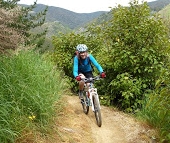
I am one of the trustees of a small 47-hectare carbon forest sink and native re-vegetation project and mountain bike park; “Project Rameka” in the east Takaka hills in Golden Bay.

It’s really a response to climate change made by two of my old friends, Bronwen Wall and Jonathan Kennett, who bought the land in 2008. Bronwen and Jonathan decided to apply their experience organising native planting projects in Wellington to climate change after reading the 2007 fourth report of the International Panel on Climate Change (IPCC).

It’s been embraced enthusiastically by the Golden Bay community who do the planting, pest control and track work through Project Rameka Inc.

The land is owned by a trust and I am one of the trustees. I did the early accounting for the trust and prepared the application to get the land into the Permanent Forest Sinks Iniative (PFSI).

In return for a 50-year covenant restricting the land use to forest, we receive about 800 carbon credits (specifically assigned amount units) per year for Project Rameka. These units started life as part of New Zealand’s 1990 baseline amount of ‘Kyoto’ units under the Kyoto Protocol.

How many units we get is based on the amount of carbon withdrawn from the atmosphere by the trees. Thanks to the Golden Bay weather, plants grow really quickly. So we really are storing carbon. We have seen 3cm annual growth rings in the few pines we have removed.

Continue reading “Carbon offsets from a permanent forest sink project – keep it real”

People talkin’ #10

A new open comment thread for the New Year, mainly because it’s too long since I posted the last one, but also because I’ve been declaring too many comments on recent posts to be off-topic. James Hansen‘s commentary on last year’s temperatures and the prospects for this year (pdf) is your starter for ten…

Meanwhile, I’m preparing a couple of talks for this weekend’s Coal Action Network Summer Festival near Gore. I’ll be briefing attendees on the state of the climate, and what we know about where we’re heading. There’s a session for the public on Sunday at the James Cumming Wing in Ardwick Street in Gore — I’ll be speaking at about 10-30 am. See you there? Failing that, I’ll probably post edited highlights of my thoughts next week.

Domestic solar PV: practical for NZ?

This is a guest post by Jason Kemp of DialogCRM. It originally appeared at Jason’s blog last week, but I thought it deserved an airing here because it directly addresses many of the issues HT’s readers have been keen to discuss. With luck, this won’t be last time Jason’s work pops up at Hot Topic

Many NZ consumers will be wondering if solar power for the home is a practical option. In simple terms despite New Zealand having mostly renewable energy our power costs to the home have continued to climb in the past few years despite low inflation. In real terms power costs have pretty much doubled for me in the last 4 years and some of that is due to changing power use but most of it comes from cost increases made by the lines companies and the electricity retailers.

According to one source: Andrew Booth of Solar City re intelligent roof tiles

“The price of power in New Zealand is more than 70% higher than in Australia and the United States. There is very little point switching power companies in the face of such high prices. Homeowners would be far better off switching to solar.”

I suspect having an unprofitable aluminium smelter sucking up huge amounts of power at a huge discount and a government hell bent on selling shares in power companies ( that we already own – double dipping anyone?) complicates the math on why NZ power costs are extortionate but having high power costs should incentivise us to investigate alternatives – shouldn’t it? Continue reading “Domestic solar PV: practical for NZ?”

Climate Show New Year podcast special: where it’s at and where it’s going

Here’s the podcast you’ve all been waiting for — The Climate Show New Year special. Glenn and Gareth review the big climate stories of 2012, discuss at the big picture post Doha, and peek into their transcontinental Skype-powered crystal ball to prognosticate on the next 12 months. The three sections were recorded shortly before Christmas for Glenn’s New Year Things You Need To Know for 2013 summer series on Radio Live. The first two aired last week – the final section will be broadcast on Wednesday, so consider this an exclusive preview.

Climate Show Podcast special

PS: My reference to CO2 at 400 ppm in 2013 should have been qualified with where it will happen — which is northern hemisphere, high (Arctic) latitudes.

A Celtic New Year: lilt or lament?

[youtube]qUTMgobBiqg[/youtube]

Mr Morrison invites us all to come on home, and have a Celtic new year — which is always a good thing, as I can testify, being a Celt of many generations standing. While I wait for the ham to subside and the cabernet merlot to wash out of the system ((Tomorrow, of course.)), I’ll point you to the thoughts of George Monbiot, who is less than impressed with the old year:

It was the year of living dangerously. In 2012 governments turned their backs on the living planet, demonstrating that no chronic problem, however grave, will take priority over an immediate concern, however trivial. I believe there has been no worse year for the natural world in the past half-century.

Nor do the efforts of the British government bring him much cheer:

Continue reading “A Celtic New Year: lilt or lament?”