
Telling the whole truth

Not infrequently when reading and reviewing a book I find myself wishing there was some way of lingering longer on what it has to say before the spotlight moves on. David Orr’s Down to the Wire: Confronting Climate Collapse, published in 2009 and reviewed here, was one such book, and it was therefore with pleasure that I saw it highlighted on Joe Romm’s Climate Progress a few days ago. A paperback version is to be published in some months’ time and Orr (pictured) had sent Romm a copy of the new preface.

He contacted Romm because of a post Romm had written the previous day on the necessity of including science-based (dire) warnings as an essential part of good climate messaging, along with a clear explanation of the myriad clean energy solutions available and the multiple benefits they deliver. Romm was exasperated at the idea (and apparent White House practice) of not mentioning global warming or climate change but simply concentrating on green jobs, national pride, and reducing dependence on foreign oil. He regards it as a foolish strategy. Continue reading “Telling the whole truth”

The billion dollar gap

Dr Jan Wright, New Zealand’s parliamentary commissioner for the environment, today released her submission (pdf) to the Emissions Trading Review panel. It calls for a significant toughening up of the scheme that was so extensively watered down by the current government in 2009, in order to avoid a billion dollar per year cost to taxpayers. Wright’s recommendations make it clear that any further weakening of the scheme as the result of pleading by special interests can not be justified. She recommends that:

  • both the price cap and the two-for-one deal expire on 31 December 2012 as currently legislated.
  • a) a cap on the number of carbon credits freely allocated be put in place; and that
    b) the phase-out rates for allocation be increased, not expressed as a percentage decrease of the previous year, and that the latest year in which allocation of free carbon credits must cease be specified.
  • the ETS is amended:
    a) so that new industries that use lignite on a large scale are specifically excluded from receiving any free carbon credits;
    b) to provide criteria for deciding which new activities are eligible to receive free carbon credits, including a requirement that the new activity will reduce New Zealand’s national net greenhouse gas emissions.
  • agriculture is brought into the ETS by 2015 as currently legislated.

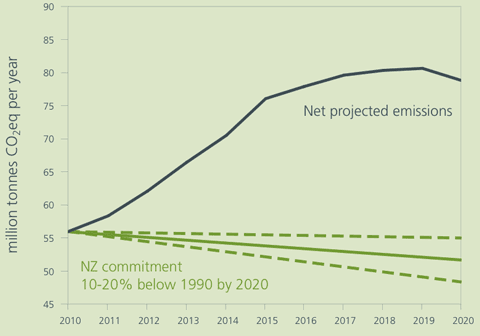
The submission contains a picture worth at least a thousand words: this graph makes it very clear why the NZ ETS needs toughening up:

PCEgraph

Current policy settings effectively guarantee that the government’s Copenhagen Accord commitment to a 10% cut in emissions by 2020 is nothing but an empty promise. The ETS is not delivering the goods — and it will be the taxpayers that pay the cost. Wright estimates that the “gap” between target and projected emissions “is likely to cost New Zealand over a billion dollars per year” by 2020.

Earth: The Operators’ Manual

Earth: The Operators' ManualRichard Alley’s splendid abilities as a communicator are well displayed in his new book Earth: The Operators’ Manual. Written as a companion book for a forthcoming PBS documentary he hosts, it provides a lively review of the science of climate change and of the renewable energy sources now able to be employed. The general reader who wants to understand why human activities are causing climate change and why it matters, and is prepared to put a little effort into the quest, will find the book an engaging explanation.

Continue reading “Earth: The Operators’ Manual”

Lester Brown and the water lilies

When I was reviewing Paul Gilding’s book The Great Disruption I was frequently aware of similarities with Lester Brown’s writing, most recently World on the Edge. The parallels were highlighted further for me when I viewed an excellent recent documentary on Lester Brown’s advocacy which has recently screened on PBS in the US. I recommend the film as providing a clear overview of Brown’s thinking. It is available streamed during the month of April. For those who don’t have the time to look at it I’ll briefly highlight one or two significant points which are echoed by Gilding and which sound themes that are surely central to any hope of preventing the full danger inherent in climate change.

Continue reading “Lester Brown and the water lilies”