

Clive Hamilton on Einstein, scientific dadaism and the roots of climate denial

Clive Hamilton has a riveting essay in a new book edited by psychoanalyst Sally Weintrobe, Engaging with Climate Change, which had its origin at an inter-disciplinary conference at the Institute of Psychoanalysis in London a couple of years ago. Hamilton’s subject is what history can teach us about climate change denial. He begins with the deep polarisation of US society and the way in which global warming has become a battleground in this wider culture war. The implications of climate change threaten conservative cultural identity. Not that liberals are less likely to sift evidence through ideological filters, but in the case of global warming the evidence overwhelmingly endorses liberal beliefs that unrestrained capitalism threatens future well-being, that government intervention is needed and the environmentalists were right all along. In Europe, the absence of a long and rancorous culture war explains the relative weakness of climate change denial.

Continue reading “Clive Hamilton on Einstein, scientific dadaism and the roots of climate denial”

Sustainable Energy NZ #3 – When having a Hot Earth is Desirable – Crunching the numbers on Geothermal.

This is the third post in the Sustainable Energy without the Hot Air – A New Zealand Perspective series. Today we’ll be crunching the numbers on geothermal potential in New Zealand. For the background to the work and an explanation of the methodology, please visit this post. Also check out the last post on the potential of hydro power.

Unlike the UK, New Zealand has significant geothermal resources which currently contribute to national energy requirements. Geothermal energy has the advantage of being always available at full capacity, and unaffected by weather. Currently about 5.2kWh/d/p is available (3.6kWh/d/p of electricity is produced plus 1.6kWh/d/p in direct heating) but it is estimated that there is potential for a total of 12kWh/d/p at an admittedly higher price than gas generated electricity [dbpz7n]. Environmental and regulatory constraints further limit development. The Electricity Authority foresees generation rising by a further 4.4kWh/d/p by 2025 [9v5c9my] but little growth beyond that. Geothermal energy is low quality, producing lots of hot water for disposal. Ideally, better use of this hot water in co-located industry would improve overall efficiency.

Summary: There’s definitely potential here – but remember that even if we built every geothermal plant in the pipeline it’ll only ever make up about 8-9% of our overall energy supply.

Further Reading:

UCSD Professor Tom Murphy of Do The Math does the numbers on global geothermal potential.  

Arctic meltdown: two views and a bit of PIG

[youtube http://www.youtube.com/watch?v=G08xPmxR28U&w=480]

From NASA’s Earth Observatory Youtube channel: a great video showing the calving of this year’s Petermann Ice Island. Most impressive is the speed with which it passes down the Nares Strait. And to provide a little North-South symmetry, today’s EO Image of the Day shows the steady enlargement of a giant crack in the Pine Island Glacier in West Antarctica, which will calve the biggest piece of PIG in recent history, sometime soon.

For a somewhat different reaction to what’s going up North, try this video from Greenpeace’s Save The Arctic campaign. Great fun…

[youtube http://www.youtube.com/watch?v=ZOHKu2vFp34&w=480]

Brother, can you spare $3.10 for a tonne of carbon dioxide?

cup of coffee In which Mr February (aka Simon Johnson) looks at the uselessness of the report of the Finance and Expenditure Committee on the Climate Change Response (Emissions Trading and Other Matters) Amendment Bill, people begging on Lambton Quay in Wellington, and the fact that the spot price for a tonne of carbon dioxide is the same as for a flat white.
Have you heard the old Tin Pan Alley song “Brother can you spare a dime?” The experience of poverty and the Depression in America summed up in a popular song. The lyrics were written by Yip Harburg, and the music by Jay Gorney in 1931. The version by Al Jolson is very well known, but I like this version by Charlie Palloy and his Orchestra.

I usually start most weekdays getting off a bus on Lambton Quay. From the bus stop I walk along to work looking forward to the first coffee of the day. I usually note how many people are begging. There are almost always a few people begging on Lambton Quay. Who says NZ is not in a depression? Not Paul Krugman. ‘Brother can you spare a dime’ is alive and well.

Except it’s sad cardboard signs saying ‘Homeless and need help’. Also it’s at least $3 to $4 for a coffee, not a dime. Not for a long time.

The other price that’s less than the cost of a flat white is the spot price of carbon dioxide in NZ. Carbon trader OMF reports spot prices each day at CommTrade Carbon. Guess what? The last trade of a New Zealand Unit (a tonne of carbon dioxide) was $3.10.

Continue reading “Brother, can you spare $3.10 for a tonne of carbon dioxide?”

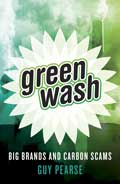
Greenwash: Big Brands and Carbon Scams

Greenwash: Big Brands and Carbon Scams by Guy Pearse was an eye-opener for a reader like me who pays practically no attention to brand advertising. I didn’t realise how many major brands are striving to present green credentials to their consumers. The book covers a multitude of them across many sectors of the economy, from banks to retailers, car manufacturers, electricity providers, appliances, sports, professional services, soft drinks, real estate, and many more, including even the sex industry.

In some respects it’s perhaps encouraging that so many firms think it important to communicate to the public that they are addressing the question of their carbon footprint and working to reduce the greenhouse gas emissions associated with their business. But looked at closely the positive message they proclaim is often highly disproportionate to the measures they are taking. Minor adjustments to practice are offered as if they were major reorientations of business.

Continue reading “Greenwash: Big Brands and Carbon Scams”