
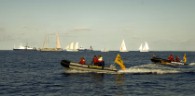
 Pursuing the last drop of oil should not be on the agenda of any country which takes climate change seriously. That’s why I applaud the Greenpeace and Te Whanau a Apanui action in endeavouring – successfully for a time – to stop the Petrobas seismic testing vessel off the East Cape. Potential danger to the marine environment is one of the reasons for the protest, and in the thinking of Greenpeace climate change is the other. The action is part of their longer term campaign against new oil and coal development in favour of a clear orientation to the clean technology which would show New Zealand was serious about moving to a low-carbon world.
Category: Climate politics
The billion dollar gap
 Dr Jan Wright, New Zealand’s parliamentary commissioner for the environment, today released her submission (pdf) to the Emissions Trading Review panel. It calls for a significant toughening up of the scheme that was so extensively watered down by the current government in 2009, in order to avoid a billion dollar per year cost to taxpayers. Wright’s recommendations make it clear that any further weakening of the scheme as the result of pleading by special interests can not be justified. She recommends that:
- both the price cap and the two-for-one deal expire on 31 December 2012 as currently legislated.
- a) a cap on the number of carbon credits freely allocated be put in place; and that
b) the phase-out rates for allocation be increased, not expressed as a percentage decrease of the previous year, and that the latest year in which allocation of free carbon credits must cease be specified.- the ETS is amended:
a) so that new industries that use lignite on a large scale are specifically excluded from receiving any free carbon credits;
b) to provide criteria for deciding which new activities are eligible to receive free carbon credits, including a requirement that the new activity will reduce New Zealand’s national net greenhouse gas emissions.- agriculture is brought into the ETS by 2015 as currently legislated.
The submission contains a picture worth at least a thousand words: this graph makes it very clear why the NZ ETS needs toughening up:
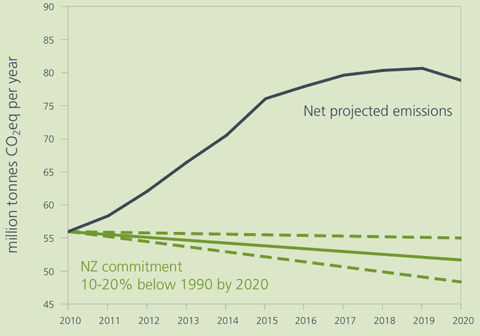
Current policy settings effectively guarantee that the government’s Copenhagen Accord commitment to a 10% cut in emissions by 2020 is nothing but an empty promise. The ETS is not delivering the goods — and it will be the taxpayers that pay the cost. Wright estimates that the “gap” between target and projected emissions “is likely to cost New Zealand over a billion dollars per year” by 2020.
Earth: The Operators’ Manual
Richard Alley’s splendid abilities as a communicator are well displayed in his new book Earth: The Operators’ Manual. Written as a companion book for a forthcoming PBS documentary he hosts, it provides a lively review of the science of climate change and of the renewable energy sources now able to be employed. The general reader who wants to understand why human activities are causing climate change and why it matters, and is prepared to put a little effort into the quest, will find the book an engaging explanation.
Lester Brown and the water lilies
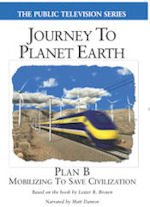 When I was reviewing Paul Gilding’s book The Great Disruption I was frequently aware of similarities with Lester Brown’s writing, most recently World on the Edge. The parallels were highlighted further for me when I viewed an excellent recent documentary on Lester Brown’s advocacy which has recently screened on PBS in the US. I recommend the film as providing a clear overview of Brown’s thinking. It is available streamed during the month of April. For those who don’t have the time to look at it I’ll briefly highlight one or two significant points which are echoed by Gilding and which sound themes that are surely central to any hope of preventing the full danger inherent in climate change.
Routefinding the future: reflecting on the climate futures forum
 Two busy days in Te Papa last week, and a lot to think about. The Climate Futures Forum organised by the Climate Change Research Institute at VUW was fascinating and disturbing in equal measure. Fascinating because it’s hard not to be interested when a lot of very smart people are feeding you information, and disturbing because they provided a stark reminder of how hard is the task that confronts us all. Below the fold: some reasonably random thoughts on the forum, interviews with some of the key speakers, and a summing up based on Jonathan Boston‘s remarks at the close of the forum.
Continue reading “Routefinding the future: reflecting on the climate futures forum”