The shape of wind to come

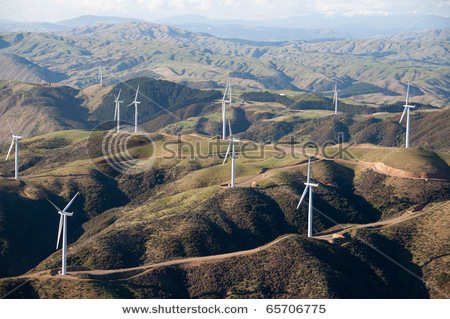
The NZ Wind Energy Association (NZWEA) has a published a new report setting out their vision for the coming years, Wind Energy 2030: the growing role for Wind Energy in New Zealand’s electricity system (PDF). It reiterates their expectation that by 2030 wind energy will be supplying 20 percent of our electricity. This is double the amount forecast by the Ministry of Economic Development in their recent Energy Outlook, a forecast which the WEA protested  about at the time.

The report (or its summary) communicates some salient points about wind energy in New Zealand. There is plenty of reason to be upbeat about the prospects. New Zealand’s wind resource is one of the best in the world, with a potential that we have barely begun to realise. Our wind is predictable, able to be forecast accurately 24 hours in advance.  Seasonally, wind is actually more predictable than rainfall. And because wind is nearly always blowing somewhere in New Zealand wind farms in different parts of the country will contribute to overall grid reliability.
Continue reading “The shape of wind to come”

Cartophilia (something to pore over)

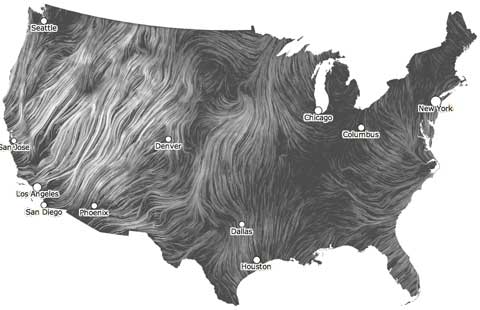
Windmap

Click on the image. Wait. Watch and be mesmerised by this visualisation by Hint.fm of current wind flow over the USA. It’s a tremendous way to get a feel for the shape of the weather. Something similarly hypnotic and revealing of weather patterns is the animation of global total precipitable water (that is, atmospheric moisture content) from the Cooperative Institute for Meteorological Satellite Studies at the University of Wisonsin-Madison. I haven’t embedded it because it’s a big animation, but it’s well worth a few bits of bandwidth.

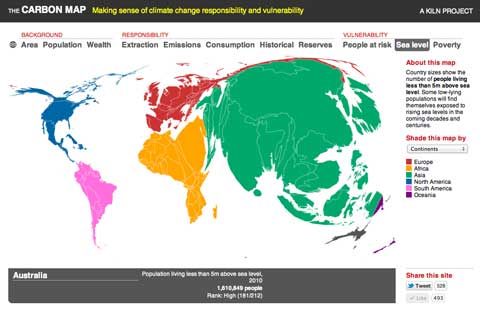
Carbonmap

The Carbon Map is another tour de force of data visualisation — changing the shapes and sizes of countries on a global map to show how they measure on a number of indices: area, population, wealth, historic emissions, current emissions, carbon reserves and so on. The image I’ve grabbed shows the exposure of countries to sea level rise. More about the map and its creation at the Guardian.

Updated to add this amazing NASA animation of global ocean currents over 2005/7. Just look at those whorls spinning off the bottom of Africa…

[youtube]CCmTY0PKGDs[/youtube]

The Climate Show #25: Box on ice (a polar special)

[youtube]vWARYfLnDXI[/youtube]

As the northern hemisphere starts to warm (rather rapidly in the USA), climate watchers’ thoughts turn to melting ice, and to tell us what happened last year and what might be in store this summer, Glenn and Gareth welcome back Greenland expert Jason Box from the Byrd Polar research Centre at Ohio State University. It’s a wide ranging and fascinating discussion, not to be missed. John Cook looks at the differences between sea ice in the Arctic and Antarctic, and we have news coverage of the new HadCRUT4 global temperature series, summertime in winter in the USA, worrying news about sea level from the Pliocene, a new report on climate change in the Pacific, and new developments in solar power and biofuels.

Watch The Climate Show on our Youtube channel, subscribe to the podcast via iTunes, listen to us via Stitcher on your smartphone or listen direct/download from the link below the fold.

Follow The Climate Show at The Climate Show web site, and on Facebook and Twitter.

Continue reading “The Climate Show #25: Box on ice (a polar special)”

A challenge to the dream of reason

This article by David Schlosberg, professor of Government and International Relations at the University of Sydney was first published earlier today at The Conversation. It’s an excellent and forthright overview of the challenges we will face in coming to terms with the reality of climate change.

When thinking of the challenges we face in responding to climate change, it is time to admit that our political focus has been fairly narrow: limiting emissions and moving beyond carbon-based energy systems. For 30 years, prevention has been the stated goal of most political efforts, from UNFCCC negotiations to the recent carbon tax.

For anyone paying attention, it is clear that such efforts have not been enough. And now we have entered a new era in the human relationship with climate change, with a variety of broad and different challenges.

The first of our current challenges is to admit that we will not stop climate change. Prevention is no longer an option. The natural systems that regulate climate on the planet are already changing, and ecosystems that support us are shifting under our feet.

We will be a climate-challenged society for the foreseeable future, immersed in a long age of adaptation. What we might have to adapt to, what an adapted society might look like, and how we design a strategy to get there are all open questions.

One of the hopeful signs is that, even if many national governments are not preventing climate change, there is a growing concern for adaptation at the local level.

Climate change challenges the whole enlightenment project – the dream that reason leads us to uncover truths, and those truths lead to human progress and improvement.

Continue reading “A challenge to the dream of reason”

Unstoppable waves of innovation in the Waikato?

A pleasant surprise this morning to see across the front page of the Waikato Times the headline “Waikato’s plan to harvest sunlight”.  The article reports that lines company WEL Networks has been evaluating photovoltaic cells and is now investigating the feasibility of solar power production in the Waikato region.

Commercial viability is the determining factor. It’s the dramatic fall in the cost of photovoltaic cells which has caused WEL Network’s investigation. CEO Julian Elder said that the low price of the cells, compared with where they were a few months ago, made solar power stations affordable in New Zealand. He said that in the space of a few months the return on investment had gone from about half a century to under 10 years.

We are looking at the whole range, from 1-2 kilowatt units on a house, up to the thousands of kilowatts for a large-scale pilot,” Dr Elder said.

He said it was not a case of if they built such power stations but a matter of when.

Continue reading “Unstoppable waves of innovation in the Waikato?”