
Pure Advantage report good in parts, but silent on carbon pricing

Mr February (aka Simon Johnson) examines the latest Pure Advantage report promoting green economics. It’s all great sustainability stuff except that it fails to mention carbon pricing (emissions trading schemes or carbon taxes). How seriously can we take the Pure Advantage “green growth” message on climate change, when they are not upfront about their position on a price on carbon?

Pure Advantage, the green business advocacy group, have just released a new green growth report titled ‘New Zealand’s Position in the Green Race’. Hot Topic has posted about Pure Advantage before and PA founder Phillip Mills provided a guest post on how NZ needs a bold low-carbon business strategy.

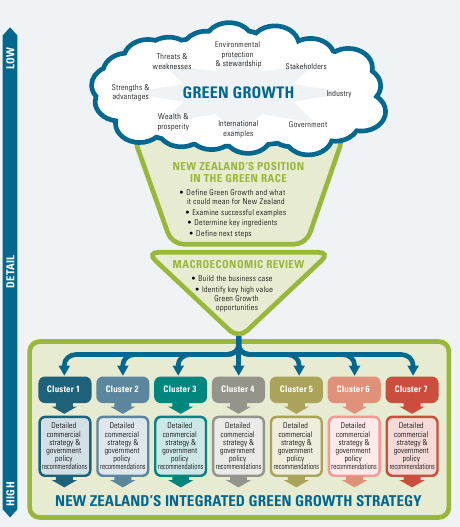
The report has three goals: to define green growth, to summarise New Zealand’s uninspiring environmental and economic performance, and to propose “a process for developing a green growth recipe for NZ and a strategy for delivering it” (page 27). The basic idea of the report is clear from this graphic — where ‘Green Growth’ starts as an amorphous brain storm of ideas, which then gets focused through the ‘NZ Green Race’ report and an economic analysis, before emerging like a butterfly from a chrysalis as a number of strategies and policies.
Continue reading “Pure Advantage report good in parts, but silent on carbon pricing”

People talkin’ #8

It’s been a long time, as the man sang, since the last open thread, and as a few comment threads have been wandering a long way off topic, here’s a new opportunity to discuss matters of current concern and/or controversy in climate science, politics and policy. There’s a lot to talk about in the run up to Rio…

A Pathway to Sustainable Energy

“Will we look into the eyes of our children and confess that we had the opportunity, but lacked the courage? That we had the technology, but lacked the vision?” These words preface the report Energy [R]evolution 2012: A Sustainable World Energy Outlook published this month by Greenpeace, the European Renewable Energy Council and the Global Wind Energy Council.  It’s the fourth edition in a series which began in 2007. The publication is book length and over its pages describes a renewable energy scenario which sees CO2 emissions fall 85% from 1990 levels by 2050. I thought it well worth drawing attention to.

The authors can hardly be accused of utopian dreams. The technology exists to access stores of renewable energy far larger than the world’s energy requirements. The publication describes in careful and comprehensive detail an achievable programme of transition which would leave no need for the world’s fossil fuel resources to be pursued to the point of exhaustion or anywhere near it.  Carbon capture and storage is not part of the scenario, for reasons of cost and uncertainty; nor is nuclear energy, which, for reasons of cost, safety and inability to reduce emissions by a large enough amount, is marked for phase-out.

The reduction of demand through energy efficiency, the “sleeping giant” which offers the most cost-effective way to reform the energy sector, is a vital element in the transition. Over and over again surveys and analyses are making this clear, and the report is very much in line with an increasingly common theme in the literature.  High levels of projected energy demand diminish dramatically when energy efficiency is given high priority. The document shows the effect of best practice in various sectors of the economy.

Continue reading “A Pathway to Sustainable Energy”

20 years on, NZ’s Rio response inadequate: WWF

PandalogoThe WWF report this week on how New Zealand has handled its responsibilities since the first Earth Summit 20 years ago is damning on the matter of greenhouse gas emissions. We have failed to measure up to our undertakings given back in 1992 and again in 2002. New Zealand signed up to the United Nations Framework Convention on Climate Change on the first day of the that Rio meeting, and subsequently ratified it. We committed in Article 4 to:

“Adopt national policies and take corresponding measures on the mitigation of climate change, by limiting its anthropogenic emissions of greenhouse gases and protecting and enhancing its greenhouse gas sinks and reservoirs. These policies and measures will demonstrate that developed countries are taking the lead.”

The WWF report points out that nothing happened here for the next fourteen years and the country’s greenhouse gas emissions continued to increase. They flattened off after 2007, but that was mainly due to a major drought affecting agriculture and then the subsequent recession. The report considers the Emissions Trading Scheme enacted in 2008 and weakened in 2009 has had limited impact on emissions.

We have clearly failed to set emissions on a downward trajectory.

Continue reading “20 years on, NZ’s Rio response inadequate: WWF”

IEA: emissions up, 2ºC target looking unlikely

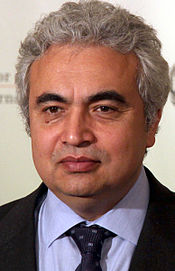
Fatih Birol, chief economist at the International Energy Agency (IEA) said at Reuters’ Global  Energy & Environment Summit this month that the door for a 2 degree Celsius target is about to be closed and closed forever. That’s a serious statement, but one which has been backed up in recent days by a news release from the IEA announcing that their preliminary estimates show that in 2011 global carbon-dioxide emissions from fossil-fuel combustion reached a record high of 31.6 gigatonnes (Gt).

This represents an increase of 1.0 Gt on 2010, or 3.2%. Coal accounted for 45% of total energy-related CO2 emissions in 2011, followed by oil (35%) and natural gas (20%).

The 450 Scenario of the IEA’s World Energy Outlook 2011, which sets out an energy pathway consistent with a 50% chance of limiting the increase in the average global temperature to 2°C, requires CO2 emissions to peak at 32.6 Gt no later than 2017, i.e. just 1.0 Gt above 2011 levels. The 450 Scenario sees a decoupling of CO2 emissions from global GDP, but much still needs to be done to reach that goal as the rate of growth in CO2 emissions in 2011 exceeded that of global GDP.

Not surprisingly Birol repeats his warning: “The new data provide further evidence that the door to a 2°C trajectory is about to close.”

Continue reading “IEA: emissions up, 2ºC target looking unlikely”