Ice bottom blues

[youtube]UaKqhRTqSlg[/youtube]

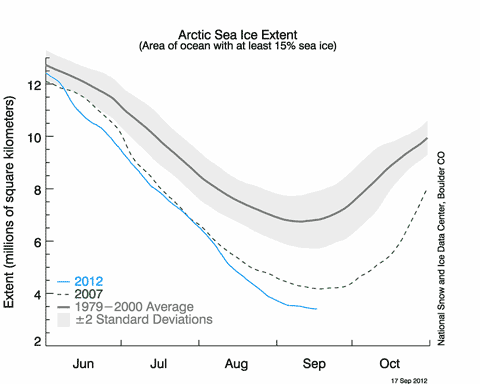
According to the latest bulletin from the National Snow and Ice Data Center in the US, Arctic sea ice is likely to be at or about its minimum extent for the summer (as of Sept 17th). The animation above shows how the ice melt proceeded through the summer (up to Sept 14th), and the graph below shows the extent as of Sept 17th — 3.41 million square kilometres (1.32 million square miles).

NSIDCseaice20120917

The NSIDC notes:

The current extent is 760,000 square kilometres (293,000 square miles) below the previous record minimum extent in the satellite record (4.17 million square kilometres or 1.61 million square miles) which occurred on September 18, 2007. This difference is larger than the size of the state of Texas. The ice extent currently tracks nearly 50% below the 1979 to 2000 average minimum extent.

For an insight into what the ice is really like, I recommend Julienne Stroeve’s blog of her trip on the Greenpeace vessel Arctic Sunrise. This is from her most recent entry (Sept 17th):

Continue reading “Ice bottom blues”

The Climate Show #28: transglobal overground (with added ice)

[youtube]OcKG1p6gLAI[/youtube]

The boys are back, and they can’t stop talking. Glenn’s got his studio set up in London, Gareth’s Waipara internet connection is still marginal, but what was meant to be a ten minute proof of international connectibility turned into a 40 minute extended rumination on Glenn’s arrival in London during the wet summer and extended hay fever season, the record-setting Arctic sea-ice melt and what that might mean for the coming northern hemisphere winter and climate in general, the defeat for New Zealand’s climate cranks in the High Court, and the soon to be obligatory plug for Gareth’s new book…

Watch The Climate Show on our Youtube channel, subscribe to the podcast via iTunes, listen to us via Stitcher on your smartphone or listen direct/download from the link below the fold.

Follow The Climate Show at The Climate Show web site, and on Facebook and Twitter.

Continue reading “The Climate Show #28: transglobal overground (with added ice)”

Bad news but great pictures: dating NZ’s shrinking glaciers shows strong link between ice loss and CO2 increases

[youtube]48ikKLGUhNs[/youtube]

Here’s a superb video from the Department of Education at the American Museum of Natural History, showing how NZ and US scientists are examining the precise timing of glacier advances and retreats in the Mackenzie country around Lake Pukaki using surface exposure dating. Like all good geologists they use big hammers and small explosives to shatter rocks in order to sample “cosmogenic” Be-10 — a beryllium isotope formed when cosmic rays hit quartz in newly exposed rocks. See here for more on recent surface exposure dating work in the Pukaki area. Hat tip to Climate Crocks for spotting the video.

NZ Herald’s turn to offer propaganda as opinion – De Freitas’ links to cranks hidden from readers

The new “compactNZ Herald has taken a downmarket tabloid approach to informing its readers by running an opinion piece about the recent courtroom defeat for NZ’s climate cranks by prominent climate sceptic and Auckland University geographer Chris de Freitas, without explaining de Freitas’ long history of association with the cranks he’s defending. In the article, de Freitas overstates the uncertainties associated with temperature records, even going so far as to imply that the warming trend over the last hundred years might be “indistinguishable from zero” ((“Temperature trends detected are small, usually just a few tenths of one degree Celsius over 100 years, a rate that is exceeded by the data’s standard error. Statistically this means the trend is indistinguishable from zero.”)). He also overplays the importance of temperature series to policy-makers — a line straight out of crank litigant Barry Brill’s playbook, and self-evident nonsense.

Despite this transparent partiality, the opinion editors at the Herald credit him like this:

Chris de Freitas is an associate professor in the School of Environment at the University of Auckland.

But, as the Herald opinion team well know, de Freitas is much, much more than a mere associate professor in the School of Environment. He has a track record of activism against action on climate change that stretches back two decades. Here, for the poor misled readers of the new Herald‘s opinion pages is a handy, cut-out-and-keep guide to de Freitas’ long history of climate denial activism.

Continue reading “NZ Herald’s turn to offer propaganda as opinion – De Freitas’ links to cranks hidden from readers”

Cranks lose court case against NZ temperature record, NIWA awarded costs

The attempt by NZ’s merry little band of climate cranks to have the NZ temperature record declared invalid has ended in ignominious defeat. In his ruling [PDF], handed down today, Justice Venning finds:

The plaintiff does not succeed on any of its challenges to the three decisions of NIWA in issue. The application for judicial review is dismissed and judgment entered for the defendant. [and] The defendant is entitled to costs.

It will be interesting to see whether the NZ Climate Science Education Trust, which was established purely to bring this action, is able to stump up to cover NIWA’s costs. If it doesn’t, the NZ taxpayer will be left to pick up the bill for this absurd bit of political grandstanding by the Climate “Science” Coalition.

In his decision, Justive Venning makes a number of interesting points, noting in paragraph 48:

This Court should not seek to determine or resolve scientific questions demanding the evaluation of contentious expert opinion.

Embarrassingly for the CSET, the judge also finds that two of its “experts” were nothing of the sort, declaring large chunks of their “evidence” inadmissible. Here’s the judge on former journalist Terry Dunleavy [par 51]

Section 25 could only apply if Mr Dunleavy was an expert in the particular area of the science of meteorology and/or climate. He is not. He has no applicable qualifications. His interest in the area does not sufficiently qualify him as an expert. I also accept Mr Smith’s further point that Mr Dunleavy’s views are not capable of offering substantial help to this Court on the issue that it has to determine. To that extent I agree that substantial passages of Mr Dunleavy’s evidence are inadmissible.

And in par 53, referring to the CSET’s stats man:

Similar issues (as to the limited nature of his expertise), apply to the evidence of Mr Dedekind.

[54]… Mr Dedekind’s general expertise in basic statistical techniques does not extend to any particular specialised experience or qualifications in the specific field of applying statistical techniques in the field of climate science. To that extent, where Mr Dedekind purports to comment or give opinions as to NIWA’s application of statistical techniques in those fields, his evidence is of little assistance to the Court.

The judge also noted that the other expert witness relied on by the NZ CSET, Bob Carter, also made a number of mistakes in his evidence. Not a good look…

I did have to laugh out loud at one point (not something that often happens when reading a judgement), when reading the judge’s comments on the original NZ CSET submissions:

Both the original statement of claim and the first amended statement of claim were prolix.

One wonders who brought a shine to those words…

No doubt the crank spin machine will be hard at work to try to salvage something from this train wreck, but it’s hard to see how. Common sense has prevailed. Warming remains unequivocal, and can’t be ruled inadmissible — unlike the Coalition’s precious “experts”.

[Update: Leading Climate Scientists Welcome Judge’s Decision on Temperatures

Associate Professor James Renwick of Victoria University said he was pleased that the court had respected and reaffirmed the credibility of the scientific process. It was a strong message to those wanting to challenge widely-agreed scientific findings to do so honestly and openly in scientific forums.

…and…

… the case represents a massive waste of New Zealand tax payer’s funds. In defending the claim, NIWA has spent a huge amount (estimated at well over $100,000) and has diverted a number of its scientists away from their research. The country can ill afford to waste such an amount. “This misguided action of a small group adds confusion to a simple issue – the world is warming and future generations of New Zealanders will have to deal with the consequences” Dr Renwick said.

The press release was prepared and endorsed by:

Associate Professor James Renwick, School of Geography, Environment and Earth Sciences, Victoria University of Wellington
Professor Jim Salinger, currently visiting Stanford University
Professor Martin Manning, Climate Change Research Institute, Victoria University of Wellington
Professor Peter Barrett, Antarctic Research Centre, Victoria University of Wellington
Professor (Emeritus) Blair Fitzharris, University of Otago
Professor Keith Hunter, Pro-Vice Chancellor Science, University of Otago ]