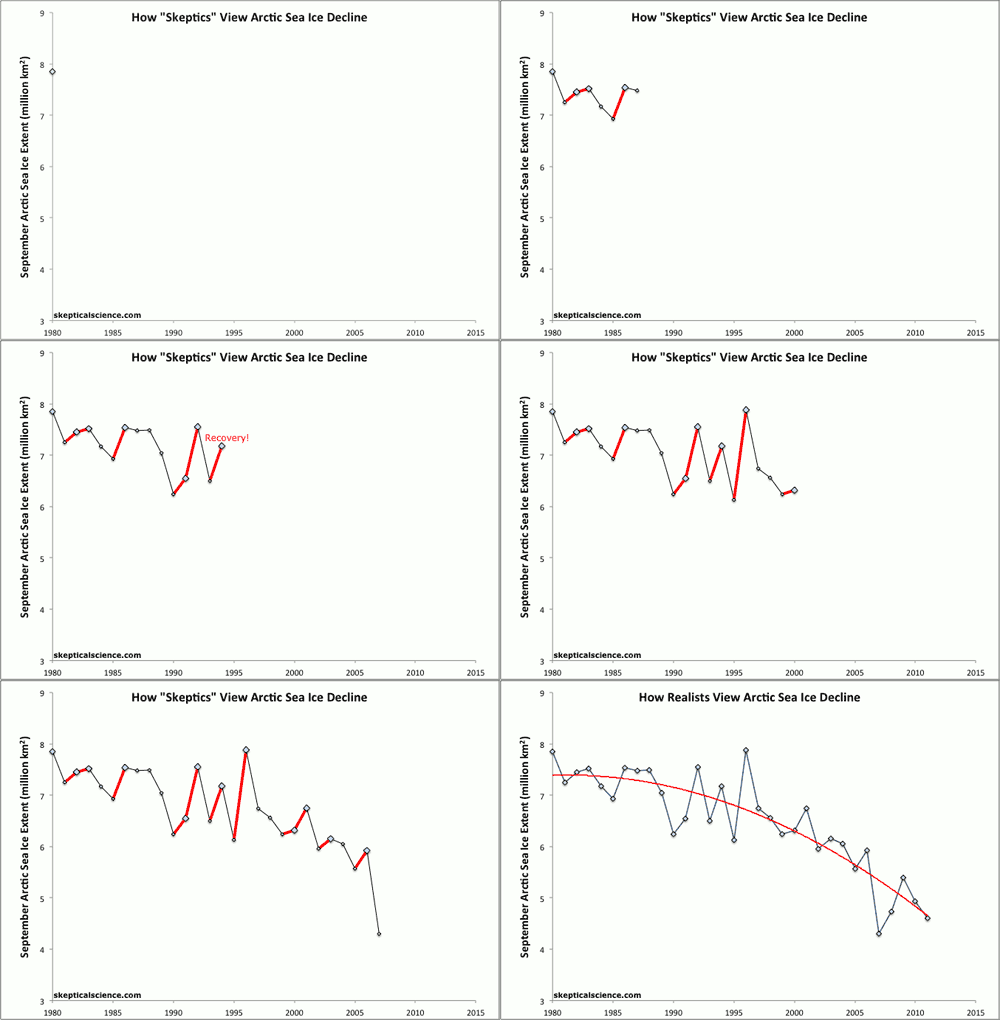
In the grand tradition of the Skeptical Science global temperature “escalator“, Dana Nucitelli has put together an animated graphic that shows how cranks/deniers/faux-sceptics tend to view the Arctic sea ice decline, contrasted with how the rest of the world sees it. Dovetails nicely with my projections of the response to the melt from the crank echo chamber. If next year’s minimum is higher than this year, you can guarantee there will be shouts of recovery…
Author: Gareth
How low can you go?
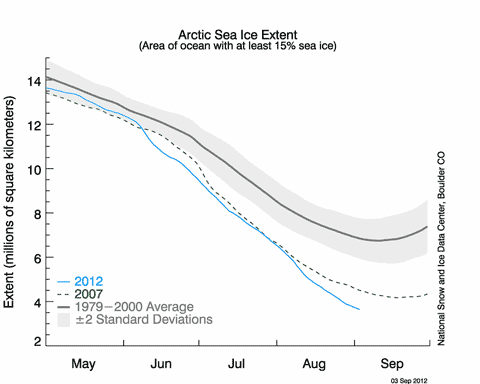
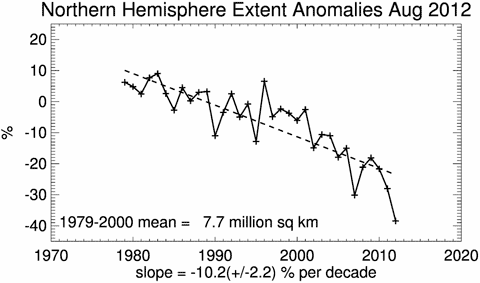
Whilst the usual suspects provide compelling demonstrations of just how the motivated rejection of science works in practice, my eyes remain fixed on the far north, where the Arctic melt season is drawing to a close. Above is the current (Sept 3rd) NSIDC sea ice extent graph, tracking well down into record territory. And here’s what the anomaly for August as a whole looks like:
Reactions to the record-breaking melt around the denialist echo chamber have been tracking my projections rather nicely. I’ll have a roundup when the final accounting of the new record minimum is done. For further reading, check out Fen Montaigne’s article on Arctic tipping points for e360, David Spratt’s summary of the state of play at Climate Code Red and a similar overview from New Scientist, Dana Nucitelli at Skeptical Science with the perfect image that demonstrates why the late 30s were not the same as today, and Gwynne Dyer on the possible consequences. For my views on the ice, the winter, peach trees and The Aviator, Alex Smith interviewed me for his Radio Ecoshock show – embedded below…
[Update 6/9/12] The NSIDC has released its Sea Ice News summary of the August melt:
Following the new record low recorded on August 26, Arctic sea ice extent continued to drop and is now below 4.00 million square kilometers (1.54 million square miles). Compared to September conditions in the 1980s and 1990s, this represents a 45% reduction in the area of the Arctic covered by sea ice. At least one more week likely remains in the melt season.
Why Arctic sea ice shouldn’t leave anyone cold
In this guest post Neven Acropolis, the man behind the excellent Arctic Sea Ice blog, looks at the reasons why we need to pay attention to the rapid loss of sea ice in the Arctic Ocean.
Arctic sea ice became a recurrent feature on planet Earth around 47 million years ago. Since the start of the current ice age, about 2.5 million years ago, the Arctic Ocean has been completely covered with sea ice. Only during interglacials, like the one we are in now, does some of the sea ice melt during summer, when the top of the planet is oriented a bit more towards the Sun and receives large amounts of sunlight for several summer months. Even then, when winter starts, the ice-free portion of the Arctic Ocean freezes over again with a new layer of sea ice.
Since the dawn of human civilisation, 5000 to 8000 years ago, this annual ebb and flow of melting and freezing Arctic sea ice has been more or less consistent. There were periods when more ice melted during summer, and periods when less melted. However, a radical shift has occurred in recent times.

Ever since satellites allowed a detailed view of the Arctic and its ice, a pronounced decrease in summer sea ice cover has been observed (with this year setting a new record low). When the IPCC released its Fourth Assessment Report in 2007, it was generally thought that the Arctic could become ice-free somewhere near the end of this century. But changes in the Arctic have progressed at such speed that most experts now think 2030 might see an ice-free Arctic for the first time. Some say it could even happen this decade.
What makes this event significant, is the role Arctic sea ice plays as a reflector of solar energy. Ice is white and therefore reflects a large part of incoming sunlight back out to space. But where there is no ice, dark ocean water absorbs most of the sunlight and thus heats up. The less ice there is, the more the water heats up, melting more ice. This feedback has all kinds of consequences for the Arctic region.
Continue reading “Why Arctic sea ice shouldn’t leave anyone cold”

A change is gonna come: no Arctic sea ice and our planet with a different climate
The crunch is coming. Before the end of this month, or very soon after, the Arctic sea ice will set a new record summer minimum for area and extent, by any measure. The only question remaining is by how much 2007’s record will be beaten. For the rest of the world, those of us who aren’t habitually glued to the Arctic Sea Ice Blog (where Neven’s counting the dominoes as they fall — one, two, three, four, five, six so far), or who aren’t checking the wonderful images from space that NASA assembles into an Arctic mosaic, or in the Greenpeace team hanging on to a Russian oil drilling rig, we have a simple lesson to learn. The climate of the northern hemisphere has changed, and with it the climate of the planet. And we have precious little idea of how that change is going to affect all of our futures.
Continue reading “A change is gonna come: no Arctic sea ice and our planet with a different climate”
The Aviator: new book now in flight
At last it can be revealed — the project that’s been swallowing most of my writing time over the last year. The Aviator is a work of speculative fiction ((Which I have sometimes described as a science fiction adventure comedy satire, or, via a tweet of Margaret Atwood’s, cli-fi.)), the first in a series set in The Burning World, and it’s my first foray into extended fiction — in which a plot idea borrowed from a bloke called Swift is wrapped around a dystopian vision of a climate-changed near future, all garnished with tales of strange people with even stranger ideas. This is how the great NZ comics artist Dylan Horrocks, who provided the book’s magnificent cover, describes it:
The Aviator is a light-hearted journey (by state-of-the-art airship) around a world transformed by climate change and subsequent political collapse. Rock God Evangelists, super-rich survivalists, back-to-nature primitivists, heavily armed luddites, goats with the secret of eternal youth, and a horny artificial intelligence with a taste for bluegrass and classic Hollywood films; The Aviator is a Gulliver-esque romp through a future we hope won’t come to pass.
I’m grateful to Mike Mann (yes, that one) for a generous note of approbation, and to sci-fi author ((And regular HT reader.)) Sonny Whitelaw for describing it as “a brilliant and wickedly satirical romp.” The first extended review — by my fellow sciblogger Ken Perrott of Open Parachute — has just been published, and provides an interesting and very positive take on what I’ve been up to.
The Aviator is currently available via Amazon for Kindle readers, and as an epub for other devices. You can download a free sample of the book — roughly 10% of the 100,000 word total — at Amazon. Editions for sale via Apple’s iBooks, Barnes & Noble and Kobo are in the works, and a paperback edition will be available in September. All digital editions are DRM free. When the publishing process is done and dusted, and I’ve stopped jumping through promotional hoops, I’ll be starting on book two. I have lots of ideas I want to explore from the vantage point of Thunderbird (the airship), if she’ll let me.
Buy now: