Greenland’s extraordinary summer #3: new record melt year, and summer’s not over yet

Greenland’s amazing summer continues, with news today that the ice sheet has already set a new record for surface melting — with four weeks of the melt season still to run. The ice sheet surpassed the previous record year, 2010, on August 8th. Marco Tedesco of the City College of New York said:

“With more yet to come in August, this year’s overall melting will fall way above the old records. That’s a goliath year – the greatest melt since satellite recording began in 1979.”

Tedesco and his team calculate the duration and extent of melt over the ice sheet, using satellite data to develop a ‘cumulative melting index’. The index is defined as the number of days when melting occurs multiplied by the total area subject to melting, and is a measure of how much melting has occurred in a season that normally runs from June to September. As the chart below demonstrates, by August 8th the melt was already well ahead of 2010.
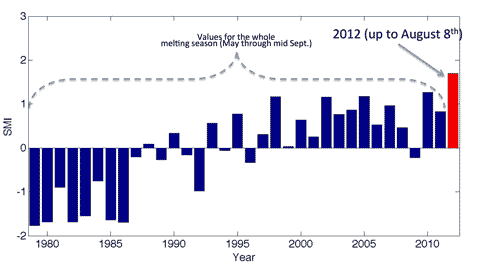
TedescoSMI2012

So far this year Greenland has experienced extreme melt in virtually every corner of the ice sheet, and especially at high altitudes. When summer’s over, and the research teams ponder the data they’ve gathered on the ice, it seems pretty clear that there are going to be some interesting figures to consider, with consequences for everyone with beachfront property… Follow Tedesco’s work, and that of other teams working on Greenland on his Greenland Melting site.
Pump up the volume (before the ice is gone)

Early results from the European Space Agency’s Cryosat-2 satellite, launched in 2010, suggest that the Arctic sea ice volume in summer is currently being lost at the rate of 900 cubic kilometres per year, Robin McKie reports in The Guardian. By combining Cryosat data with other sources they have concluded that there has been a dramatic reduction in sea ice volume over the last eight years:
In winter 2004, the volume of sea ice in the central Arctic was approximately 17,000 cubic kilometres. This winter it was 14,000, according to CryoSat.

However, the summer figures provide the real shock. In 2004 there was about 13,000 cubic kilometres of sea ice in the Arctic. In 2012, there is 7,000 cubic kilometres, almost half the figure eight years ago. If the current annual loss of around 900 cubic kilometres continues, summer ice coverage could disappear in about a decade in the Arctic.

Ten years (or less) ’til its gone in summer. I hate to say I told you so, but…

Continue reading “Pump up the volume (before the ice is gone)”

Arctic sea ice forecast: it’s going to be tough to stay cool

Bad news from the Arctic is piling up as we head into the last few weeks of the melting season. The various measures of sea ice area, volume and extent are plummeting towards a new record minimum. I have therefore reviewed the history of Arctic sea ice melting seasons since 2007, and compiled my own forecast of how the rest of the year is going to pan out. Remember, you read it here first…

When Arctic sea ice area sets a new record low in the next couple of weeks, the usual suspects ((Being Watts, Goddard, Bastardi, Jo Nova, Delingpole, the GWPF, Morano and their NZ poodle, Richard Treadgold.)) will say: “You can’t trust area, sea ice extent is the only valid metric“.

When Arctic sea ice extent sets a new record low in September, the following arguments will be run in parallel:

  • There will be a frantic search for a definition of extent in which a new record was not set
  • There will be a complaint that the satellite record has been blighted by the failure of a sensor and the calibrations needed to get a new sensor in operation have corrupted the record ((With added bonus insinuations of fixing and fraud by “warmist” scientists.))
  • It will be claimed that it was all caused by the major Arctic storm that hit in August, and thus can’t be attributed to global warming ((In 2007, the record low was all down to winds, remember?))
  • It’s cyclical — it’s all happened before, in the 1930s ((Or pick a date (any date), based on an old press clipping reporting anecdotal evidence of ice loss.)), and is therefore nothing unusual
  • That it’s irrelevant, because it’s not global and not happening where anyone lives so can’t possibly matter.

When the sea ice extent and area anomalies blow out to record levels in early October because of the delayed freeze-up, there will be silence.

When the re-freeze starts, and the Arctic basin is covered in ice once more (early December), Anthony Watts will report on the record rate of ice formation, calling it a “stunning recovery“.

When a cold spell hits the Eastern US and/or Western Europe in December/January, caused by a major Arctic Oscillation excursion and the resulting big slow-moving loops in the polar jetstream ((A result of massive heat loss from the Arctic Ocean during the refreeze, see the work of Jennifer Francis, reported earlier.)), the usual suspects will cackle loudly that global warming has suffered another mortal blow from which it will never recover.

Long range forecast for the next five years, until the Arctic Ocean is ice free in summer? Rinse and repeat.

Greenland’s extraordinary summer #2: still melting

Petermann20120806

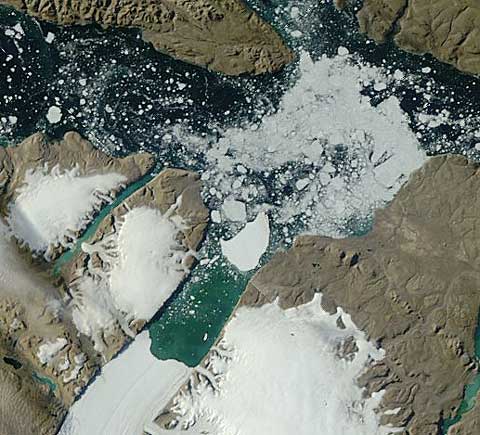
Greenland’s extraordinary summer is far from over. The ice island that broke off the Petermann glacier tongue last month — now dubbed PII-2012 — is edging its way out into the Nares Strait between Greenland and Ellesmere Island, as this satellite image, snipped from NASA’s fabulous daily Arctic Mosaic shows. For updates on events in Nares Strait, check out Dr Andreas Muenchow’s Icy Seas blog — he’s up there at the moment. Elsewhere on the great ice sheet, melting continues apace. Jason Box reports that ice sheet albedo has dipped again into record levels for the time of year, and there are reports of further extensive surface melting at the end of July. Box also reports that a recent update of the Greenland temperature record shows that current temperatures are unprecedented in at least the last 172 years. There’s also excellent coverage of the summer at Greenland melting.

Meanwhile, and rather unsurprisingly, New Zealand’s little band of climate deniers are insisting that there’s nothing special going on up North. And, equally unsurprisingly, they’re totally wrong.

Continue reading “Greenland’s extraordinary summer #2: still melting”

Favourite worst nightmare

The summer melt season in the Arctic is approaching its annual climax — the sea ice minimum, due in September — and the picture is beginning to look grim. Sea ice extent and area are tracking 2007’s record-setting melt, ice volume is at record lows for the time of year, and the ice is looking very fragmented, making it vulnerable to rapid melting events. To make matters worse, a large storm is brewing over the Arctic ocean, and is likely to create a surge of ice loss. 2012 could be heading towards breaking 2007’s record minimum, and that’s bad news for the entire northern hemisphere.

Continue reading “Favourite worst nightmare”