I scare myself

arcticmethane.jpg More news from the Arctic. While the German research vessel Polarstern is cruising through the Northwest Passage, the Russian Yakov Smirnitsky is touring the Siberian seas measuring methane – and the news from scientists on board is not good. Igor Semiletov of the Pacific Oceanology Institute of the Far Eastern Branch of the Russian Academy of Sciences told the Itar-Tass news agency (via Bernama):

“Yet another POI expedition is currently at work in the Arctic, along with ours. The expedition members are exploring the Lena River mouth, where we discovered abnormally high concentrations of methane last year. POI researchers have already carried out 47 studies and confirmed as follows: the concentration of methane in water and the atmosphere increases at a rapid pace, which is indicative of the break-up of permafrost on the shelf of Arctic seas.”

Refer to my last post on the subject and the comments here for some discussion of what that might mean. It’s not good news.

[Update 28/7: I love the internet. This morning I stumbled on a link to a Swedish team working on the Yakov Smirnitsky. Their blog is well worth a visit, if only for the amusing Google translations of the Swedish originals… Hat tip to a commenter at Eli’s warren.]

[Update 31/7: Magnus at Eli’s place links to a news item on the Swedish team’s gas measurements – Google translation here

This year’s Swedish-Russian expedition has found three new areas in western and eastern Laptev Sea where the concentration of methane is clearly increased, both in water and in the air. In addition, the scientists could measure up significantly elevated in the vicinity of Lenaflodens outflow, which Semiletov past have made similar observations.

The news gets worse.]
Taking tiger mountain (by strategy)

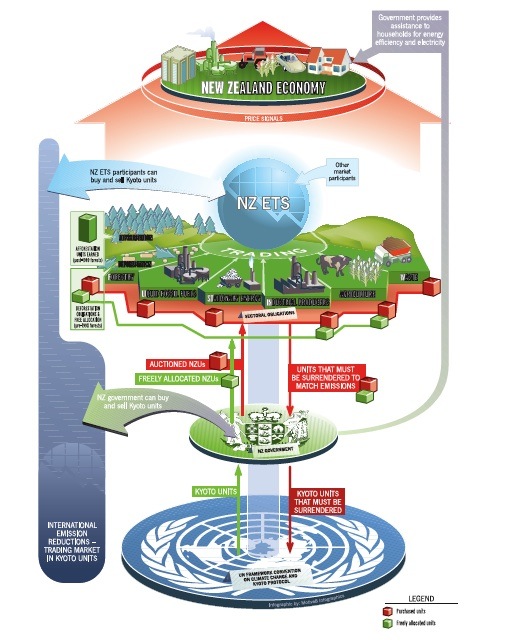
NZETS.jpgWith a final decision required next week, the Green Party has asked for public feedback on whether it should support the government’s emissions trading scheme legislation, and people have not been slow in coming forward. Jeanette Fitzsimons announcement on Thursday explained the dilemma facing the party:

“We set out to achieve a number of things, such as including transport and agriculture into the scheme earlier, a fund to insulate homes to keep power bills down, targets for emissions reduction and support for new innovations that offer significant carbon reduction. […] On some of the issues we have not been able to make progress. We have not been able to get agreement to phase in transport instead it will come in in one lump in 2011, so this has not changed. We have made very little progress on agriculture but we are still talking about this. Very importantly we have not found a way for Government to accept a biodiversity standard to ensure that planting pines does not destroy biodiversity.”

The usual suspects have not been slow to chip in. Business NZ wants them to vote against the scheme; Greenpeace believes they have no choice but to support it. The debate at frogblog and Chris Trotter’s new blog has been interesting, while No Right Turn provides a characteristically concise summary of the situation.

Continue reading “Taking tiger mountain (by strategy)”

The cracks are showing

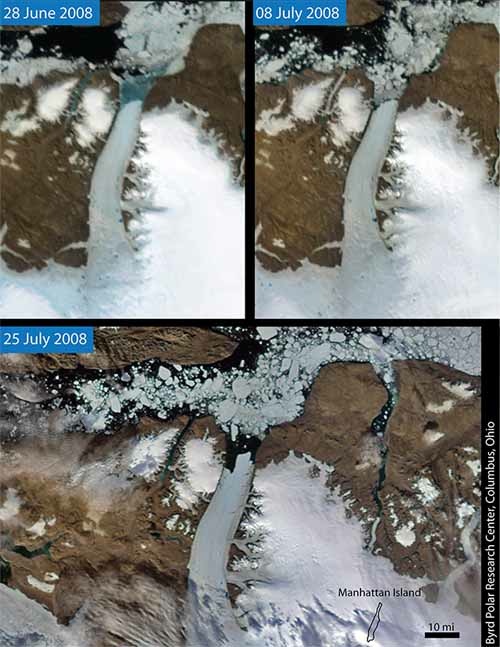
petermann_breakup-1_web copy.jpg Arctic warming is taking a toll on more than sea ice: two of Greenland’s largest glaciers have experienced significant breakups over the last month, according to researchers at Ohio State University. The Petermann glacier in the far northwest of the island has lost a 29 square kilometre chunk of its floating ice tongue, and a big crack further back suggests another large piece could be about to break off. Meanwhile, the Jakobshavn Isbrae on the west coast – the largest glacier in Greenland – has retreated further inland this summer than at any time in the last 150 years, and possibly up to 6,000 years.

Further south, a team led by Ted Scambos at the University of Boulder has examined the rate of ice loss from the glaciers of south east Greenland, previously thought to be too small to contribute much to the overall mass balance of the ice sheet. Using a combination of laser altimetry and satellite imaging, they estimate that the region is losing about 100 cubic kilometres per year, a substantial part of the overall loss.

While we’re up there, the Arctic sea ice is still melting fast. Cryosphere Today shows the current area to be 3.68m km2, homing in on last year’s record. The fat lady’s still in her hotel…

Keep searchin’ (we’ll follow the sun)

hot-topic-cover.jpg I’m still tweaking away at the new look Hot Topic: here’s today’s innovation – a Google custom search (under “recent posts” in the first sidebar), set up to look through the climate blogs in my blogroll. Want to know who’s been saying what about the Arctic? Here’s a nifty way to search through the non-crank climate blogosphere. Tip: when you get to the search results, at the top of the page (under the search box) there’s a link that says “recent4”. Clicking that will put the most recent results at the top (approximately). Please suggest sites for inclusion, and I’ll update accordingly.

Still to do: a shopping cart for the book (paperback and pdf), custom background (I’d prefer clouds to sea), comment editing restored, captions for the pix of NZ, and a few other bits and bobs. Please give me feedback!

Move on up

hot-topic-cover.jpg Sometime in the next day or so, Hot Topic will be moving to a new server and getting a spiffy new look. I’ll do my best to ensure that there’s little or no break in service, but given that my techno-competence is strictly limited there may be a hiatus – with luck only brief. There’s also the risk that some comments may get lost, especially any made after I’ve exported the blog to the new WordPress install. Tweaking the look will then take some time… so please bear with me in this, my hour of panic.