
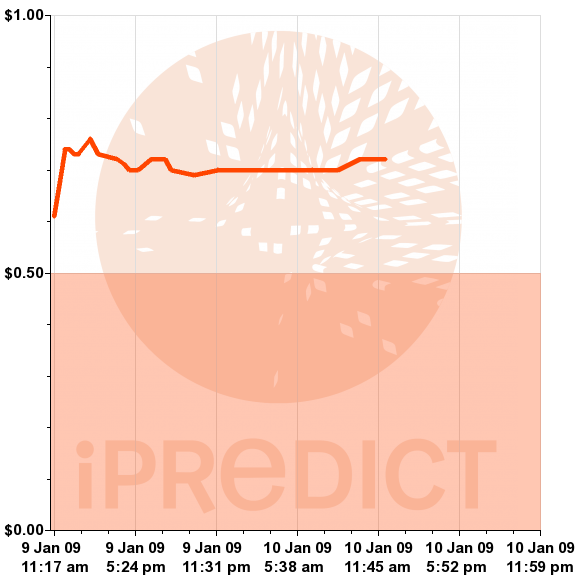
 iPredict, the NZ-based “prediction market” has offered two new contracts based on global temperatures: will 2009 be warmer than 2008, and will 2009 set a new record for warmest year? TV3 News featured the offerings last night. In iPredict’s market, buying and selling contracts — the equivalent of stock trades in a traditional market — establishes what the market (ie, the collective wisdom of the buyers and sellers) considers to be the most likely outcome, and expresses that view in the price. At the time of writing, the $1 contract “2009 warmer than 2008” (TEMP.2009) was trading at $0.7041, indicating that the market view is that it will be. On the other hand, a new record (TEMP.2009.HIGH) was trading at $0.1840, suggesting that the market deems it unlikely.
iPredict’s blog explains the thinking behind the contracts:
2009 is shaping to be an interesting year for climate science. There are, as I understand it, two camps in the climate change community. One says that greenhouse gases is a major driver of changes in climate. The second says changes in the Sun’s energy output is responsible. What makes 2009 interesting is that these drivers are expected to head in opposite directions – greenhouse gas concentrations will continue their inevitable march upwards, but the Sun’s energy is expected to continue falling. So which driver will temperatures tend to follow in 09?
Unfortunately, whether 2009 is warmer than 2008 tells us nothing about long term climate “drivers”, because there’s too much noise in the system (the variation from year to year is bigger than the signal we’re looking for — an approximate 0.2ºC per decade increase – so we need to look at long time periods to establish its existence). The swing from El Niño to La Niña — a natural oscillation — has more effect in the short term than any annual increase in CO2 forcing.
The “new record” contract is potentially more interesting, because if there is a long term upward trend (and there is) then eventually there will be a new record. That could take some time to happen, though, as Tamino demonstrated in this excellent post at Open Mind.
For what it’s worth, here’s my take. 2008 began with a very strong La Niña, which has a cooling impact on global temperatures, so unless there’s an equally strong cooling event 2009 should be warmer. On the other hand, the latest prognostication from NIWA suggests that “moderate La Niña conditions are expected to prevail into [SH] autumn”, so perhaps things may not be clear cut until much later in the year. For 2009 to set a new record, ENSO would need to swing into an El Niño early in the year, and that now looks very unlikely — hence, I would guess, the price for that contract.
To measure the market confidence in the two views on climate drivers, iPredict would need to offer longer term contracts — 2009-18 average warmer than 1999-2008, for instance, but that might not be good for active trading. There are other climate-related contracts they could offer, though, and a new record minimum for Arctic sea ice in 2009 might be a good one. That might persuade me into the market…
 The select committee established to review the Emissions Trading Scheme (ETS) is now accepting