
You keep me hangin’ on

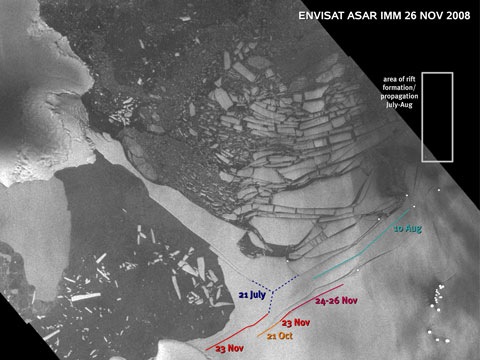
wilkins26nov480.jpg According to Alister Doyle, Reuters’ man in Antarctica (now that’s a job I’d like to try…), what’s left of the Wilkins Ice Shelf is on “the brink of collapse with just a sliver of ice holding it in place“. Earlier this week, Doyle reported on a trip with the British Antarctic Survey to the remnants of the ice shelf:

“We’ve come to the Wilkins Ice Shelf to see its final death throes,” David Vaughan, a glaciologist at the British Antarctic Survey (BAS), told Reuters after the first — and probably last — plane landed near the narrowest part of the ice. […]

BAS scientists and two Reuters reporters stayed about an hour on the shelf at a point about 2 km wide.

“It’s very unlikely that our presence here is enough to initiate any cracks,” Vaughan said. “But it is likely to happen fairly soon, weeks to months, and I don’t want to be here when it does.”

The Dominion Post‘s Paul Easton picked up the report, and managed to turn it into a story about sea level rise. Rather odd, because Doyle explicity notes:

Loss of ice shelves does not raise sea levels significantly because the ice is floating and already mostly submerged by the ocean. But the big worry is that their loss will allow ice sheets on land to move faster, adding extra water to the seas. Wilkins has almost no pent-up glaciers behind it. But ice shelves further south hold back vast volumes of ice. “When those are removed the glaciers will flow faster,” Vaughan said.

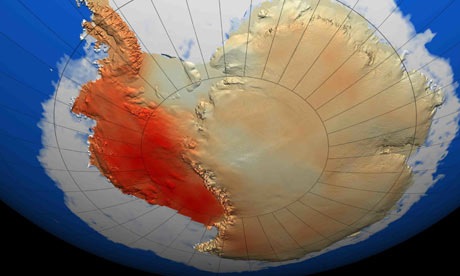
Unfortunately for us all, the most recent research suggests that the West Antarctic is warming significantly, as this image from the cover of this week’s Nature demonstrates rather well:
West-Antarctic-in-red.jpg
(E Steig/NASA)

See also: Guardian (UK) on Steig et al, Reuters on summer rain on the Antarctic Peninsula and the clear air down there, and a Danish researcher finds yet another reason to project that sea level rise this century will exceed IPCC estimates. More on land ice and the Arctic next week.

[The Supremes]

Baby, it’s cold outside

Pegsnow.jpg In the make-believe world of Climate Debate Daily, where there are two sides to a great “debate” on the reality of climate change (there aren’t), a great gulf is opening between the opposing teams. Cranks are investing a great deal of (wasted) time and effort into spreading the idea that the world is cooling, while climate scientists think a new record high global temperature can’t be far away.

In The Australian today, The Great Communicator (for it is he!) runs the cooling argument for all its worth:

Thus, using several fundamentally different mathematical techniques and many different data sets, seven scientists all forecast that climatic cooling will occur during the first decades of the 21st century. Temperature records confirm that cooling is under way, the length and intensity of which remains unknown. […] Perhaps a reassessment will finally occur when two-metre thick ice develops again on Father Thames at London Bridge, or when cooling causes massive crop failure in the world’s granary belts.

Meanwhile, in an interview with Robin McKie in The Observer, Jim Hansen nails his colours to the mast:

Deniers should show caution, Hansen insisted: most of the planet was exceptionally warm last year. Only a strong La Niña – a vast cooling of the Pacific that occurs every few years – brought down the average temperature. La Niña would not persist, he said. “Before the end of Obama’s first term, we will be seeing new record temperatures. I can promise the president that.”

There’s a collision coming…

Continue reading “Baby, it’s cold outside”

The heater

global_energy_budget_in.png While some on the crank fringe fixate over a “global cooling” (that ain’t happening), the imbalance in our planet’s heat budget has inevitable — and inexorable — consequences for our climate. More heat’s coming into the system than can leave, as this excellent new article at NASA’s Earth Observatory spells out. It’s an easy to follow, but not dumbed-down explanation of how the earth and its atmosphere respond to energy arriving from the sun, with some superb illustrations — and astronaut photographs. Well worth a read, and a useful reference on the complex reality of the “greenhouse” we live in.

[Mutton Birds]

Nice weather for ducks

Duck.jpg A couple of days ago, NIWA published its climate summary for 2008 — a comprehensive overview of all the weather events that went together to make last year what it was. In general, 2008 was sunny and warm for New Zealand, but with many notable extreme weather events — a “rollercoaster” of a year, according to NIWA principal scientist Jim Renwick (who’s been a guest poster here). The Herald picked up on the rollercoaster reference, but Stuff latched on to something else Jim said:
[…] Renwick said the extremes could be a preview of how global climate change would affect New Zealand weather. “I am not saying 2008 was a result of climate change, but we should expect to see more years like that,” he said. “The idea of a sunny year, but with some pretty violent storms, is consistent with climate change. We should expect to see more of those rainfall extremes.”

The last time I looked at my weather records was last February. After musing on a heavy rain event, my comment then was “if you were to ask me what will Canterbury’s climate be like in 2030, I’d have to answer – just like this summer…” For our property in the Waipara Valley, 2007 was a dry year — only 496 mm of rain. 2008 was much wetter: 809 mm in the year, 10% over the average for the last 11 years, and the second wettest in my record. That’s been good news.

However, when I look back at the year, nearly 40% of that rain came in just three events — a big fall in February to break the dry spell, and then two big storms in late July and August, the latter severe enough to cause dramatic flooding in the region. Roughly 320 mm fell in those three events. I had to wash mud out of the garage three times, dig a drainage trench through the truffiere (truffles don’t like drowning), gullies eroded, the road slumped, and the Waipara River lowered its bed by half a metre in places.

Take away those big storms, and we had only 489 mm for the year — a dry year by my standards. Over the ten years up to 2008, we had a total of three comparable heavy rain events (Aug 2000, Jan 2002 and Sept 2003), and then like London buses, three came along at once.

What does this prove? Precisely nothing. I don’t have records going back far enough to know whether there’s any sort of statistical significance in 2008’s North Canterbury rainstorms. But… remember what Jim said earlier? The impact of global warming on the east coast of NZ is expected to increase the frequency of drought, but because warming also means more water vapour in the atmosphere — more “fuel” for weather — when rain does fall, it could come in floods. So if you were to ask me what Canterbury’s climate will be like in twenty year’s time, I’d have to answer – just like last year.

[Lemon Jelly]

Games without frontiers

ClimCity.jpg

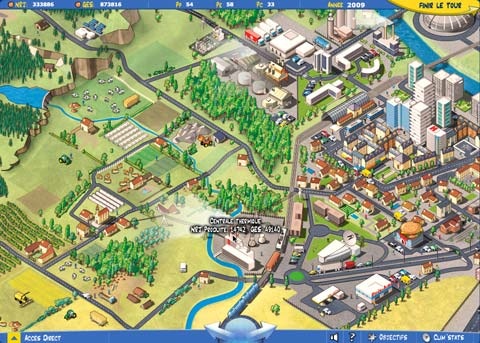
Jeux sans frontières realised in Clim’ City, an interesting learning game with obvious antecedents from Bordeaux’s Cap Sciences centre: reorganise the energy sources and economy of this French city and its surroundings – from ski field to beach resort – to reduce greenhouse gas emissions without crippling the economy. According to the Technology Review story, it’s not easy to “win”, but if you don’t speak at least a little French it’s impossible… 😉

I hope one of the English-speaking science centres does a translation: I can see this being a great teaching tool. Now, do I create an association des citoyennes or go straight to shifting the centrale thermique to burning biomass, but that means expanding the forestry sector, and perhaps I should make sure that the forests are protected against forest fires, what with the warming in the pipeline…

[Peter Gabriel]