The Doha Gateway: Look on my works, ye mighty, and despair

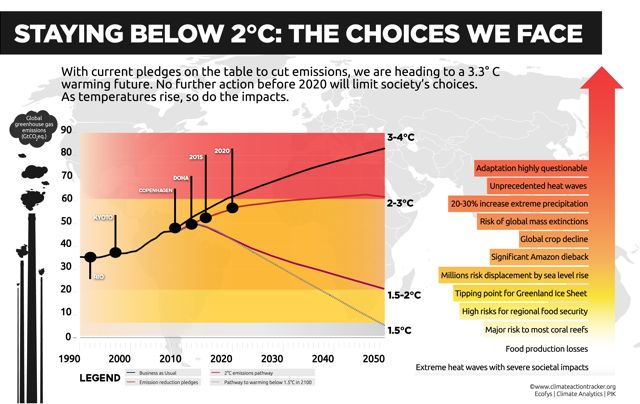
Where we are, where we should be and the consequences. Climate Action Tracker’s graphic on our future choices.

And so. Another set of climate talks done, this year dusted with Doha sand and labeled the “Doha Gateway”.  I’m not sure what they’re a gateway to,  certainly no immediate improvement to the climate. The final hours were bizarre, to say the least.  We began the day on Saturday with a text much improved from the day before, but with some major issues outstanding.  Ministers wrangled behind closed doors for most of the day, changing bits of text here and there.

We were preparing for Russia who, with Kazakhstan, Belarus and the Ukraine, were set to continue the talks way into Saturday night.   They were holding out in the informals, furious about the discussions on hot air.

Hot air

The “Russian factor” is one those of us who’ve been involved for a few years are all too familiar with. Just when you think there’s general agreement, in come the Russians who manage to drag the talks on for hours.

“Hot air” has been major problem with the Kyoto Protocol for years.  Somehow, the Russians managed to get the Kyoto negotiators to agree to a baseline of 1990, before the collapse of the former Soviet Union, which meant millions of tonnes of carbon credits ended up in the hands of Eastern European countries, bringing them a handy income, and other countries an easy and cheap option to do nothing at home and buy cheap hot air.  Russia has 6Gt of hot air – that’s how much it’s been cheating the atmosphere.

In Durban and Doha, New Zealand has sided with this team against the wish of the rest of the world to make sure that this “hot air” didn’t get carried over into Kyoto’s second commitment period (CP2).

Continue reading “The Doha Gateway: Look on my works, ye mighty, and despair”
Stuff and nonsense (ministerial condescension and media fossil fools)

A select few politicians have the ability to make me (and others) shout at the radio. New Zealand’s minister of climate change issues Tim Groser is one such. On Radio New Zealand National’s Morning Report this morning he gave vent to his feelings on NZ’s Colossal Fossil winning performance at Doha. It was an “absurd and juvenile prank”, apparently, put together by “extreme greens and youth groups”. He definitely had it in for the youth groups, referring to them twice. His extreme condescension to young people who think that his policies are at best wrong-headed, at worst disastrous for the country they will inherit, caused me to interrupt my tea making to shout at the radio, much to the dog’s surprise. Hear the full interview here, and see if you are immune to Groser’s aggressively smug assumption that only he holds the key to climate action:
Tim Groser on Morning Report

And then, over the now brewed cup of tea, Google’s morning newspaper presented me with a news item from the Dominion Post (via Stuff) about a new paper in Nature Climate Change co-authored by Dave Frame of the New Zealand Climate Change Research Institute. The basic news item’s straightforward enough: Frame and co-author Daithi Stone, from the Lawrence Berkeley National Laboratory, have looked back to the IPCC’s 1990 projections, and found that they were remarkably close to what has actually happened over the last 20 years — bad news for climate deniers who insist that model projections have failed and that warming has stopped. (See also VUW press release, Phys.org, The Conversation). Perhaps that’s why the journalist, one Tom Hunt, chose to close his piece with a quote from physics denier Bryan Leyland (cue coughing and spluttering):

But Bryan Leyland, from the New Zealand Climate Science Coalition, said science had shown global temperatures had not risen in 16 years and the world was more likely to get cooler.

Leyland, as we discussed at Hot Topic recently, is now happy to align himself with the über cranks who deny the reality of the greenhouse effect. Quoting him on climate research is about as meaningful as seeking the flat earth society’s opinion on orbital mechanics.

For that stupid piece of false balance, Tom Hunt and the Dom Post win my inaugural Media Fossil Fool award. Anyone care to design a nice badge they can wear with shame?

Lost and damaged

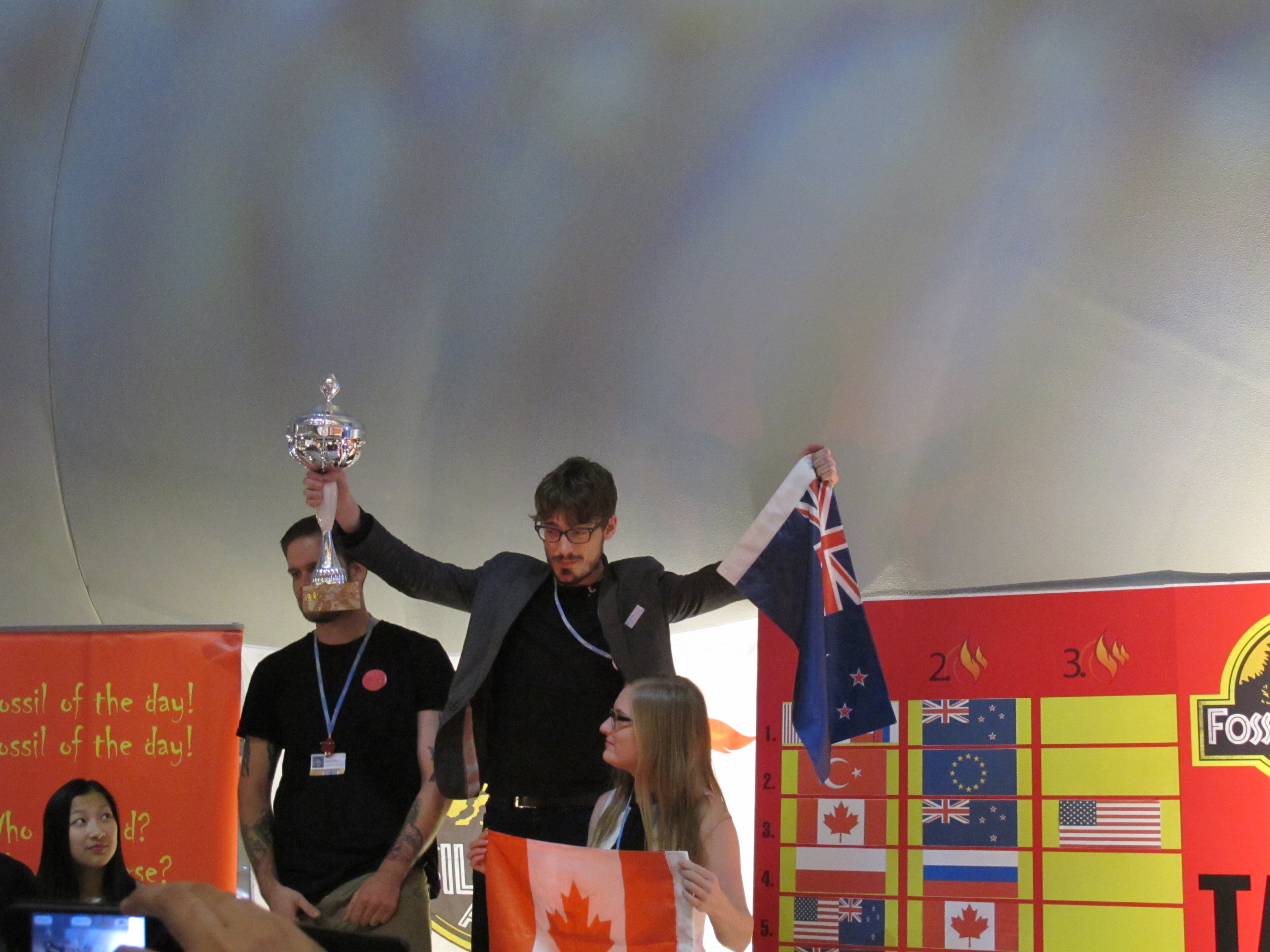
New Zealand Youth Delegate Simon Tapp with our golden prize: a Colossal Fossil, shared with Canada.

At the end of every UNFCCC meeting, on the last day, there’s a grand prize: the Colossal Fossil. So proud:  New Zealand took top prize for the first time, shared with Canada.

For a country whose emissions are similar in scale to the Canadian tar sands, New Zealand has demonstrated exceptional blindness to scientific and political realities. Surprising many and disappointing all, New Zealand has fought hard to unseat 5-time Colossal Fossil winner, Canada, in a campaign of extreme selfishness and irresponsibility.

While New Zealand may have helped drown the talks for another year, New Zealand’s small and vulnerable Pacific neighbours should take heart that they have not been forgotten – New Zealand intends to drown them too.

I don’t think I can add much to this, except to say that for a small country, we sure manage to punch above our weight at these talks, upsetting more governments and people than is warranted for our small size.   Sam from the Youth Delegation has summed it up nicely over on the youth blog. It’s all about trust.

I was going to write a light-hearted blog today, poking fun at Lord Christopher Monckton’s appearance in Doha, in his Arabic dress and antics in the plenary. But I thought about it overnight and woke this morning more angry about it than amused. Continue reading “Lost and damaged”

The Climate Show #31: Doha! Doha! Doha!

[youtube]z9t7cFjOo_Q[/youtube]

It’s the run up to Christmas, and the annual ritual repeats. Diplomats gather in Doha to discuss and debate action on climate change, so Glenn and Gareth talk to their correspondent on the spot, New Zealand climate media strategist Cindy Baxter to find out what’s happening in the oil kingdom’s echoing halls. At the Fall AGU meeting in San Francisco, NOAA has published its 2012 Arctic Report Card (grim reading, it has to be said). Plus Gareth talks about truffles as a bellwether for Europe’s changing climate, and the boys get all enthusiastic about nanophotonics and steampunk.

Watch The Climate Show on our Youtube channel, subscribe to the podcast via iTunes, listen to us via Stitcher on your smartphone or listen direct/download from the link below the fold.

Follow The Climate Show at The Climate Show web site, and on Facebook and Twitter.

Continue reading “The Climate Show #31: Doha! Doha! Doha!”

Arctic records tumble as ice melts: 2012 Arctic report card released at AGU

[youtube]O5h02Yc6lfA[/youtube]

The latest Arctic Report Card was published yesterday at the American Geophysical Union’s Fall Meeting in San Francisco, and it makes grim reading. Apart from last summer’s new record low sea ice minimum, all the indicators of warming are pointing in the wrong direction. The Arctic is making a rapid transition to a new climate state. Highlights of the report (from the press release):

  • Snow cover: A new record low snow extent for the Northern Hemisphere was set in June 2012, and a new record low was reached in May over Eurasia.
  • Sea ice: Minimum Arctic sea ice extent in September 2012 set a new all-time record low.
  • Greenland ice sheet: There was a rare, nearly ice sheet-wide melt event on the Greenland ice sheet in July, covering about 97 percent of the ice sheet on a single day.
  • Vegetation: The tundra is getting greener and there’s more above-ground growth. During the period of 2003-2010, the length of the growing season increased through much of the Arctic.
  • Wildlife & food chain: In northernmost Europe, the Arctic fox is close to extinction and vulnerable to the encroaching Red fox. Massive phytoplankton blooms below the summer sea ice suggest that earlier estimates of biological production at the bottom of the marine food chain may have been ten times lower than was occurring.
  • Ocean: Sea surface temperatures in summer continue to be warmer than the long-term average at the growing ice-free margins, while upper ocean temperature and salinity show significant interannual variability with no clear trends.
  • Weather: Most of the notable weather activity in fall and winter occurred in the sub-Arctic due to a strong positive North Atlantic Oscillation, expressed as the atmospheric pressure difference between weather stations in the Azores and Iceland. There were three extreme weather events including an unusual cold spell in late January to early February 2012 across Eurasia, and two record storms characterized by very low central pressures and strong winds near western Alaska in November 2011 and north of Alaska in August 2012.

It’s well worth digging down beyond the executive summary to look at the individual reports for key elements in the Arctic — there’s a lot of detail to digest, all of it fascinating, much of it sobering, if not downright scary. This is rapid climate change, happening now. I wonder if anyone in Doha will notice?