Five years (threnody for Arctic sea ice)

Earlier this month the US National Snow & Ice Data Center issued its analysis of this year’s Arctic sea ice minimum — at 4.60 million km2 on September 19, the third lowest extent in the satellite record. However extent (defined here) doesn’t tell you everything about the state of the ice — according to the University of Washington’s PIOMAS ice model 2010 managed to set a new record low for sea ice volume.
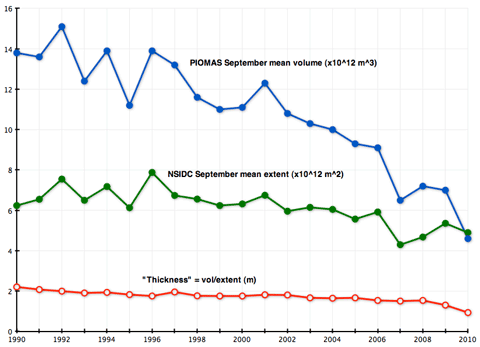

In terms of the future of the Arctic sea ice, the volume of ice remaining at minimum is a crucial metric because it represents the size of the heat budget buffer between an ocean with a perennial floating ice cap and one that’s seasonally ice-free. For the Arctic to be ice free in summer, that buffer has to disappear, or become a lot smaller. I’ve been writing about sea ice volume for some time, and considered the overall Arctic heat budget in this post a couple of years ago, so news of the new low volume prompted me to think about what it might mean for the extent metric over the next few years. To do that, I downloaded the NSIDC’s September monthly average extent for the last 21 years, and plotted that against the PIOMAS model’s September average monthly volume (kindly supplied by Jinlun Zhang). Here’s what the data looks like when you plot it on the same chart.

SeaIceData.png

The red line at the bottom, labelled “thickness”, is what you get when you divide volume by extent, and that too has been in decline, reflecting the fact that the loss of volume has been happening faster than the reductions in extent.

Continue reading “Five years (threnody for Arctic sea ice)”

I’ve been wrong before

It appears that the crank pantheon has a new hero: John O’Sullivan — the “world’s most popular Internet writer on the greenhouse gas theory” and the man unafraid of getting everything wrong. The last time we encountered him, he was getting everything wrong about the New Zealand Climate “Science” Coalition’s attempt to take NIWA to court. In his latest piece — Royal Society Humiliated by Global Warming Basic Math Error — he’s getting everything wrong about CO2 and, surprise, his piece is being touted round the crank echo chamber — Delingpole’s blogged it, Morano’s linked to it, and poor old Treadgold’s repeated it verbatim. According to O’Sullivan, an article by an obscure Canadian scientist proves that:

Top international experts prove British numbers on carbon dioxide are wrong. Royal Society blunder grossly exaggerates climate impact.

Oh really?

No.

Continue reading “I’ve been wrong before”

Waving, not drowning (yet)

I found myself hesitating over reporting a further attempt on the part of Oxfam to draw attention to the increasing plight of populations in poorer countries faced with the early effects of climate change. In this case it is Oxfam New Zealand’s Wave of Change campaign, highlighting climate impacts in the Pacific region.

Why was I hesitating?  Fear of overdoing a theme? Recognition that there is not absolute scientific certainty that a particular event can be attributed to climate change? Caution about compassion fatigue? Foreseeing reactions from some that this is just another begging strategy devised by the pesky poor? A general feeling of hopelessness about the likelihood of rich nations taking a sustained interest in the plight of others, even when their responsibility for that plight is established? Not wanting to be seen as a bleeding heart liberal?


All these elements, and others, were discernible when I interrogated myself. None of them justified ignoring the Oxfam news release sitting in my inbox.  All the more when I read George Monbiot’s latest Guardian article. His argument is more generally political than climate change related, and I don’t propose discussing it here in those wider terms. But his conclusion was entirely relevant to this post:

“People with strong intrinsic values must cease to be embarrassed by them. We should argue for the policies we want not on the grounds of expediency but on the grounds that they are empathetic and kind; and against others on the grounds that they are selfish and cruel. In asserting our values we become the change we want to see.”

So let me write briefly about the Wave of Change campaign. It’s timed as the Cancun conference comes into view.  There appears to be some slight hope that Cancun will see advance on the transfer of finance and technology from developed countries to help developing countries adapt to climate change. Oxfam intends that New Zealand politicians and negotiators are well aware of the seriousness of the need of our Pacific Island neighbours in this respect. The declaration opening the short video on their website:

“People of the Pacific are among those to be hit first and worst by climate change.”

This isn’t just about the future danger of islands disappearing as a result of sea level rise, as Oxfam’s Coordinator Anne-Marie Mujica pointed out when launching the campaign:

“Right now people are struggling with salt poisoning their staple food crops and polluting their drinking water.”

A Pacific Conference of Churches spokesperson underlines this when he  speaks on the video of the increase in the severity and frequency of extreme weather patterns.

“Salt water is now seeping into the food crops and the drinking water. Tropical storms are more fierce.”

One woman puts it simply:

“Seawater is coming. Every high tide I have water in my front yard.”

The campaign seeks a fair deal. Two Pacific Islanders on the video say it:

“Our Pacific urgently requires a fair deal on climate change.”

“We need to protect our Pacific regions. We need to speak out loud and clear for a fair and ambitious deal on climate change.”

Fair deal is the right note to strike since issues of justice are clearly involved when the effects of  emissions are felt by those least responsible for them.   One woman speaker says:

“Climate change is not just about science; climate change is about human rights.”

These are island voices. People alarmed by what they see happening where they live and asking for attention and fair treatment. Auckland is the most appropriate city in the developed world for their voice to be raised loud and clear.

Awareness-raising events taking place around Auckland this week are detailed on this Facebook page.

One of the campaign activities suggested is writing to the NZ Prime Minister. He should be open to the plea. New Zealand has signed up to the Copenhagen Accord and consequently no doubt expects to make a proportionate contribution to the funding targets outlined in that Accord to assist developing countries adapt to and mitigate climate change.

Last word to Oxfam’s Mujica:

“New Zealand may be a small country, but we’re a big player in the international climate talks. Our negotiators lead, or are members of, important working groups. It’s time to show the government that its citizens want them to do more to protect our Pacific.”

Money (that’s what I want)

I participated a few days ago in a Friends of the Earth urgent email action concerning US stances on the proposed Global Climate Fund through which developed countries will give financial assistance to developing countries in tackling the impacts of climate change. Friends of the Earth were alarmed by the US push for the management of the Fund to be handled by the World Bank rather than come under the aegis of the Conference of Parties of the United Nations Framework Convention on Climate Change.

They noted dryly that the World Bank has more experience causing climate change than preventing and addressing it.

”Despite the climate crisis and its devastating impact on developing countries, the World Bank loaned more money for coal in 2010 than it ever has before, with a 40-fold increase over the last 5 years”.

They also consider that the World Bank falls short on the important issues of democratic governance, sustainability, poverty alleviation, human rights and environmental integrity.

The other US position which Friends of the Earth took exception to was the threat at the Tianjin talks to block the establishment of a Global Climate Fund this year if US demands for more actions from developing countries like China are not met. They pointed out that the threat is unfair given that the US is the country most responsible for causing the climate crisis and among the world’s least active in addressing it.

Oxfam was another NGO last week expressing concern about the management of the Global Climate Fund.  They issued a report Righting Two Wrongs:  Making a New Global Climate Fund Work for Poor People which called for a new Fund to be set up at the UN climate summit in Cancun in December. In the Copenhagen Accord last year developed countries committed to a goal of mobilising US$100 billion a year by 2020 to address the needs of developing countries. Oxfam’s concern is that as much of the money as possible should be channelled through a single fund and that the fund should be “fairly governed, accountable and accessible to the groups, including women, who are on the front lines of climate change.”

Oxfam wants us to learn from the experience of recent years which shows that poor people in developing countries are not receiving an appropriate share of the climate funds disbursed. They are already having to adapt to severe effects of climate change and are not being supported as they should be. Currently money is being applied much more to mitigation in developing countries than to adaptation.

The report is typically detailed in its suggestions as to how the Fund should be set up and managed, and while it wants the populations most affected by climate change impacts to be much more involved in the process it also recognises the interest of the donor countries in being assured that the money is used transparently and wisely.

“New and additional” are the words the Copenhagen accord used to describe the funding they committed to. Some will no doubt try to simply divert existing development aid to climate projects, but they will have no basis to defend such attempts The new money will add up to a similar amount to that already spent on development aid, and Oxfam considers that at least 50% of it should be allocated to adaptation in vulnerable developing countries.

A sense of the urgency Oxfam feels behind the measured statements of their report was well communicated by their senior climate change advisor Kelly Dent when announcing its release:

“For many people around the world, this has been a year from sheer hell. We’ve seen floods, droughts, fires, storms and other extreme weather events that will only get worse as climate change intensifies. Some of the poorest people in the world have seen their crops wiped out and livelihoods destroyed – but we still haven’t caught on to their needs. Will we sow the seeds of resilience now or pay the price of failure later?”

[The Fabs]

Gambling with nature’s tolerance

Al Morrison, the director general of New Zealand’s Department of Conservation — the government body that manages about one-third of the country’s land area, from World Heritage temperate rainforest in the south to kauri forests in the north (not to mention running world-class efforts to conserve endangered native species such as the kakapo and tuatara) — gave a remarkable speech to Lincoln University last week. It was brave, far-sighted and touched so many right notes that it brought a bright little melody to my weekend reading.

Morrison was giving the university’s 12th annual State of the Nation’s Environment Address, and took the opportunity to discuss the pursuit of economic growth above all else in a country where conservation is a major contributor to that economy. Here are some of the highlights, but the whole thing is well worth a read:

Morrison considers the message from the Millenium Ecosystem Assessment:

We are degrading ecosystems and destroying species to a point where the services that nature provides, that we rely on for our sustenance, and that determine our prosperity, are being run down and out.

If we are to save ourselves from ourselves, then appealing to the intrinsic value of nature is not enough. It is not a matter of giving up that sense of awesome wonder, but rather adding to that, an argument designed to compel the uncommitted.

He explores the case for business to play a role in conservation in its widest sense.

It may seem crass to say that climate change and it’s big cousin, biodiversity loss, create a potential competitive advantage for New Zealand. But connecting the ethics and the self-interest; intrinsic value and economic benefits, helps us better understand that sustainable management of natural resources is not just about nice things to do when time and discretionary resources are available.

It is a necessary investment in the natural capital that sits at the base of our economy. Water, soil, air, nutrient cycles, climate regulation, pollination…these and other services are the natural capital we need to survive and prosper. That reality turns on its head the received wisdom that only rich counties can afford clean environments.

The way we measure economic progress is broken:

When the current recession revealed a collapsing financial system, some 12 trillion dollars was found in quick time across the globe to prop it up. But when nations met at Copenhagen to try and restore a collapsing environmental system, the cupboard was apparently all but bare.

Therein lies the nub of the problem.

The way we conventionally describe and measure economic progress is an incentive to ignore the impacts of unsustainable natural resource use and management, and capture the benefits and subsidies from that with a clear conscience.

We need to move beyond GDP as the measure of the real economy, and beyond growth as the only goal:

If GDP is failing as a measure of environmental sustainability then surely that is a powerful incentive to find a new construct that measures true progress.

It is no easy task to build one. First base is to balance economic, social and environmental considerations and reach a pragmatic compromise. But that’s far from a home run. Living in harmony with nature’s systems; living sustainably, is not apart from the economy, it is a key component of it. Nature’s systems lie at the base of any economy. If they are not functioning efficiently, then the economy cannot function efficiently. If we destroy them, we destroy the economy.

So like or not, our future is inextricably linked to how we tread on our land and oceans, and manage the natural resources that are the key to our surviving and thriving.

And finally:

But there is a lot of work to do to make this a prosperous path for New Zealand. It will require radical change in public policy and management, economic thinking, and business practice. I see enough activity to make me optimistic, but no real sense of urgency. We are still gambling with nature’s tolerance.

It was a brave speech by a senior civil servant who reports to a government committed to growing New Zealand’s by all means possible — including more exploration for oil and mineral resources in the conservation estate. It shows an awareness of the real issues that confront New Zealand and the world, something that seems to be all too uncommon in government anywhere. If you read nothing else today, read Morrison’s speech.

Morrison quoted poet Brian Turner at the beginning of his address, but the Otago poet’s words also make a fitting conclusion.

Under Mt St Bathans

There is majesty in the mass

Light moves, tints the snow;

The wind shakes the sparse grasses;

Water runs, stones rattle unexpectedly

And the land speaks;

None of us are greatly different,

We’re ordinary more than extraordinary

Most of the time. And if there’s one word

For what the sun highlights on the hills,

One word that we should apprehend

And make our own, it is

Decency: and, what’s ever implacable,

And what stone has irreducibly,

Dignity

From: Into The Wider World by Brian Turner

For some reactions to Morrison’s speech, see this piece by David Williams in The Press.