 No sooner had I finished reviewing Fools Rule, which recounts the determination of many nations to carry on with the further discovery and exploitation of fossil fuels in blunt defiance of the warnings of science, than I read Fred Pearce’s article in Yale Environment 360 detailing how the world is in fact burning more and more coal. He pointed to the irony of the forthcoming UN negotiations in Durban, South Africa, where the talk of how to kick the coal habit will take place in a country with high CO2 emissions and a thriving export industry in power-station coal. Not that he was singling out South Africa – the trend is shared over many countries. As if in confirmation our Prime Minister on the same day, during the leaders’ debate, affirmed yet again his government’s commitment to expand mining and drilling operations – in an environmentally responsible way, of course. He offered Australia as an example of the prosperity to be obtained thereby.
Category: Climate science
Cracked PIG spawns big berg
[youtube http://www.youtube.com/watch?v=CuvAtyXvpoc&w=480]
NASA’s IceBridge operation for this Antarctic summer has discovered that the Pine Island Glacier is in the process of calving a massive iceberg — 880 square kilometres of the floating glacier tongue is about to go floatabout, leaving the glacier snout shorter than any time since its position was first recorded in the 1940s. The crack was first spotted by a flight on October 14, and surveyed during a flight on the 28th — featured in the video above. NASA’s Earth Observatory has more pictures and commentary, and there’s a background piece for the video at the NASA IceBridge news page. See also the NASA Ice Fickr stream and NASA Explorer Youtube channel.
Wrapped up in books: Don Easterbrook drags Elsevier through the mud
 Don Easterbrook, the retired geology professor with an unhealthy obsession about Greenland ice cores, is back. His latest book, the punchily titled Evidence-Based Climate Science – Data opposing CO2 emissions as the primary source of global warming, was published last month by Elsevier, “the world’s leading provider of science and health information” (they publish The Lancet, Grey’s Anatomy, and are part of the same group as the publishers of New Scientist). Don has penned an introduction, the opening chapter, and contributed to a couple of others, but he leaves the rest of the book to a hand-picked team of “leading climate scientists”. Here’s how the Elsevier blurb describes the book’s “key features”:
- An unbiased, evidence-based analysis of the scientific data concerning climate change and global warming
- Authored by 8 of the world’s leading climate scientists, each with more than 25 years of experience in the field
- Extensive analysis of the physics of CO2 as a greenhouse gas and its role in global warming
- Comprehensive citations, references, and bibliography
- Adaptation strategies are presented as alternative reactions to greenhouse gas emission reductions
Regular readers will know that I have been following Don’s career as a climate expert with some interest, having caught him out stealing and altering other people’s work, misrepresenting the Greenland ice core evidence, and generally behaving in a manner unbecoming of a would-be distinguished academic. Imagine my surprise therefore when a little digging into the contents of Evidence-Based Climate Science (EBCS) showed that every one of the key features being trumpeted by Elsevier appears to be a gross misrepresentation of the content of the book. Let’s dig a little deeper…
Continue reading “Wrapped up in books: Don Easterbrook drags Elsevier through the mud”
We can’t rule out catastrophic climate change
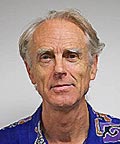 A couple of weeks ago I plugged an upcoming talk by Pieter Tans of NOAA’s Earth Systems Research Lab in Boulder — a carbon cycle specialist and winner of the Roger Revelle Medal. The talk has now been and gone (on Wednesday in Wellington), and the Science Media Centre has made an audio recording available. It’s embedded below the fold, and very well worth a listen. After an excellent introduction to climate basics (basic physics and chemistry mean that the climate’s changing), Tans traverses our addiction to fossil fuels, and how we might fix the problem.
Continue reading “We can’t rule out catastrophic climate change”
Wake of the flood (first reprise)
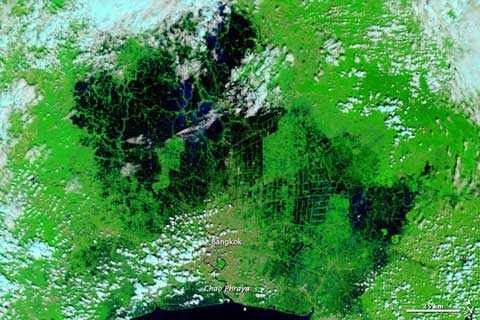
Thailand is experiencing its worst monsoon flooding for at least 50 years. The NASA Earth Observatory image above shows the waters piling up to the North of the capital Bangkok, which is already beginning to experience flooding (visit the EO page to see a comparison with earlier floods, and The Guardian for a striking set of flood pictures). The Thai government yesterday declared a five day weekend to allow the city’s inhabitants to make preparations. The intense monsoon season has also brought extensive flooding to Cambodia and northeastern India over the last couple of months, and destroyed a significant part of SE Asia’s rice crop. On the other side of the planet, heavy rain and flooding has been affecting Mexico, El Salvador, Costa Rica, Honduras, Guatemala, and Nicaragua. Jeff Masters reported that in the ten days up to October 20th, Huizucar in El Salvador received an astonishing 1.513 metres of rain.
At first glance, it looks like a continuation of the remarkable series of extreme weather events — especially heavy rainfall and flooding — that we’ve seen over the last few years. But apart from the human suffering and economic dislocation being experienced around the world, it appears there’s another interesting consequence of all this precipitation — it’s causing global sea level to fall.