You’re (not) the BEST thing

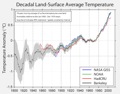
Set aside for one moment the fact that New Zealand has just (in every sense of that word) won the Rugby World Cup for the first time in a quarter of a century, and consider instead events in the world of temperature records. (Don’t worry, it won’t take long). A team led by Berkeley physicist Richard Muller — the Berkeley Earth Surface Temperature project (BEST) — has successfully reinvented the wheel, by demonstrating (once again) that the planet has been warming over the last 150 years. Tim Lambert at Deltoid explains the algorithm Muller employed:

  1. State that “reported global warming may be biased by poor station quality“.
  2. Collect funding from Charles G. Koch Charitable Foundation.
  3. Make the utterly predictable finding that warming is not a product of poor measurement.
  4. Brief reporters.

Michael Tobis at Planet 3.0 puts the affair in its proper context:

The science has not changed a whit – no serious scientist cares very much that the record has been confirmed yet again. Under ordinary circumstances this paper would have trouble getting published. This is not a red-letter day in scientific history. No new information is on the table. It’s posturing.

As for posturing, Brian Angliss at Scholars & Rogues points out that a certain US weather station quality control effort is under a little stress. One wonders if this might not spread to those who would wish to cast doubt on the NZ record?

[The Style Council]

The Climate Show #20: the boys are back (on Tuvalu)

[youtube]oiIk_3RU4XM[/youtube]

Battling against rural broadband that resembled digital molasses (or the bunker oil being pumped out of the Rena), Gareth returns to NZ and joins Glenn Williams and John Cook to discuss drought in Tuvalu, the El Niño Southern Oscillation (ENSO), floods and sea level falls, ocean cooling (that isn’t), solar towers of power and much, much more…

Watch The Climate Show on our Youtube channel, subscribe to the podcast via iTunes, listen to us via Stitcher on your smartphone or listen direct/download from the link below the fold…

Follow The Climate Show at The Climate Show web site, and on Facebook and Twitter.

Continue reading “The Climate Show #20: the boys are back (on Tuvalu)”

Not a pretty picture: recent science summarised

A valuable review, Climate Science 2009-2010, has just been published by the World Resources Institute. It’s a summary of major peer-reviewed research in climate change science and technology during those two years. Aimed at policymakers, the NGO community, and the media, it offers succinct summaries of the findings of a wide array of scientific papers, a short discussion of the implications of each paper, and brief overviews along the way of where the research is pointing.

It’s 48 pages in length, not a quick read but tailored for easy comprehension for anyone with a general lay understanding of climate science.  A sample list of some of the findings is provided at the start, but the full survey is well worth reading through. The range of papers is a reminder of how much scientific work is being done and how the full picture is built from many studies and a great variety of detailed investigations. The review is restrained in its drawing of implications from the studies, often pointing to the need for further investigation and certainly not hyping any of the results. Nevertheless it’s apparent that the recent research continues to reveal grim prospects for humanity as emissions continue to rise.

Continue reading “Not a pretty picture: recent science summarised”

Climate Change and the End of Exponential Growth

An intriguing title for what promises to be an interesting seminar in Wellington later this month. Pieter Tans of NOAA’s Earth Systems Research Lab in Boulder — a carbon cycle specialist and winner of the Roger Revelle Medal at the 2010 Fall AGU — will be the guest of the NZ Climate Change Research Institute. Here’s a flavour of what he’ll be talking about:
Man-made climate change is a clear manifestation that we have reached limits of resource consumption by our species, and that continuing business‐as‐usual has a substantial chance of destroying civilization. It is also likely that fossil fuel resources will not remain cheap for much longer, with high energy prices becoming an impediment to development. Vigorous policies to decrease our dependence on fossil fuels are necessary to continue enabling development and to safeguard it by reducing the risk of catastrophic climate change.

Tans’ talk is scheduled for Wednesday 26 October at 6:00 pm in Lecture Theatre 1, Old Government Buildings. I’d be there, if I were in Wellington. I’m not, so I’d welcome first hand reports. For more information, contact Liz Thomas at the CCRI.

Geoengineering down under: Is Stratospheric Sulphate Injection Completely Reversible?

This guest post is by Simon Terry, Executive Director of the Sustainability Council of New Zealand. The risk rating on stratospheric sulphate injection went up another notch on the basis of material presented at a recent geoengineering symposium in Australia organised by the Australian Academy of Science, while the existing climate change risks did not get any better. The event made a useful contribution to the understanding down under of so called ‘geoengineering’ and delivered some perspectives that will be useful internationally, including a review of sulphate injection that raised a new issue: is it completely reversible? More on that below.

While not exactly the “southern hemisphere perspective” that was billed (as the contributors barely exceeded Australia’s borders), it nonetheless delivered strong presentations and discussion — partly as a result of most speakers being specialists in the field related to each technique reviewed but not technique proponents themselves.

Continue reading “Geoengineering down under: Is Stratospheric Sulphate Injection Completely Reversible?”