While they sleepwalk in Warsaw: icebergs calve, emissions climb, “pause” disappears

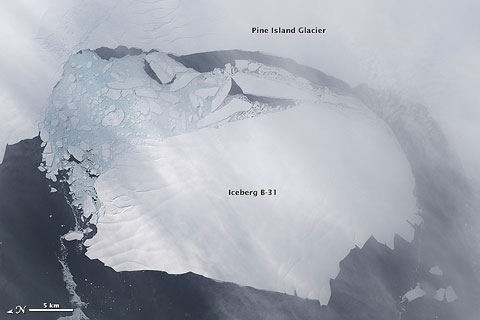
PIG B31

Warsaw has seen a deluge of important climate-related information released — so much that it’s been difficult to keep up — but still not enough to steel negotiators to reach an equitable arrangement that gives us all a chance at a reasonable future climate. And at the same time, the planet has been sending signals that it’s not happy. The Pine Island glacier has finally calved the giant iceberg that first started to shown signs of cracking away from the ice stream a couple of years ago. Iceberg B-31 has been described as being the size of Singapore (about 700 km2), but isn’t likely to move far from Pine Island Bay in the near future. NASA Earth Observatory coverage here and here; see also Telegraph (UK) and Antarctic Sun.

The Global Carbon Project announced earlier this week that greenhouse gas emissions are projected to reach the highest level in human history this year — 36 billion tonnes. There are some encouraging signs that the rate of growth may be slowing, but nowhere near enough to enable the planet to avoid hitting a two degree rise in the first half of this century. There’s an excellent visualisation of national emissions at the Global Carbon Atlas (and at the Guardian). See also The Age, Think Progress. Continue reading “While they sleepwalk in Warsaw: icebergs calve, emissions climb, “pause” disappears”
Welcome to the Carbon COP

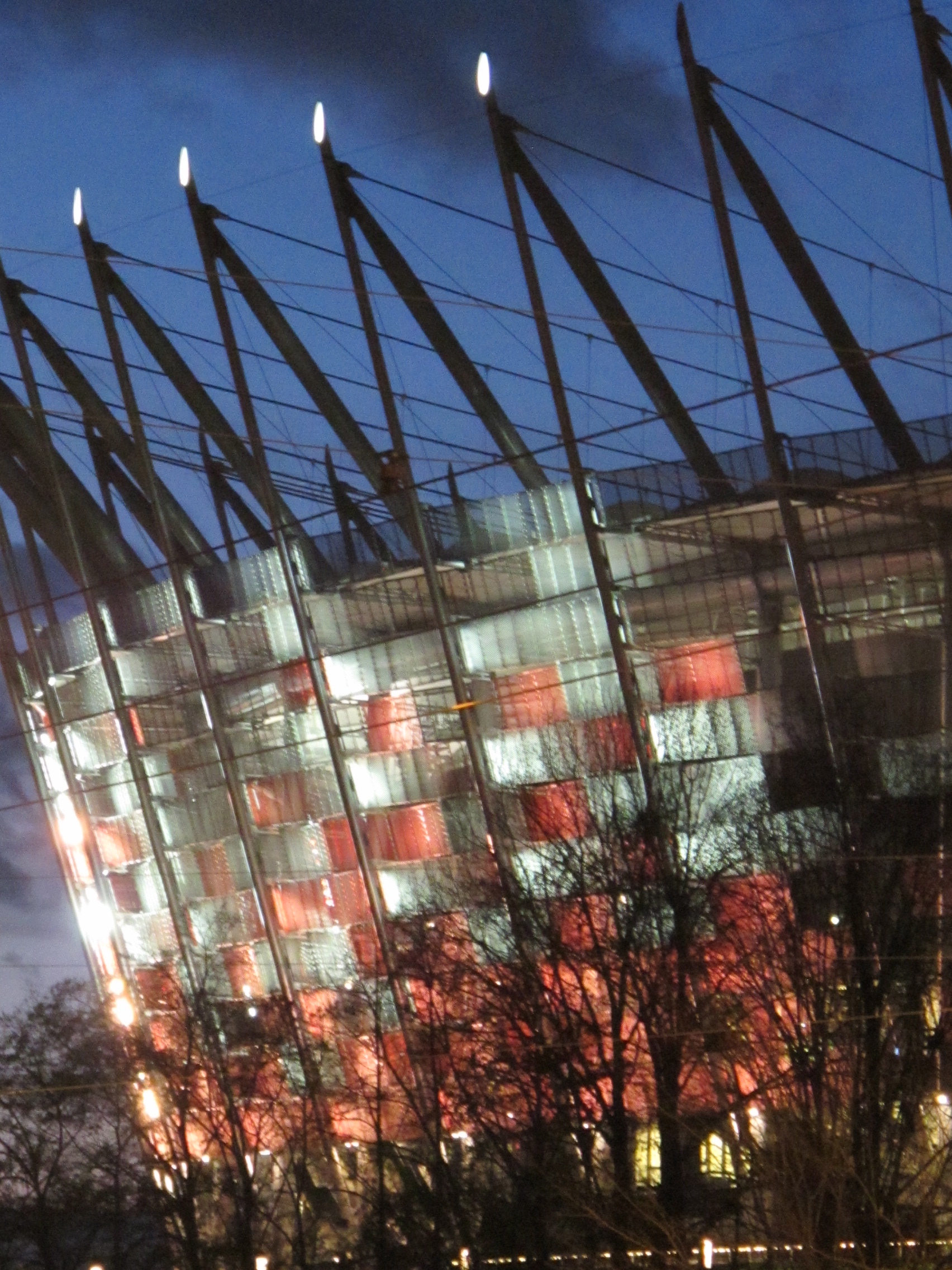
The Polish National Stadium
The first week here at the climate talks in Warsaw kicked off with the super typhoon Haiyan hitting the Philippines in a terrible tragedy, brought into the meeting by the country’s lead negotiator Seb Yano, whose fast has been joined by many from civil society. The plight of his people has been a rallying call around the world as we all look at the aftermath of this storm with horror.  Is it a direct result of climate change? What we do know is that the sea surface temps were 1.5degC above normal, and that we can expect more intense cyclones as the earth’s temperature warms.  But  as NCAR’s Kevin Trenberth wrote:

“The answer to the oft-asked question of whether an event is caused by climate change is that it is the wrong question. All weather events are affected by climate change because the environment in which they occur is warmer and moister than it used to be….”

As we’ve been all walking around in circles of the Polish National Stadium, trying to stay sane, looking at the images from the Philippines and the campaigning by their government to get a stronger outcome, it seems several governments have kept their eyes firmly OFF the ball, instead  taking the opportunity of the occasion to walk away from their commitments. Continue reading “Welcome to the Carbon COP”

Australia’s burning – again

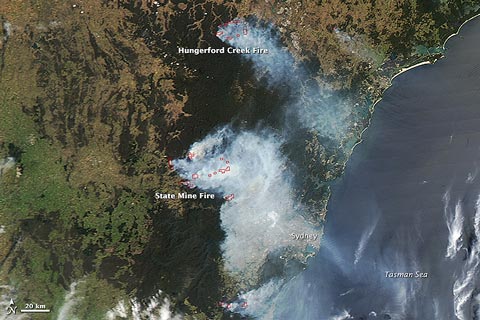
NSWfiresNASAEO2013294

Smoke from the bush fires burning in the Blue Mountains blows over Sydney in this NASA Earth Observatory image captured yesterday. The scale of the fires and their impact on the skies over Sydney and much of New South Wales is prompting much discussion in Australia about the link between weather, climate warming and wildfires, and bringing international pressure to bear on new PM Tony Abbott’s plans to scrap carbon pricing. Here’s researcher Roger Jones, writing in The Conversation:

We found that fire danger in Victoria increased by over a third after 1996, compared to 1972-1996. The current level of fire danger is equivalent to the worst case projected for 2050, from an earlier analysis for the Climate Institute.

While it’s impossible to say categorically that the situation is the same in NSW, we know that these changes are generally applicable across south-east Australia. So it’s likely to be a similar case: fire and climate change are linked.

This early start to the fire season comes after a year of record warmth in Australia — the hottest summer on record, the hottest 12 month period (to September), and it’s looking odds on that calendar 2013 will be the warmest on record. NSW also had its second warmest winter on record, which helped to dry soils out more than usual. With summer still a month away, the prospect for SE Australia’s fire-prone states looks grim.

For historical background on Aussie bush fires, see this overview from Weather Underground expert Chris Burt, and keep up to date with excellent analysis at The Conversation by following the NSW bushfires 2013 tag.

[Update: For pithy comment, do not miss today’s First Dog On The Moon ((Do something about climate change you disingenuous muppet!)). ]

Something (early) for the weekend: grim forecast for oceans and the roots of denial

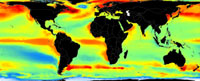
Something of a miscellany today, coupled with an open thread, to keep you going during a brief pause in posting. First up: a study published this week in PLOS Biology looks at changes in ocean chemistry, temperature and primary productivity over the next century under two emissions scenarios, and finds that no corner of the ocean escapes untouched. From Science Daily:

“When you look at the world ocean, there are few places that will be free of changes; most will suffer the simultaneous effects of warming, acidification, and reductions in oxygen and productivity,” said lead author Camilo Mora, assistant professor at the Department of Geography in the College of Social Sciences at the University of Hawai’i at Mānoa. “The consequences of these co-occurring changes are massive — everything from species survival, to abundance, to range size, to body size, to species richness, to ecosystem functioning are affected by changes in ocean biogeochemistry.”

It’s been a productive few weeks for Mora: he was lead author on a recent study ((Full text, free!)) published in Nature that estimated when climate in different parts of the world would move beyond anything experienced in the last 150 years — have a play with this interactive map to find out when your part of the world will move into the unknown. See also Climate Central, Science Daily, and a huge amount of press coverage.

Continue reading “Something (early) for the weekend: grim forecast for oceans and the roots of denial”

Stocker in Wellington: RSNZ to stream AR5 science workshop

Swiss climate scientist Thomas Stocker, joint chairman of the IPCC’s Working Group One, is in New Zealand for a few days, and the NZ Climate Change Centre and the Royal Society of NZ have taken the opportunity to put together a stakeholder workshop to allow Stocker and NZ lead authors to present the key findings of the recently published AR5 WG1 report. The workshop is being held tomorrow, Friday 11th, from 9am to 1pm at the RSNZ in Wellington, and is open to the public (spaces limited, register here). For the geographically challenged, the event will be web-cast live.

The workshop will open with an introduction by Richard Bedford, a council member of the RSNZ, and an overview of the IPCC process by WG1 vice-chair David Wratt. Stocker will present the key Working Group I report findings from about 9-10am. NZ’s coterie of lead authors — Dave Frame, Tim Naish, and Jim Renwick — will provide snapshots of the parts of the report they were involved with. From midday on, the Science Media Centre’s Peter Griffin will chair a “stakeholder panel” including Rod Oram, Federated Farmers vice-chair William Rolleston and Frances Sullivan from Local Government NZ to discuss how the report has been received and what it means for New Zealand.

Stocker is also being interviewed by Radio NZ National’s science correspondent Veronika Meduna, and that should be broadcast in her show next week.