This better be good

Memo to self: finish polishing submission to the Emissions Trading Scheme Review committee, because it has to be delivered by Friday. It’s mostly done — I know what I’m saying — but it has to be put into proper form. I’ll have edited highlights up here on Thursday (with luck) after delivering the submission by email, but don’t let that stop you, dear reader, from making your own submission. The terms of reference are here, the guidelines on making submissions here, and a list of committee members here. I imagine the cranks will be out in force, and Rodney Hide angling to get them heard, so it makes sense to let the committee know that there’s a substantial body of opinion backing strong climate policy. Don’t delay, do it today!

[Update: The committee secretariat don’t seem to want PDF/email submissions, but will accept submissions postmarked Friday or earlier.]
[Fountains of Wayne]

Fires (which burn brightly)

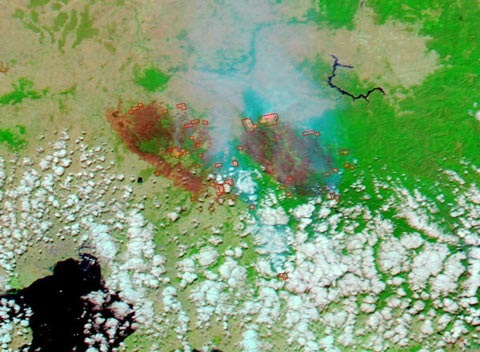
Vicfires090210.jpg

The sheer scale of the Victorian bushfire tragedy (over 170 dead at the time of writing: BBC coverage here) is apparent in this false colour satellite image from NASA’s Earth Observatory, captured on Feb 9th. Melbourne is at the top of the bay bottom left, and two large brown areas are the extensive burnt areas centred round Kinglake (left) and Marysville (right) in the Barry Mountains. Red boxes mark active fires, and in some of those boxes bright orange colours show intense heat, probably flames. To be visible from satellite, those fires must be enormous.

The Australian Bureau of Meteorology has updated its statement on the heatwave [PDF], prompting further commentary by Barry Brooks. For me, the money quote is this:

[…] a colleague at BOM pointed out just how exceptional this event was:

“Given that this was the hottest day on record on top of the driest start to a year on record on top of the longest driest drought on record on top of the hottest drought on record the implications are clear… It is clear to me that climate change is now becoming such a strong contributor to these hitherto unimaginable events that the language starts to change from one of “climate change increased the chances of an event” to “without climate change this event could not have occured”.

Jeff Masters at Weather Underground also adds his thoughts. The Herald has details on how to make donations to support fire victims.

[Procol Harum]

The boatman’s call

Lovelock.jpg The Sunday Times has begun publishing a series of excerpts from James Lovelock’s new book, The Vanishing Face of Gaia: A Final Warning, due out at the end of this month. It makes bleak reading for climate optimists:

So are all our efforts to become carbon neutral, to put on sandals and a hair shirt and follow the green puritans, pointless? Can we go back to business as usual for a while and be happy while it lasts? We could – but not for long. Apart from a lucky break of a natural or a geo-engineered kind, in a few decades the Earth could cease to be the habitat of seven billion humans; it will save itself as it dispatches all but a few of those who now live in what will become the barren regions. Our greatest efforts should go to learning how to live as well as is feasible on the soon-to-be-diminished hot Earth.

Lovelock is riffing on the theme he developed in The Revenge of Gaia: it’s too late to stop rapid and highly damaging climate change, so we should concentrate on saving ourselves. Climate change will cull humanity: from seven billion down to one billion will deliver effective emissions reductions. Meanwhile, we should start looking for lifeboats.

Continue reading “The boatman’s call”

Fractured air

[youtube]QfQ0kZ13-JA[/youtube]The roots of the recent cold weather in Britain and eastern North America lie in unusual goings on high in the atmosphere above the North Pole, as this animation from NASA’s Earth Observatory demonstrates (full video here: 6MB .mov file). The left hand image shows vorticity (rotation, roughly) and the right the temperature at 20km. As the animation moves through January into February, we see the polar vortex (the red bit in the middle) split into two, and stratosphere temperatures over the Arctic jump by as much as 50C. The Earth Observatory explains:

The big change in the Arctic came when the polar vortex ripped apart. A developing weather system in the lower atmosphere traveled upward into the stratosphere. The disturbance nudged into the center of the Arctic air mass, elongating it and eventually splitting it like a cell in mitosis. By February 2, two air masses existed, each with a jet of wind circling it counterclockwise […]. Warm air filled the gap between the two colder air masses, and temperatures high over the North Pole climbed […]. Now the colder air had shifted farther south over Canada and Siberia. Over North America, this piece of the stratospheric polar vortex had a deep reach into the lower atmosphere (troposphere), which created strong winds from the north that carried cold Arctic air far south into the United States.

In Europe, the split in the air mass actually changed the direction of winds in the lower atmosphere. The second piece of the polar vortex was centered east of Western Europe […], and it too was surrounded by a jet of strong wind moving counterclockwise. Like the segment of the polar vortex over North America, this piece of the polar vortex also had a deep reach into the lower atmosphere. It caused cold continental air to blow in from the east, replacing the warmer air that typically blows in from the west. As the frigid air moved over the North Sea, it picked up moisture, which fell over the United Kingdom and parts of France as heavy snow.

There’s a full explanation of the polar circulation at the Earth Observatory page. Well worth a read. Any meteorologists care to comment on just how unusual a feature this is? Are the large blocking highs that bring cold easterlies to Western Europe often associated with polar vortex splits? This is weather, not climate, but the Arctic is experiencing rapid climate change, and this will be expressed as changing weather patterns. A new paper in Climate Dynamics examines this and found “large increases in the potential for extreme weather events […] along the entire southern rim of the Arctic Ocean, including the Barents, Bering and Beaufort Seas.”

[Calexico]
Long hot summer

kanga.jpgThere’s record heat in Australia and deep snow in England (with more to come, say Met men), and it’s all consistent with continuing global warming. Over at Wellington’s leading public transport blog, this is enough to inspire a remarkably ill-informed diatribe:

Following the news as I do, it was delicious today to see the global warmers claiming Melbourne’s summer heatwave was proof of Pope Gore’s alarmism, while ignoring the inconvenient truth that the heaviest snowfalls in decades are falling in London, Paris and much of the north-east of North America.

The really inconvenient truth, of course, is that both weather events neatly demonstrate some of the impacts of global warming and the changes in climate that result.

Continue reading “Long hot summer”