
You can’t always get what you want

The Awa Book of New Zealand ScienceHot Topic didn’t win the Royal Society of New Zealand’s first Science Book Prize: the cheque went to Rebecca Priestley, who compiled and edited The Awa Book of New Zealand Science — a very worthy winner. I had a glass of wine with Rebecca before the event, and we were both picking other books to win. We were both wrong… The judges said some very nice things about HT, which I’ll stick up in the sidebar when I can remember what they were, but the real honour was in being shortlisted.

Apart from the excitement of the presentation, the evening’s highlight was an amiable Sean Plunket pressing Richard Dawkins on which religion he’d choose if his life absolutely depended on it. After no more than moment’s thought Dawkins revealed himself to be a Pastafarian: a devotee of the Church of the Flying Spaghetti Monster. The author of The God Delusion prefers a delusional god…

[Update 18/5: Kathyrn Ryan interviewed Rebecca Priestley on Nine To Noon this morning: audio here.]

[Stones (not obscure at all, StephenR)]

Friday omnibus #37b

To keep things ticking over while I’m in Auckland for the Royal Society’s inaugural Science Book Prize presentation here are a few items that have caught my eye over the last few days:

  • The BBC reports on the end of the Catlin Arctic Ice Survey expedition, and prompts UK ice specialist Peter Wadhams to comment on the current state of the ice: “By 2013, we will see a much smaller area in summertime than now; and certainly by about 2020, I can imagine that only one area will remain in summer.” For this year, the Canadian Ice Service expects a summer minimum similar to the last two years.
  • However much I moan about NZ’s big emitters arguing for delay and inaction (there was a particularly specious piece by Catherine Beard of the Greenhouse Policy Coalition in the Herald yesterday), our politicians have it easy compared to lawmakers in Washington. The Guardian reports that coal and oil interests lobbying against emissions reductions have spent US$45 million in the first three months of this year.
  • Aficionados of conspiracy theories (Wishart, are you reading this?) will enjoy this review by Johann Hari of Voodoo Histories, a new book by David Aaronovitch: “[Aaronovitch] argues that we keep returning so obsessively to conspiracy theories because they are, paradoxically, reassuring. “Paranoia”, he writes, “is actually the sticking plaster we fix to an altogether more painful wound”: the knowledge that life is chaotic and random and nobody is in charge.”
  • New Scientist explores the deep roots of our understanding of the greenhouse effect by looking at the life of John Tyndall. Well worth a read.

A pillow of winds

WindturbineNot content with being one of NZ’s leading climate cranks, energy consultant Bryan Leyland also has views on wind power that are well out of the mainstream. Muriel Newman’s NZ Centre for Policy Research this week gives Bryan a chance to fulminate about the economics of wind energy:

I believe that, given the high cost and operational problems of wind power, no responsible Board of Directors of a state-owned or private company could — or should — agree to “investing” in windpower. There are better and cheaper alternatives.

Is that so? I thought it might be wise to check Bryan’s take on the business, and so I asked Fraser Clark, chief executive of the NZ Wind Energy Association to take a look at his article and give us an idea of what the real situation is. Here is his analysis…

Electricity generation technology and the way electricity systems are managed are continually evolving. Bryan Leyland’s recent think piece, which criticised wind energy as ‘foolish energy’, failed to consider many of the factors that are influencing the development of modern electricity systems.

Broader energy security concerns are driving the global shift to renewable electricity generation. Uncertainty regarding the supply and price of fossil fuels increases the attractiveness of wind energy as it has no fuel cost, no supply risk, and will not be affected by the introduction of a price on greenhouse gas emissions.

Leaving aside security concerns, which I have discussed elsewhere, many of Mr Leyland’s recent assertions about wind energy are irrelevant, alarmist and unsupported by other, more robust analysis.

Continue reading “A pillow of winds”

We better talk this over

jim_salinger.jpg Jim Salinger’s sacking by NIWA has gone to mediation. Stuff has an iffy picture but good background to today’s first meeting: six NIWA execs attended, facing up to Salinger and his lawyer. The meeting finished at 3pm this afternoon, and Jim tells me that “the matter has not reached resolution, but talks continue”. He won’t be saying more until the process has concluded. Meanwhile Ken Perrott has an excellent summary of the reaction to Salinger’s sacking from the NZ scientific community at Open Parachute. Should be more coverage in the days to come, and I’ll update this post with links as they come in.

[Bob Dylan]

What’s a few tears to the ocean?

coccolith.jpgNew Zealand could be amongst the first places in the world to feel the effects of ocean acidification, according to a new “emerging issues” paper released today by the Royal Society of New Zealand. Surrounded by cold oceans which absorb CO2 faster than warm waters, and with a $300 million shellfish industry based on mussels, oysters, scallops and paua, NZ is vulnerable to disruptions in the carbonate chemistry used by these animals to build their shells, but the risks cannot be quantified at present.

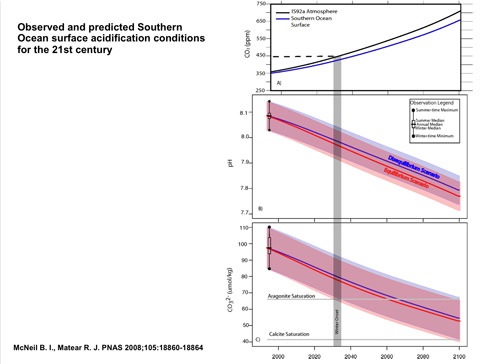
At a briefing to launch the paper, Professor Keith Hunter of the University of Otago pointed to recent work which suggests that for creatures that build their skeletons from a form of calcium carbonate called aragonite, the Southern Ocean could be reaching a critical point as early as the 2030s, as this slide shows:
OAcidRS1.jpg

The magic number is 450 ppm: at that point low pH waters in winter could begin to make it difficult for creatures to build aragonite skeletons or shells. How this might cascade through marine ecosystems is unknown, because the impact on different species can vary through their lifecycle and by season. Some species are also known to be able to adapt. Sydney rock oysters, for example, have been bred to withstand more acid conditions, but it’s not known whether this sort of work would be possible with mussels and other shellfish.

Work on ocean acidification is beginning to provide a valuable and independent line of evidence supporting the need to shoot for stabilisation of atmospheric CO2 at low levels. It may also point to problems with emissions trajectories that are allowed to “overshoot” the desired target: if oceanic CO2 uptake does produce a biologically critical response, exceeding that point might be very bad news for oceanic ecosystems.

The new Royal Society paper gives a very useful overview of what we currently know about ocean acidification and its potential to impact New Zealand ecosystems and marine farming operations. The RS is also organising a workshop in September to discuss the issue.

[Dimmer]