
Spinning wheel…

MITroulettebig.jpg

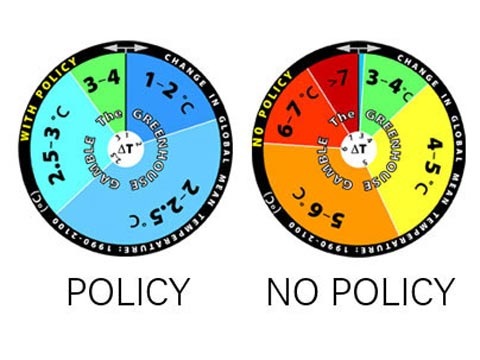
Feeling lucky? Spin these roulette wheels and see where the future lies: on the left, if the world takes decisive action to reduce emissions over the next 100 years, and on the right if we don’t. If we do: most likely an increase of 2 – 2.5ºC. If we don’t: most likely is 5 – 6ºC. Produced by the Joint Program on the Science and Policy of Global Change at MIT, the wheels are a novel way to express the uncertainties associated with projections of future climate and the way they interact with policy decisions. The message for policy makers is clear, according to study co-author Ronald Prinn:

“There’s no way the world can or should take these risks,” Prinn says. And the odds indicated by this modeling may actually understate the problem, because the model does not fully incorporate other positive feedbacks that can occur, for example, if increased temperatures caused a large-scale melting of permafrost in arctic regions and subsequent release of large quantities of methane, a very potent greenhouse gas. Including that feedback “is just going to make it worse,” Prinn says.

For a reminder of just what six degrees means, I recommend Mark Lynas. George Monbiot suggests that climate cranks will object to model projections like these:

Climate change deniers hate these models. Why, they say, should we base current policy on scenarios and computer programmes rather than observable facts? But that’s the trouble with the future: you can’t observe it. If you reject the world’s most sophisticated models as a means of forecasting likely climate trends, you must suggest an alternative. What do they propose? Gut feelings? Seaweed? Chicken entrails?

Tea leaves, obviously…

[Blood, Sweat & Tears]

Bird on the wires

bellbird.jpg Another week, another step forward in the relentless march of progress. Hot Topic now has its very own Twitter account: hottopicnz. Why? Is it simply born of the insufferable self-importance of your blogger, or does it have a purpose? Probably both, but I’ll only deal with the latter. In the process of keeping up-to-date with climate issues, I read a lot of stuff that would be nice to blog. There isn’t enough time to do a proper post about everything, so the Hot Topic tweets are little text messages pointing to stuff that I think is interesting (or in the case of goats and windfarms, amusing — if you’re not a goat-owning windfarmer). New blog posts are tweeted automatically, so followers can keep right up to date. An alternative to HT’s RSS feed, using the latest micro-blogging platform. The most recent tweets will appear in the left sidebar, and you can get to the twitter feed by clicking on the timestamps there. Feel free to retweet at will…
[Definitely not Leonard Cohen]

Missing the point by miles

I have been steering clear of Wishart-related material for the last week or two (on the “wrestling with pigs” principle), but I can’t let this post at his blog pass without comment. It begins:

In the climate debate, we can choose to listen to truffle fanciers like Gareth at Hot Topic, journalists like myself or politicians like Al Gore, or one of the leading scientists in the climate field, like Roy Spencer from University of Alabama-Huntsville. The following is a fascinating essay from his blogsite, which backs up the central thesis in Air Con – most of the CO2 increase is natural, not man-made:

He then reposts Spencer’s blog item in full, adding in the comments:

Spencer’s study suggests strong evidence that oceanic CO2 is the primary driver of increased CO2 levels in the atmosphere. (Looking at the graphs, very strong evidence).

Not a squeak out of Hot Topic and no one posting here challenges it.

Notice how a blog post became a “study”? Ah well, here’s a squeak…

Continue reading “Missing the point by miles”

Polar journey

Poles Apart: The Great Climate Change DebatePerhaps the most interesting thing about Gareth Morgan’s Poles Apart is the process he used to arrive at his opinion: using two “teams” of experts — three of NZ’s leading scientists against the pick of the climate cranks — to provide advice. The Science Media Centre has just posted an interesting article by the New Zealand trio, all based at the Antarctic Research Centre at Victoria University — Dr Dave Lowe, Adjunct Professor of Atmospheric Chemistry, Dr Lionel Carter, Professor of Marine Geology and Dr Peter Barrett, Professor of Geology, discussing their experiences while working on Morgan’s project. And, with the kind permission of the SMC, I’m delighted to reproduce the article here.

***

In mid 2007 Peter Barrett and wife were invited to dinner at the Morgans to talk about their upcoming Antarctic trip. Late in the evening Gareth mentioned an idea he had for a book on climate change to sort out the range of views he was seeing in the press.

Two weeks later Peter received a two-page 9-chapter outline for comment. It covered everything from: “What is Climate Change” to “What should New Zealanders do about it”, and the words “need a well-formed scientific perspective” appeared in several places.

Peter’s initial response was “Thanks…need a bit more time..”. Through the rest of the year Gareth motor-biked from Cape Town to London (among other things), and by the following January, Gareth had in hand a substantial report on why climate change was no cause for concern from a climate “Sceptic”. The book was plainly under way and it was time for some balance. Peter suggested a small group to cover what we considered the mainstream view. This would be led by recently retired atmospheric chemist Dave Lowe and include marine geologist Lionel Carter, who had recently moved to VUW. Gareth agreed, and that’s where the story really begins.

Continue reading “Polar journey”

What’s the world got in store?

NZCCC_conference.jpgA long time ago, when this writer was doing a portion of his growing up on an island far, far away, if you were unfortunate enough to not attend an important or enjoyable event, you were said to have “missed yourself“. This week I shall be missing myself in Wellington at the NZ Climate Change Centre’s conference Managing The Unavoidable, in Te Papa on May 20 – 21. The focus of the conference is on adaptation to the inevitable consequences of climate change, and considers two scenarios: what if global negotiations achieve a “rapidly decarbonising world” and what if, instead, the future is one of a “high carbon world”? Keynote speakers are Chris Field, Director of the Department of Global Ecology Carnegie Institution of Washington, recently elected co-chair of WG2 for the IPCC’s AR5, and Roger Jones of Centre for Strategic Economic Studies in Melbourne. Presentations and panel discussions will address six themes: land-based primary industries, including agriculture, horticulture and forestry; energy and industry, including mining / quarrying and manufacturing; māori; health; local government, including transport and infrastructure, and conservation and natural systems, including biodiversity and biosecurity. Full programme is here. If I lived in Wellington (per the Mutton Birds), I’d be there. Environment minister Nick Smith’s opening the event: I hope he sticks around to listen to what’s said. I’ll see what more info I can dig up from the organisers…