
 While we’re on the subject of ice, Australia’s Antarctic Climate & Ecosystem Cooperative Research Centre today launched two new publications: Polar ice sheets and climate change: global impacts [PDF], and Changes to Antarctic sea ice: impacts [PDF]. Described as “position analyses”, the papers provide an excellent overview of the current state of our understanding of ice sheets and how they’re behaving in a warming climate and the way Antarctic sea ice is responding to climate change.
Author: Gareth
North to Alaska
 Interesting times in the Arctic, as spring turns into summer and the sea ice melts towards its summer minimum. Will this year’s minimum be a new record, or will the ice bounce back towards the long term (but still downward) trend? The first scientific forecasts of the season are expected soon from the Sea Ice Outlook project coordinated by ARCUS, the first yacht has set sail for an attempt to get through the Northwest Passage, and the usual suspects are insisting that the ice is continuing to recover. So what are the odds of a new record this year, and how is the ice really doing at the moment? The picture’s mixed…
Upward over the mountain
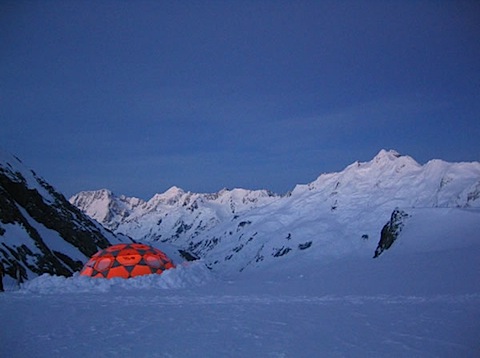
There are chilly weeks ahead for a team of six scientists — two New Zealanders, two Chinese and and two from the USA — who are heading into the Southern Alps around Mt Cook for a winter ice core drilling project organised by GNS Science. Winter drilling is necessary to avoid the cores melting on extraction — daytime temperatures will be around freezing, but could drop to -20ºC at night. Julian Thomson (blog — worth a read) of GNS explains how they will select sites:
“Ideal ice core sites are flat, at high altitude, with a slow-moving glacier and moderate snow accumulation. These sites enable good preservation of a long continuous record of annual ice core layers,†he said. “Such sites are rare in the Southern Alps where the highest areas are typically steep and with very high snow accumulation rates. New Zealand glaciers are therefore fast moving and dynamic.†Weather permitting, the scientists plan to retrieve ice cores from several sites.with altitudes ranging from 2200m to 3000m.
The logistics are a challenge:
The cores will be brought to the surface in 1m lengths, bagged in clear polythene and stored in purpose-built insulated boxes. Typically, it can take up to 12 hours to retrieve 50m of core from a site. The ice cores will be air-lifted off the glacier and taken to Mt Cook Village and stored in a walk-in freezer at The Hermitage Hotel. From there they will be taken in a refrigerated truck to the New Zealand Ice Core Research Laboratory at GNS Science in Lower Hutt.
Retrieving the climate records in the cores is becoming urgent because NZ’s glaciers have lost 60% of their volume since the 1850s. The Press coverage quotes Thomson:
“There is definitely a feeling that these glaciers are not going to come back for a good while. It is a priority to get the ice cores out as soon as we can,” Thomson said. “We’re not sure how old the ice is at the bottom. If we’re really lucky, we hope to go back a few hundred years. “That takes us back further than instrument weather stations, which have been around for about 150 years. If we went back into the thousands of years we’d be absolutely gobsmacked.”
We have to hope that the staff at The Hermitage resist the temptation to serve the ice with whiskey at the bar…
[Update: RNZ National’s Jim Mora interviewed Julian Thomson this afternoon: audio here at 14:10.]
Such ignorance must not be allowed to go uncontradicted (*)
 Last week an essay — Why I Am A Climate Realist — by NZ CSC “science advisor” Dr Willem de Lange started popping up all over the crank web. I first spotted it at Muriel Newman’s NZ CPR site, and it has since appeared at Monckton’s US lair (complete with a pretty cover). De Lange, a senior lecturer in the Dept of Earth & Ocean Sciences at Waikato Unversity, has not had many starring roles as a climate crank — his biggest claim to fame was a place on the panel discussion after Prime’s showing of The Great Global Warming Swindle last year. But this time he has really stuck his neck out, channelling Wishart’s delusions in this sentence:
It is more likely that the warming of the oceans since the Little Ice Age is a major contributor to the observed increase in CO2.
To show just how wrong he is, I asked Doug Mackie, who is a researcher in chemical oceanography at the University of Otago and regular commenter here, to point out the flaws in de Lange’s essay. Over to Doug:
When Gareth invited me to write a guest post about Willem de Lange’s Why I am a climate realist I knew it was going to be hard. Most of the article is wibble and he really only makes 2 serious points:
– About sea level
-The oceans as the main source of CO2.
(*) Katherine Mansfield, The Advanced Lady.
Continue reading “Such ignorance must not be allowed to go uncontradicted (*)”
Climate alarmist spouts nonsense
 New Zealand agriculture is doomed and the country will go bust if it adopts measures to restrain carbon emissions, claims Dennis T Avery of the “centre for global food issues” at right wing US think tank the Hudson Institute. Avery is notorious as a vocal climate crank, and was invited to speak at last month’s Agribusiness conference in Blenheim. His message was standard crank nonsense, as the Marlborough Express reported:
Charging farmers for carbon emissions is unfounded and will cripple the New Zealand economy, according to a United States expert on global warming. […] “Do not let them send you out of business. Don’t go quietly. Not only will [a carbon tax] kill you, it will kill the entire economy of New Zealand.”
The alarmist message is underlined in an article he penned on returning home to the US:
No country in the world would risk as much for “global warming†as New Zealand if it goes ahead with the cap-and-trade energy taxation installed by Helen Clarke’s now-departed Labour Government.
Avery’s do-nothing line might have gone done well with some at the Agribusiness conference, but it apparently didn’t find much favour elsewhere:
I said this recently to several New Zealand government ministers and business leaders at a private dinner in Wellington. My message was not welcomed. John Key’s new government seems to understand that New Zealand’s economy would be at terrible risk from carbon taxes — but its voters apparently don’t realize it.
Intriguing. I wonder which ministers he met, and who organised the dinner? And who still thinks Avery is remotely credible on climate issues? Just look at his handy summing up of why action on climate change isn’t necessary:
Never mind that the earth’s global warming stopped after 1998 because the sun has gone into a startling quiet period. That’s why New Zealand’s many glaciers have been growing recently instead of receding. Never mind that even full member compliance with Kyoto would “avoid†only about 0.05 degree C of warming over the next 50 years—by the alarmists’ own math.
Avery is making stuff up — telling lies in an attempt to influence policy. NZ’s glaciers growing? Not what the figures show, Dennis. But then if you think global warming stopped in 1998, you’re clearly not the sharpest pencil in the drawer. It’s a pity the organisers of the Agribusiness conference hadn’t spotted that before inviting him over here to mislead, misinform and misdirect.