
Gone too soon

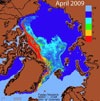
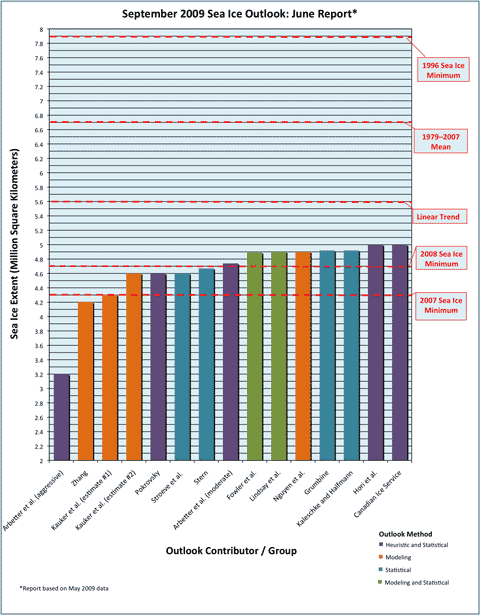
SIOJune2009iceages.jpg The June Sea Ice Outlook forecasts for the Arctic sea ice September minimum extent have been released today by SEARCH. Most groups are picking a minimum close to last year’s 4.7m km2, but the melt season is starting with an unusually small amount of multi-year ice. The report suggests that there is “a small but important probability of a major sea ice loss event this year, given that the ice is thinner and younger than previous years, combined with a possibility of atmospheric conditions that cause significant ice retreat.” The full range of forecasts is shown in this chart:
SIO_JuneReport2009.gif

The range of individual outlook values is from 4.2 to 5.0 million square kilometers. All estimates are well below the 1979–2007 September climatological mean value of 6.7 million square kilometers. Half of the responses are in the range of 4.9–5.0 million square kilometers; the remaining estimates are in the range of 4.2–4.7 (Figure 1, above). The uncertainty / error values, from those groups that provided them, are close to 0.5 million square kilometers, thus many of the values overlap.

Interestingly, the forecasts showing the lowest minima are based on sea ice modelling driven by atmospheric forcings and initialised with current sea ice conditions. The projection by Jinlun Zhang (next to lowest in the chart) suggests that even with conditions like last year — that is, without the Transpolar Express of warm southerlies that set up in 2007 — the 2007 record could fall. On the other hand, a Russian scientist suggest thats Pacific sea surface temps could be priming a cooler pattern than last year.

The full report [PDF] is a very interesting read for all ice watchers (and gamblers). On this guide to the form, it looks as though I’ll lose my bets – but the weather over the next two months will be the deciding factor. Do I feel lucky…?

[Michael Jackson RIP]

Deckchairs? We haven’t even got a boat…

Followers of Hot Topic’s new Twitter feed might have noticed this link, posted this morning. It’s a Guardian report of a select committee hearing in the UK Parliament, in which the director of the Tyndall Centre for Climate Change (at Manchester University) took the Labour government to task for the “dangerously optimistic” nature of the targets it has adopted.

Professor Kevin Anderson, the director of the Tyndall Centre for Climate Change Research, said the government’s planned carbon cuts – if followed internationally – would have a “50-50 chance” of limiting the rise in global temperatures to 2C. This is the threshold that the EU defines as leading to “dangerous” climate change. Anderson also said that the two government departments most directly involved with climate change policy, were like “small dogs yapping at the heels” of more powerful departments such as that run by the business secretary, Lord Mandelson. He said that the Department of Energy and Climate Change (Decc), run by Ed Miliband, should be given more power.

What are the British targets that so concern Professor Anderson? In the April budget, Gordon Brown’s government formally adopted the target suggested by the committee it established to advise on the matter — a 34 per cent cut in emissions by 2020 from a 1990 baseline. Anderson wants that tightened to 40% before the Copenhagen meeting in December, in order to get a reasonable deal out of the process.

… without more ambitious action he feared that a significant deal at Copenhagen would not be achieved. “No one I talk to thinks there is going to be anything significant to come out of Copenhagen,” he said. “We are going to come out and recover the deck-chairs in preparation for moving them as the Titanic sinks. We’re not even at the stage of rearranging them,” he added.

There’s a message here for New Zealand’s politicians and scientists, and it’s not a comfortable one for either group.

Continue reading “Deckchairs? We haven’t even got a boat…”

A long way from Home

homer.jpgFilm review corner: Dr Ron Smith, a senior lecturer at the University of Waikato and a regular contributor to Muriel Newman’s crank echochamber went to see Yann Arthus-Bertrand’s film Home earlier this month (previewed here), and was moved to provide Muriel with a review. As crank effluvia go, it’s a classic…

Continue reading “A long way from Home”

The moneygoround

NZETS.jpgBack in March climate change minister Nick Smith decided it was time to sort out whether the Emissions Trading Scheme was a recipe for economic disaster, as ACT and big emitters were insisting (using figures from a shonky report by NZIER), or affordable, as Treasury modelling (conducted by Infometrics) showed. Smith commissioned both economic consultancies to work together to arrive at a consensus, which they were happy to do (at a cost of $79,200 + GST). The result of this ministerial banging of heads was released yesterday [PDF], and it is simultaneously interesting, encouraging and profoundly disappointing.

Continue reading “The moneygoround”

Start me up

[youtube]ro0-7U8UtvI[/youtube]

Above: a new animation of Arctic sea ice from 2000 to May 2009, from the Alfred Wegener Institute for Polar and Marine Research and KlimaCampus of the University of Hamburg in Germany. It accompanies their first contribution to this year’s sea ice forecasts — and they put the odds of a new record minimum at either 28%, or with an enhanced model that takes better account of current ice conditions about 49%. Close enough to my gut feeling of 50/50 to allow me a little confirmation bias, I think… The press release is here, and the full forecast here (pdf). The AWI modelling is part of the Search forecasting exercise I mentioned last week. The full set of forecasts should be out in the next week to ten days, according to project co-ordinator Jim Overland, and I’ll cover them when they become available.

[The Folksmen]