The PIG is flying

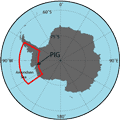
PIGmap.gif The Pine Island Glacier in West Antarctica is thinning four times faster than 10 years ago, a new study(*) of satellite measurements shows. Since 1994, the central portion of the glacier has thinned by as much as 90 metres, and the ice surface is currently lowering by 16 metres a year. At this rate of thinning, the glacier could disappear in 100 years, instead of the 600 years earlier estimates had suggested. The BBC report includes an excellent video, and focuses on the implications for sea level rise:

One of the authors, Professor Andrew Shepherd of Leeds University, said that the melting from the centre of the glacier would add about 3cm to global sea level.
“But the ice trapped behind it is about 20-30cm of sea level rise and as soon as we destabilise or remove the middle of the glacier we don’t know really know what’s going to happen to the ice behind it,” he told BBC News. “This is unprecedented in this area of Antarctica. We’ve known that it’s been out of balance for some time, but nothing in the natural world is lost at an accelerating exponential rate like this glacier.”

Unlike Greenland, where surface melting adds to losses caused by warming oceans, in West Antarctica it’s thought that warm ocean currents (specifically the Upper Circumpolar Deep Water, which is 3ºC warmer than surface water in the region) are being channelled in under the PIG ice shelf, helped by the large trough the glacier carved in the sea floor during previous glacial maxima. Given concerns about the stability of the West Antarctic ice sheet as the world warms and sea level rises, the words “exponential rate” sound particularly ominous…


(*) Wingham, D.J., D.W. Wallis, and A. Shepherd (2009), Spatial and temporal evolution of Pine Island Glacier thinning, 1995-2006, Geophys. Res. Lett., doi:10.1029/2009GL039126, in press.

Science advice to Key: NZ “must be fully involved”

gluckman.jpgThe Government’s new chief scientist, Sir Peter Gluckman, yesterday published an excellent overview of the scientific understanding of climate change and how that impacts on policy in New Zealand. It’s a notably calm and measured piece — about as far from “alarmism” as it’s possible to be. Discussing the consequences of a 3.3ºC increase in global temperature by the 2090’s, Gluckman describes them as “quite scary”:

If the temperature rose by this amount then the scenarios become quite scary in terms of changes in climate, flooding of low-lying areas, new patterns of infectious disease, and reductions in the capacity of many parts of the world to support agriculture and therefore to support our continued existence as we know it. New Zealand would not be immune from these changes.

Others might prefer stronger language… but Sir Peter makes a number of telling points elsewhere. He likens those who oppose the mainstream scientific view on global warming to scientists who argued that AIDS was not a viral disease:

A similar debate occurred about AIDS, where a minority of scientists maintained for a long time that the disease was not caused by a virus. This view was manifestly wrong in the eyes of most scientists, but nevertheless some distinguished scientists, albeit usually not experts in virology, took different views until the science became irrefutable. The political consequences of this denialism had tragic results in some African countries.

Gluckman leaves the obvious corollary unspoken, so I hope he’ll forgive me for putting it into my own words: we can expect tragic results to flow from climate denial.

I’ll quote his final paragraph in full:

There is no easy answer -– the science is solid but absolute certainty will never exist. As part of the global community, New Zealand has to decide what economic costs it will bear and what changes in the way we live will be needed. We must be involved. This is a global challenge, and a country like ours that aspires to be respected as a leading innovative nation cannot afford to appear to be not fully involved. Indeed, such a perception would compromise our reputation and potential markets.

This is the advice John Key is receiving, and it’s good to see that Gluckman, while being measured and careful, is not underplaying the size of the problem or the role we should play. In fact, it might be possible to detect a mild rebuke for the government’s pusillanimous approach to emissions targets in the phrase we “cannot afford to appear to be not fully involved”. 10 – 20% is a long way from “fully involved”, I would argue.

Lies, damned lies, and the Employers and Manufacturers Association (Northern)

targetAmongst the many responses to the 2020 emissions “target range” at Scoop I stumbled upon this cracker from Alasdair Thompson, chief executive of the Employers and Manufacturers Association (Northern). It’s such a blatant misuse of statistics that I can’t let it pass unnoticed. Thompson describes the modest target as…

…a challenge for New Zealand is as big, or bigger than when the UK entered the European Common Market (EU).

And why? Because it’s going to cost a lot.

“At an average 15 per cent reduction, the cost of $30 per week per head amounts to $6.7 billion each and every year, said Alasdair Thompson, EMA’s chief executive. “This is more than the total of all our lamb, beef and other meat exports. It represents about 60 per cent of our total dairy exports. […] It’s the price we are being told in effect we need to pay – nearly five per cent of GDP – to retain access to world markets, mostly for our agricultural products.”

It appears Thompson has used the figures Nick Smith used at the announcement of the targets, then added his own gloss. Why is this misleading? First, the NZIER-Infometrics report [PDF] is useless as a guide to the cost of emissions reductions, as I showed here. Second, Smith’s use of figures from the report is itself suspect, as Keith Ng memorably noted at OnPoint. Thompson presents $30 a week as a “cost”, when in fact it’s a measure of foregone growth (ie the difference between two projections of economic growth). He then presents this in terms of GDP — a full 5% cost. This is a complete misrepresentation of the numbers. The NZIER-Infometrics report suggests that GDP will be reduced by 2.4 to 2.6% in 20202 on a scenario where NZ buys emissions units at $100/tonne to cover emissions that have not been subject to any reductions. In other words, even if you make lots of unrealistically expensive assumptions, the cost will be a lot less than Thompson wants us to think.

As baseless economic scaremongering goes, Thompson’s press release takes a very large biscuit. I’ve no doubt the membership of the EMA will insist that Thompson take a course in basic numeracy, and issue a retraction and clarification (but I won’t be holding my breath).

The size of a cow

AtomHeartMother.jpg NZ’s farming leadership remains in denial about the need for action on climate change, as a remarkable speech [full text, Stuff report] by Federated Farmers president Don Nicolson demonstrates. Addressing the Plant Protection Society’s annual conference in Dunedin yesterday, Nicholson took swipes at Keisha Castle-Hughes, Greenpeace and the Green Party:

It’s not the reality that Greenpeace or the Green Party informs people before they ‘sign-on’. There’s no hint of a real solution apart from some ‘great leap backwards’. No, the vision they extol is instead apocalyptic. It is designed to create a climate of fear and don’t the anti-progress agents love fear. A fear of no oil, rising sea levels, extinction and starvation. It’s moral brainwashing without facts or context.

No real solutions on offer? No facts to support calls for action? It looks to me like Nicolson’s the one who’s making stuff up — and leading NZ’s farmers down a commercially disastrous path in the process.

Continue reading “The size of a cow”

No vision, no guts, no future

targetThe New Zealand government announced this afternoon that NZ would table a conditional emissions target of between 10% and 20% cuts on 1990 levels by 2020 [Scoop, Herald]. The range is supposed to allow for a response to the progress of international negotiations, and the conditions are that there should be a comprehensive international agreement that (according to the MoE Q+A):

…sets the world on a pathway to limit temperature rise to not more than 2°C; developed countries make comparable efforts to those of New Zealand; advanced and major emitting developing countries take action fully commensurate with their respective capabilities; there is an effective set of rules for land use, land-use change and forestry (LULUCF); and there is full recourse to a broad and efficient international carbon market.

Climate minister Nick Smith says that the target will be achieved by a mixture of domestic emission reductions, the storage of carbon in forests, and the purchase of emission reductions from other countries. The MoE Q+A page lists the measures in place to help NZ reduce emissions (#25): it amounts to a watered down emissions trading scheme, a $323 million home insulation and clean heating fund, a new Centre for Agricultural Greenhouse Gas Research, incentives for new energy technologies like sustainable biofuels, electric cars and solar water systems, Resource Management Act reforms and a National Policy Statement to support renewable electricity generation. No mention of forestry. Are the trees expected to plant themselves?

The target range comes as no surprise, given the signals emerging from the government over recent weeks, but the modest nature of the target and the fact that it is all conditional puts NZ in a weak position internationally. Smith & Co continue to insist that their targets, based on “50 by 50”, are in line with what the science is telling us, but that is only true if they cherry pick the most optimistic IPCC scenario, and ignore the evidence that’s been emerging over the last two years. This is not mysterious stuff, not news. The science and policy community has told the government the facts — it looks like they have chosen to ignore them and pander to those who would rather do nothing.

It is now transparently obvious that this National-led government simply does not understand the real challenges presented by climate change. They do not appreciate the full seriousness of the situation that confronts the planet, they underestimate the need to act, and they have completely failed to make any coherent assessment of what could be done. That amounts to gross incompetence, and they should be held to account for it, both at the ballot box and in the court of public opinion.

[Pusillanimous]