
Nitrous oxide no laughing matter for ozone layer

Nitrous oxide (N2O, aka laughing gas) apart from being a powerful greenhouse gas, 298 times more effective at trapping heat than CO2, is also the single most important ozone depleting gas being emitted by human activities. A paper published in this week’s ScienceXpress, Nitrous Oxide (N2O): the dominant ozone-depleting substance emitted in the 21st century, by Ravishankara, Daniel and Portman(*), shows that as the chlorofluorcarbons controlled by the Montreal Protocol have been phased out, atmospheric N2O has continued to increase. Here’s the abstract:

By comparing the ozone depletion potential-weighted anthropogenic emissions of N2O with those of other ozone depleting substances, ODSs, we show that N2O emission currently is the single most important ODS emission and is expected to remain the largest throughout the 21st century. N2O is unregulated by the Montreal Protocol. Limiting future N2O emissions would enhance the recovery of the ozone layer from its depleted state, and would also reduce the anthropogenic forcing of the climate system, representing a ‘win-win’ for both ozone and climate.

Continue reading “Nitrous oxide no laughing matter for ozone layer”

Come together

ANZlogo.jpg Signals are beginning to emerge (from the 5th Australia-New Zealand Climate Change & Business conference in Melbourne this week) that the “harmonisation” of New Zealand’s emission reduction policy framework may take longer than expected (or feared). Following a breakfast with his Australian counterpart Penny Wong, both ministers were reported to be playing up the difficulties of linking the two schemes. The Stuff report quotes Wong:

“The first step for both of our governments is to get our legislation in place, to get our trading schemes in place,” Ms Wong told reporters. “The second point is this — we are doing the work to explore options for harmonisation. There is obviously a lot more work that needs to be done.”

Smith was equally cautious:

“That is why the two governments are in a pretty common space in saying we are going to start these two schemes separately but in time it is our ambition to bring them closer together.”

Meanwhile, Reuters reports that businesses on both sides of the Tasman are urging their governments to get a move on.

“You don’t shift significant billions of dollars of investment on the basis of what’s likely to happen,” said Barry Harris, director of milk supply for Fonterra, the world’s biggest dairy exporter and a pillar of the New Zealand economy. “The financial consequences of reacting to the wrong signals are absolutely massive,” he told the conference.

In NZ, Labour’s climate spokesman Charles Chauvel today warned that softening up the current ETS arrangements to match Australian proposals could cost taxpayers up to $200m a year. But perhaps the most telling statement to emerge this week is this line form Nick Smith’s speech to the Melbourne conference:

It is just unrealistic to continue to pretend we are, or can be, world leaders in reducing emissions.

To some, that may be admirable pragmatism. To me, it demonstrates a catastrophic lack of vision and a failure to rise to a challenge. If Smith wants no part of leadership, he should resign his cabinet post immediately.

[Lennon, J]

Why did Nick Smith hide the facts on forestry?

targetGovernment ministers have deliberately played down the role of forestry in meeting emissions targets, documents released under the Official Information Act suggest. Diligent digging at No Right Turn has uncovered a Ministry of Agriculture & Forestry paper [PDF] titled New forest planting and harvesting intentions under high carbon prices, which makes clear that forest planting will increase significantly under a stable Emissions Trading Scheme, and that even a modest ($20/tonne) carbon price could trigger planting of up to 100,000 hectares a year — a rate not seen since the forestry boom of the 1990s, and enough to offset a huge chunk of NZ’s emissions to 2020 and beyond. Climate change minister Nick Smith did not mention these figures during the target consultation process, though it is clear he must have known about them. His failure to front with the facts on forestry amounts to a clear attempt to manipulate public perception of the difficulty of meeting steep targets, and raises serious questions about the agenda driving government policy.
Continue reading “Why did Nick Smith hide the facts on forestry?”

Colbert v McKibben: physics and chemistry don’t haggle…

The Colbert Report Mon – Thurs 11:30pm / 10:30c
Bill McKibben
www.colbertnation.com
Colbert Report Full Episodes Political Humor Health Care Protests

Bill McKibben in the lion’s den: 350 ways to tame the Colbert Nation. Brave man — but the plug for October 24th is an effective one. Check here for NZ events…

[H/T to Whoar]

And now the bad news…

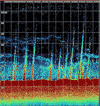
methaneSpits.gifActive methane plumes over the West Spitsbergen shelf discovered last summer are being driven by warming of an ocean current over the last 30 years, a new study(*) reports. The team on the British research vessel the James Clark Ross from the National Oceanography Centre Southampton (working with scientists from the University of Birmingham, Royal Holloway London and IFM-Geomar in Germany) found more than 250 plumes of bubbles of methane gas rising from the seabed of the West Spitsbergen continental margin at depths of 150 to 400 metres. From the press release:

Graham Westbrook Professor of Geophysics at the University of Birmingham, warns: “If this process becomes widespread along Arctic continental margins, tens of megatonnes of methane per year – equivalent to 5-10% of the total amount released globally by natural sources, could be released into the ocean.”

New Scientist expands the story somewhat, and looks at the total potential methane release in the region:

The methane being released from hydrate in the 600-square-kilometre area studied probably adds up to 27 kilotonnes a year, which suggests that the entire hydrate deposit around Svalbard could be releasing 20 megatonnes a year.

With global methane emissions of the order of 500 – 600 megatonnes per year, that’s a substantial potential addition to the global budget — and there’s a lot more methane hydrate on the East Siberian Shelf that is already showing signs of breaking down.

(*) Westbrook, G.K. et al. Escape of methane gas from the seabed along the West Spitsbergen continental margin. Geophysical Research Letters, 2009; DOI: 10.1029/2009GL039191 (preprint here: well worth a read)