New comment system for Hot Topic

It’s Saturday afternoon, and between finishing the chilli jam to go with tonight’s six-hour roast lamb and a quick pre-dinner bike ride, I’m moving Hot Topic over to use the Intense Debate comment system. This is an externally-hosted comment service, operated by Automattic, the WordPress people. During the import process, existing comments may not appear on the site, but all should be well within a few hours. This is only a trial, and I can revert to the basic WordPress comment system at any time (it runs in parallel, in fact), but Intense Debate offers a wide range of features that should make commenting (and managing comments, from my point of view) easier. Existing log-ins should synchronise with Intense Debate, but if you create an Intense Debate account you can have personal profiles and other things. The experiment has begun…

[Update Sunday evening] It appears that existing Hot Topic log-ins are not automatically recognised by Intense Debate. I recommend that regular commenters sign up for an ID account. That gives you access to “reply by email”, which is a neat feature of the system. You can also comment as a guest, but without that (and other) features.]

This perfect storm of calamities…

This guest post is by David Round, lecturer in environmental law at the University of Canterbury. It first appeared in the Christchurch Press on March 18.

It was once a truth universally acknowledged that good times never last. But we now seem to consider ourselves immune from the laws of nature and history. Times have been good and getting better for most of our lifetimes. All but the very poorest of us enjoy comforts beyond our grandparents’ wildest imaginings. We cannot imagine anything but the good life.

But actions have consequences, and if even half the articles we read in this newspaper every day are actually true – and surely The Press does not lie – then chickens are rapidly coming home to roost. We face the end of cheap and abundant oil, on which our entire civilisation and way of life depends. Oil we cannot afford is, for most purposes, little different from no oil at all. No adequate substitute exists. How will we manage if we cannot even get to work in the morning, and bring the groceries from the supermarket, let alone send our goods to the other side of the world and bring large numbers of tourists here?

There is no doubt significant global climate change is happening. The “challenge” to climate change science recently whipped up by vested interests is only a quibble over a couple of footnotes. We will inevitably see more extreme weather events, crop failures, famine, economic collapse, mass population movements and war. The earth’s human population increases each year by some 90 million, all of them wanting not just life but a life as good as ours. As all of this happens, we are running out of the most basic resources; not just oil, but water, soil and fresh air.

Continue reading “This perfect storm of calamities…”

Great balls of… air

airballnieman.jpg

Two images of the day: above — the picture says it all. Doesn’t look like much, does it? [via Ecohustler, h/t @Revkin]. And below, a NASA photograph from the International Space Station showing what that thin skin of air looks like in situ. Note the large cumulonimbus clouds casting shadows, especially the one left of centre, which looks as though it’s bumped into the tropopause. [h/t In It For The Gold]

AirnotballISS.jpg

The man who loved beer: Skeptics in the pub talk next week

Christchurch readers might like to know that I’m talking at the local Skeptics in the pub meet up next Tuesday evening (23 March) — working title is Sceptics, skeptics and septicsâ„¢. Should be a lively evening… 😉 Meet at The Twisted Hop from 5-30pm, talk begins at 6pm, probably over the road at CPIT before returning to the pub. Keep an eye on the Skeptics MeetUp page for final details.
[â„¢ as coined by Stoat, headline by David Byrne.]

New Aussie state of the climate snapshot: NZ needs one too

Australia’s CSIRO and Bureau of Meteorology have released a State of the Climate report [PDF], a succinct six page effort designed to provide the Aussie public with an overview of how their climate has been changing, and how it is expected to change in the future. Headlines (from the media release):

  • Highly variable rainfall across the country, with substantial increases in rainfall in northern and central parts of Australia, as well as significant decreases across much of southern and eastern Australia.
  • Rapidly rising sea levels from 1993 to 2009, with levels around Australia rising, between 1.5cm and 3cm per decade in Australia’s south and east and between 7cm and 9cm in the country’s north
  • About half of the observed reduction in winter rainfall in south-west Western Australia can be explained by higher greenhouse gas levels.

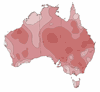
The news about temperature isn’t good either. All of the continent has warmed over the last 50 years, but some regions have warmed at up to 0.4ºC per decade during that time (see the dark red blobs on the map above) and have seen warming of 1.5 — 2ºC. By 2030 the average temperature is expected to have increased by a further 0.6 — 1.5ºC, and decreases in rainfall will continue in the south, south-east and southwest. The graphics are particularly good — and very telling.

I’m not aware of any similar recent overview for New Zealand, and with the usual suspects doing their level best to promote uncertainty and inaction at the moment, it would be helpful if the local climate science community could cooperate on producing such a clear statement of current evidence and future change. NIWA’s last set of projections for NZ were released in 2008, and are summarised on this informative but rather dense web page. I had a go at bringing the details to a wider public, via articles in NZ Geographic (not my knees, by the way) and Good magazine, but apart from press coverage when the projections were launched, there’s not been much since. I doubt many people will seek out Climate Change Effects and Impacts Assessment: A Guidance Manual for Local Government in New Zealand, 2nd Edition (Ministry for the Environment 2008) for an easy introduction to the subject…