

Time of the season

Climate change involves more than straightfoward warming, it also affects the patterns of weather and the seasons, as John Parker discovers in an excellent feature — What’s happened to the seasons? — in the Spring issue of The Economist’s Intelligent Lifemagazine. Parker’s done his homework, and his article is the best overview of recent changes in seasonal weather around the world, and the knock on impacts on agriculture and ecosystems that I’ve read. Here’s a sample:

Some seasons have vanished altogether. In Kashmir there used to be a brief rainy season between winter and spring, called tsonth -— three or four weeks of torrential downpours, bright sunshine and snow on the ground. But, says Rais Akhtar of the University of Kashmir, the state has not seen a tsonth for ten years. The first rainy season seems to have dried up in Uganda. In Ntchenachena, in northern Malawi, villagers used to describe four episodes of rain, each with their proper name and association with particular farming events. Since 2001, they say, the pattern can no longer be discerned.

Parker points to increasing unpredictability in “traditional” seasons posing a challenge to agriculture as well as dislocations in ecosystem linkages. We may even have seen an example of that in the last year in New Zealand. 2009 was a remarkable switchback between hot and cold weather. May was very cold, but August was the warmest in the 155 year record. And temperatures then flatlined through until the end of October, which was the coldest for 64 years. Check out the NIWA summary of the year, or MetService Weather Ambassador Bob McDavitt’s round up at Sciblogs. Perhaps global warming really is turning out to be global weirding.

[Zombies (I used to play for the same cricket team as Colin Blunstone, but never at the same time, unfortunately)]

Feel floes (gone by 2016)

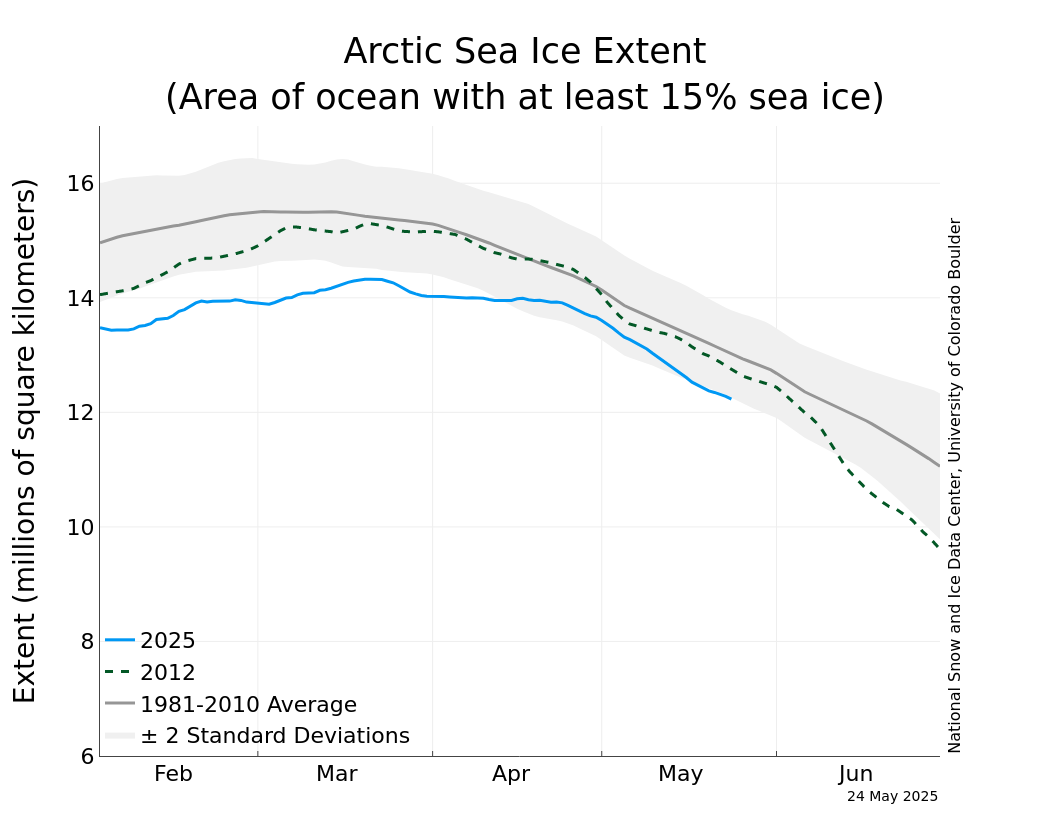
The usual suspects have been making much of the fact that over the last few weeks Arctic sea ice extent (NSIDC daily graph here) has been bumping around the 30 year average for this time of year. John Cook at Skeptical Science posted on the subject last weekend, making the important point that what matters most is not extent or area, but the total volume of ice that’s present — and that’s showing no signs of “recovery”. John’s post is well worth reading, but it set me off on a very interesting trawl through the references he provided — and drew my attention to a most useful graph of ice volume and trend. It also pointed me to research that suggests the Arctic could be effectively ice-free in summer within ten years — possibly as soon as 2013.

Continue reading “Feel floes (gone by 2016)”

There’s nothing quite as sexy as fossil fuels

[youtube]I0oqeJ7a_hE[/youtube]

Slightly off topic, but who can resist two of NZ’s sexiest women having a bit of fun with energy minister Gerry Brownlee, and his plans to mine national parks for more coal? Not me.

Leaked! – NZ talks at Heartland crankfest

BREAKING NEWS: A mole in the Heartland Institute has leaked details of presentations planned for the fourth “International Conference on Climate Change”, to be held in Chicago from May 16 – 18. Over the weekend a file containing a selection of emails between Heartland senior executives and their invited speakers was uploaded to a Russian server, and a link to the file posted in comments at Hot Topic (since removed, to protect the whistleblower). To give you a flavour of the explosive contents, here are extracts in which prominent New Zealand sceptics Bob Carter, Chris de Freitas and Bryan Leyland discuss the talks they plan to give.

Continue reading “Leaked! – NZ talks at Heartland crankfest”

In the land of Gray (and pink)

homer.jpgI have been asleep at the wheel of the good ship Hot Topic, for it appears that I have missed the latest pearls of wisdom to emanate from that grand old man of New Zealand science, Vincent Gray. Vincent’s latest Envirotruth Newsletter (#244) has been a lead item at Climate Realists, and received headline treatment at Mark Morano’s Climate Depot. Michael Tobis even catches Morano describing Vincent as a “UN IPCC Scientist”, which is somewhat stretching the truth, given that his major input has been diligent proof-reading. So what is Vincent’s great revelation? That climate scientists think the earth’s flat.
He starts with a schematic of the earth’s energy budget, and notes:

The attached graph is in all of the Reports of the Intergovernmental Panel on Climate change, and it is fundamental to all their activities.

It assumes that the earth can be considered to be flat, that the sun shines all day and all night with equal intensity, and that the temperature of the earth’s surface is constant.

Then he inserts a later version of the diagram, commenting:

The earth is now thoroughly flattened, as if it had been run over by a cosmic steamroller. […] It ought to be obvious. The earth does actually rotate. The sun does not shine at night. The temperature is not constant. Every part of the earth has a different energy input from its output.

Unfortunately for Vincent, climate science has noticed that we’re standing on a planet that’s evolving and revolving at nine hundred miles an hour, that’s orbiting at nineteen miles a second, so it’s reckoned, a sun that is the source of all our power. And that’s reflected in the calculations. But let’s not let that little truth get in the way of a good story. Here’s Vincent’s coup de grace:

The currently promoted greenhouse theory is dead and its consequences have to be removed at once.

And of course that’s good enough for Climate “Realists” and Scaife-funded Morano. Where’s the peer review when you need it most? Deciding not to stand for the UK parliament, it seems. Dr Gray will be 89 next birthday.

[Big hat tip to Michael Tobis who did all the work, via Stoat]

[Caravan (takes me back, way, way back…)]