

Bum notes from the Brill building (and a question for the minister)

The new chairman of the NZ Climate “Science” Coalition, Barry Brill OBE, is certainly not shy about parading his point of view to the world at large. Brill, a lawyer and former junior minister in the 1975-81 “Think Big” Muldoon government, has attempted to argue with John Key’s science advisor, Sir Peter Gluckman, and last weekend followed in the oversize footsteps of Bob Carter by popping up at denier-friendly Aussie “journal of ideas” Quadrant Online with a lengthy rant on the “Crisis in New Zealand climatology”. Crisis? What crisis? It appears he means the ACT Party beat-up of the shonky analysis by Richard Treadgold and un-named “researchers” at the Climate “Science” Coalition. Brill seems blissfully unaware of the real controversy surrounding this affair, but his article — and its appearance at places such as Watts Up With That— gives me another chance to demonstrate that this whole affair is nothing more than a politically-inspired attempt to undermine action on climate change.


Underpinning this manufactured controversy is one big lie: that the New Zealand temperature record has been important in determining government policy on climate change, and has somehow been influential on a global scale. Here’s Brill:

For nearly 15 years, the 20th-century warming trend of 0.92°C derived from the NSS [NIWA’s “seven station series”] has been at the centre of NIWA official advice to all tiers of New Zealand Government – Central, Regional and Local. It informs the NIWA climate model. It is used in sworn expert testimony in Environment Court hearings. Its dramatic graph graces the front page of NIWA’s printed brochures and its website.

Internationally, the NSS 0.92°C trend is a foundation stone for the Australia-New Zealand Chapter in the IPCC’s Third and Fourth Assessment Reports. In 1994, it was submitted to HadleyCRUT, so as to influence the vast expanses of the South Pacific in the calculation of globally-averaged temperatures.

At the centre of advice to government? A foundation stone for the IPCC? Brill is channelling Treadgold, but doing us the favour of being explicit. He wants us to think that the NZ temperature record is really, really important. The bad news for Brill? It isn’t, and never has been. The New Zealand record is interesting, certainly, but has only ever been a tiny part of the global evidence that has persuaded governments around the world to enact policies designed to address climate change. The truth is that even if the NZ record showed cooling (which it doesn’t), the case for taking action wouldn’t change one iota. However, Brill wants us to believe that warming in New Zealand isn’t real:

First, we know what New Zealand’s average temperature was in 1867. The predecessor of the Royal Society of New Zealand (The New Zealand Institute) made a formal minute in 1868 of:

“Tables, which form the most reliable data for judging of the Climate of New Zealand, are extracted from the Reports of the Inspector of Meteorological Stations, for 1867”.

The mean annual temperature was 55.6F – the equivalent of 13.1C. Now consider this extract from NIWA’s “Climate Summary for 2005”: The national average temperature of 13.1°C made 2005 the fourth warmest year nationally since reliable records commenced in the 1860s.

No change whatever in 138 years! In fact, if 2005 was warmer than most 21st century years, New Zealand has obviously experienced some cooling during the past century or so.

Oh really? Brill is here lifting “work” from none other than Bryan Leyland, which I dealt with in this post in January last year. But for the purposes of further showing Brill to be wrong, take a look at the cover of this book:

Hasst.jpg

This is the cover of a 2005 book from Canterbury University Press. The top sketch was painted by Julius von Haast in 1864, and shows the Cameron Glacier in the Arrowsmith Range in Canterbury. The photograph underneath shows the same scene in 2004. The glacier has retreated more than two kilometres. A lot of ice has vanished. I wonder how that happened? Fairies, perhaps? Or oofle dust? Here’s a photograph of the Cameron taken a few months ago. Still retreating, it would seem. As Jim Salinger noted in his PhD thesis, when commenting on a paper by Jim Hessell which purported to show little warming in NZ since 1930:

However, almost universal occurrence and synchroneity of the warming at 66 out of 70 sites associated with years of profound glacial retreat cannot be explained simply by instrumental or observer error.

We can be confident that New Zealand has warmed not just because the temperature record shows that to be the case, but because the country has lost a huge amount of ice over the same period. The ice melt is confirmation that the process Jim followed when adjusting station records for moves and changes was yielding results that pointed in the right direction.

Brill moves on to thank his supporters:

Piecing together the provenance of the New Zealand historical temperature record has been no easy task. Much of the detail is set out in the Climate Conversation blog. It has involved a myriad of investigative methods but the most productive has been the placement of nearly 50 Parliamentary Questions for Written Answer, for which credit must go to John Boscawen MP. The New Zealand mainstream media, all highly partisan on climate change matters, have evinced little interest in the scandal to date.

Fifty questions to Parliament, about a shonky analysis being given a politically-inspired beat-up? That sounds like an outrageous waste of tax payer funds to me. I wonder which MP will have the nous to ask Wayne Mapp, the minister responsible for NIWA, how much time and money the National Institute of Water and Atmospheric Research has had to expend on answering those 50 questions. Because that’s the legacy of Treadgold, Brill and the ineducable Boscawen — a spectacular waste of time and money.

There’s the real scandal. NIWA and its scientists have been subjected to baseless attacks and smears, and the organisation’s limited resources have been diverted to feed nothing more than the monstrous egos of New Zealand’s climate cranks, who are happily slinging mud as part of an extreme right wing political campaign to persuade the government to drop the ETS. Brill’s fact-challenged rant only demonstrates that he’s the latest in a long line of people prepared to spout nonsense in pursuit of inaction.

[The Animals, doing an appropriate Brill Building song (Mann/Weil)]
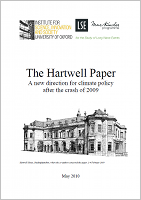
What becomes of the broken Hartwell?

Calls for a radical re-framing of policies to deal with climate change are intuitively attractive — after all, current national and international policies don’t seem to be doing much to curb rising emissions. The latest effort comes from a group of developed world academics brought together by London School of Economics professor Gwyn Prins, and takes the form of The Hartwell Paper [PDF] — a document based on discussions held in February at the English country houseof the same name. It suggests ditching Kyoto and all its structures, and instead tackling climate change with policies that approach the problem more obliquely. The authors claim:

…it is not possible to have a ‘climate policy’ that has emissions reductions as the all encompassing goal. However, there are many other reasons why the decarbonisation of the global economy is highly desirable. Therefore, the Paper advocates a radical reframing – an inverting – of approach: accepting that decarbonisation will only be achieved successfully as a benefit contingent upon other goals which are politically attractive and relentlessly pragmatic.

Sounds reasonable enough at first reading, but my suspicions were roused when I read beyond the executive summary.


Prins et al derive the need for their new approach from what they describe as two watersheds that were crossed in late 2009: the failure of COP15 in Copenhagen to deliver on its promise of a global deal to follow Kyoto, and what they call “an accelerated erosion of public trust [in climate science] following the posting […] of more than a 1,000 emails from the University of East Anglia Climatic Research Unit” last November. Copenhagen clearly did not live up to expectations, and the UN-mediated policy process may well have lost impetus, but the authors go on to assert that the CRU email theft, and the subsequent press furore and investigations means that “the legitimacy of the institutions of climate policy and science are no longer assured”. That, it seems to me, is a very long bow to draw. To see the Hartwell take on the emails applauded by Steve McIntyre and that they approvingly reference Andrew (Bishop Hill) Montford’s book The Hockey Stick Illusion suggests to me that the authors are coming at the issue with their own set of preconceptions — a framing they want to impose on the issue. A look at the author list (Roger Pielke Jr, Nordhaus and Shellenburger from the US think tank The Breakthrough Institute, amongst others) hardly dispels that notion…

When they consider the underlying science, they are at pains to misrepresent what’s going on:

Climate change was brought to the attention of policy-makers by scientists. From the outset, these scientists also brought their preferred solutions to the table in US Congressional hearings and other policy forums, all bundled. The proposition that ‘science’ somehow dictated particular policy responses, encouraged – indeed instructed – those who found those particular strategies unattractive to argue about the science. So, a distinctive characteristic of the climate change debate has been of scientists claiming with the authority of their position that their results dictated particular policies; of policy makers claiming that their preferred choices were dictated by science, and both acting as if ‘science’ and ‘policy’ were simply and rigidly linked as if it were a matter of escaping from the path of an oncoming tornado.

If “the science” has been unhelpful, then this misrepresentation of the message is even more so. The basic message from “the science” is clear enough. There’s too much carbon in the atmosphere, and adding more is going to make life very uncomfortable — all life, not just human beings — in the not too far distant future. Did scientists really bundle this message with “particular policy responses”? Only if reducing carbon emissions can be considered a policy response — but that’s the very response Prins et al seems to want to dance around. Decarbonisation they can countenance, but not now, not quantified. They want to ignore the quantification of the size of the problem we face because it might be inconvenient:

We share the common view that it would be prudent to accelerate the historical trend of reducing the carbon intensity of our economies, which has been a by-product of innovation since the late eighteenth century. However, we do not recommend doing so by processes that injure economic growth, which we think – and the history of climate policy demonstrates – is politically impossible with informed democratic consent.

What if political impossibility is confronting the harsh impact of physical reality? The Hartwell Paper assumes that we have the luxury of time, that we can step away from the progress made over the last 20 years , and somehow recast international policy according to a wishlist of interventions that might (if we’re lucky) set us on the right path. They imply that we need not face reality now, that we should take the Capability Brown approach to a country house, up a winding path that yields carefully framed glimpses of our goal, rather than march straight towards a target defined by our understanding of physical reality.

There is some good analysis of The Hartwell Paper at the Economist (with nice Eno reference), and by Richard Black at the BBC. Both writers suggest that whatever the merit of the Paper’s recommendations, the authors cannot ignore where we are now. We may not want to start from where we are, but we have no choice. In a wider perspective, the Paper is arguing for a bottom up approach to carbon reductions, looking for the low hanging fruit — efficiencies, black carbon reduction — while the Kyoto approach is top-down, starting (with luck) from an informed appreciation of what we would do well to avoid. It seems obvious to me that we need both approaches, at a national as well as international level. Setting a 40% target for emissions reduction by 2020 is just as valid as mandating the use of low energy lightbulbs, or encouraging the adoption of electric vehicles.

Prins, Pielke Jr et al prefer to ignore what we really know about the climate system and the one-way nature of the changes we’re imposing on it (who can put a species back after it’s gone, or reconstruct a coal seam?), adopting instead a high-minded but ultimately wishy-washy stew of policies that look a lot more like sticking plasters than a remedy. And, being a cynic, I can’t resist asking the cui bono question… who might benefit most from the policy mix they propose? I leave the answer as an exercise for the reader.

[Jimmy Ruffin]

An open letter to climate sceptics

Alert readers may have noted my absence over the last few days: Bryan’s been doing all the hard work while I swanned off to Sydney (wedding anniversary, 25th, for the celebration of). And so I’ve been reading the Sydney Morning Herald. Saturday’s edition featured this “interesting” take on the state of denial in Australia, in which a key player — John Roskam, executive director of right wing think tank the Institute of Public Affairs — chortles about the success of his denial campaign. It’s a long article, but the thing that really caught my eye was this succinct poem by John Bryant on page 37 of the Spectrum section:

An Open Letter to Climate Sceptics

Among your loved ones choose
— when the sweet airs fail,
when the rivers run dry —
the hand of whom to hold
until the last breath,
until the last cry.

Sometimes balance is not measured by the number of words.

Ah, I see you have the Wishart that goes “ping”

n Ian Wishart’s lexicon, to “ping” someone seems to mean catching them out in a mistake or false claim. It’s a word he’s fond of using in his regular attacks on Hot Topic, most recently over my post on sea ice volume, and a comment thereunder by William “Stoat” Connolley. My post was “bad science” and I’m a “science illiterate” it seems. Unfortunately, all Ian does is demonstrate that his own science literacy is somewhat limited. His ping, like sonar, comes bouncing right back at him…


My post Feel floes (gone by 2016) was mainly concerned with looking at the issue of whether the Arctic sea ice was “recovering” from the record minimum of 2007. Wishart says it is “recovering strongly for the third year in a row”, but the volume data shows that to be nonsense. Wishart’s main bone of contention, however, seems to be about the impact of sea ice reduction on northern hemisphere climate. Here’s his first misdirection:

Gareth, incidentally, tries to argue in reply that volume is relevant because of the heat exchange to the atmosphere involved in re-freezing water.

My reply made no mention of volume versus area — I was just pointing out that albedo effects (though important) are not the only climate impact to be expected from a reduction in sea ice. The last three years have averaged around 2 million square kilometres below the average minimum over 79-00. That huge area of ice has to refreeze in autumn, and in so doing releases heat to the atmosphere. It seems Ian doesn’t have the foggiest how much is involved.

But here’s some news that evidently they missed over at HT: when ice grows in volume, it’s because sea water is converting to solid ice, with the same heat exchange taking place in regards to the first six inches of ice, the next six inches of ice, and all the ice thereafter. And sea ice grows because it is freakishly cold, and what little heat is liberated in the process is not strong enough to compensate for the cold.

Read that last sentence again: “what little heat is liberated in the process is not strong enough to compensate for the cold.” Time for today’s lesson. The heat required to warm 1 kg of water by 1ºC is a little over 4,000 Joules. The heat required to melt 1kg of ice is 333,550 Joules (aka the enthalpy of fusion) — about 80 times as much. The same applies in reverse — that is, when 1 kg of water turns to ice, it releases 333 kilojoules of energy. Now consider how much extra heat (compared with the long term average) is being liberated by the formation of 2 million km2 of new ice, which over winter will become about 1.5 metres thick. It’s a very big number indeed — my back of the envelope calculation (corrections and precisions welcome — William?) suggests it’s of the order of 11.5 x 10¹¹ GJ (gigajoules). A big number. Let’s halve it, to allow for ice acting as an insulator. Still more than big enough to show up in the figures for Arctic climate. And it does.

Wishart dislikes Skeptical Science almost as much as Hot Topic (he describes John Cook as my alter ego, which is much more flattering to me than John). There’s a recent post there about a new paper describing the feedback loop between summer sea ice reductions and autumn and winter warming (also at Science News). But there’s an earlier paper to refer to, that I’ve written about before: The emergence of surface-based Arctic amplification by Serreze et al (The Cryosphere, 3, 11–19, 2009 – PDF) who examined Arctic climate data up to 2007 and found them to be “consistent with the emergence of surface-based Arctic amplification associated with declining sea ice extent”. There’s a good discussion of what this is and what it might mean for climate and weather in Mark Serreze’s chapter in last year’s WWF Arctic report, discussed at Hot Topic here. In any event, it’s not news. You might have expected someone as au fait with the literature as Wishart to have been keeping up. Or perhaps not…

Still, I did learn something interesting from his post. He’s finished his “Climategate” revision of Air Con, and apparently this “new edition also contains extensive new information on why ocean acidification is not being caused by CO2“. Oh really? That’ll be news to the oceanographers of the world. An excellent excuse for another look at his “work”, perhaps… ;-)

[The hospital sketch (bonus audio edit)]