 First essay in the new Scoop/Celsias/Hot Topic Imagining 2020 series is a thought-provoking vision from Gareth Morgan and John McCrystal of the Morgan Charitable Foundation:
On the eve of December’s Copenhagen conference on climate, all indications are that there will be no legally binding obligations agreed to by nations insofar as carbon emissions are concerned. The inability of civilisations to pre-empt catastrophe is nothing new: history is littered with instances of societies marching steadfastly to oblivion in full knowledge that this is the consequence of their inability to change. Jared Diamond’s book “Collapse” provides a perceptive and sobering historic collation on this topic.
Our genetic code commits us to paths portending self-destruction, albeit this time the threat is on a scale hitherto not encountered. There is no compelling reason to doubt the view that human activity is causing a rise in the atmospheric concentration of greenhouse gases, and that this in turn will lead a rise in global average temperatures, we can expect the effects of climate change to be making themselves felt in earnest in 2020. And we can probably expect the rise in temperature to be faster than the currently favoured predictions, given that most of the new evidence that emerges daily suggests that the world is warming more and faster than had been expected by those who compiled the IPCC’s Fourth Assessment Report.
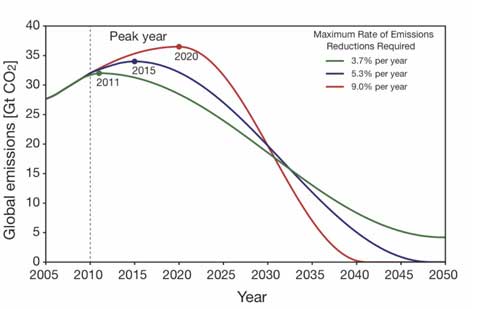
So what – if our disposition for denial dictates we adhere to insufficient pre-emptive action – might be the worst of the scenarios we face in 2020? The rate of growth in global emissions of greenhouse gases will have slowed, but it won’t have reversed, as we so badly need it to have done by then. After the debacle at Copenhagen, it will have taken several years for international accord on meaningful reduction targets to be reached. Some nations will have made great strides in reining in their emissions, and some may even have cut them, but New Zealand, like most other liberal democracies (including the United States), will be lagging behind our commitments. The tough decisions that need to be made will have continued to prove just too tough for politicians eyeing their re-election prospects. Centrally planned economies like China, by contrast, and some of the more socialist European states will have taken strong, concerted action. The worldwide search for truly sustainable energy sources will have begun in earnest as stocks of easily obtainable petrochemical resources have become depleted, sending the cost of energy soaring, and this will be the single greatest contributor to the slowdown in the rate of fossil fuel consumption.
New Zealand, like most other liberal democracies (including the United States), will be lagging behind our commitments.
Nevertheless, the world will already be nearing the maximum ‘safe’ limit of 450 parts per million of atmospheric carbon dioxide by 2020, and emissions will not yet have been stabilised, let alone reversed. The conversation both here and abroad will have shifted from what will be necessary to adapt to a rise in the global average temperature of a couple of degrees over pre-industrial levels to what will be necessary in a world that is four or five degrees warmer.
The retention of greater levels of energy within the climate system will have different effects from region to region. New Zealand will be comparatively better off than some places. Next door, for example, Australia will be losing vast areas of formerly arable land to intractable drought, even as the major population centres on the east coast are hammered by powerful tropical storms in the north and torrential rain events in the south. Desertification in Africa and Central Asia will accelerate. Extreme weather events such as flooding, heavier-than-usual and unseasonal snowfalls and heatwaves will afflict Europe. The hurricane-prone regions of the world — the Atlantic seaboard of the Americas, the Pacific Islands, East Asia and the sub-continent — will find themselves cleaning up after more and more intense storms.
In New Zealand, the west coast of both islands will experience increased rainfall, while eastern areas will see precipitation rates dwindle, both the consequence of a more persistently westerly set to the weather. Ironically, our regional average temperature may have cooled over the decade, which would be of considerable comfort to climate change sceptics if only there were any left outside asylums for the chronically deluded by 2020. More powerful weather systems in the Southern Ocean will drag cold air into our latitudes from Antarctica during our winter, making for some pretty grim winters in the south. But increased precipitation and colder winters won’t disguise the change in the distribution of rain and snowfall, and nor will it be any consolation to farmers who are forced to walk off their dusty holdings in North Canterbury, Marlborough, the Wairarapa, Hawkes Bay and the Far North. The competing claims of conservation, agriculture and recreation will be bickering even more bitterly over water use rights in these areas than they presently are.
Ironically, our regional average temperature may have cooled over the decade, which would be of considerable comfort to climate change sceptics if only there were any left outside asylums for the chronically deluded by 2020.
Fox and Franz Josef glaciers will have spent most of the decade advancing, due to higher snowfalls on the western aspect of the Southern Alps. Meanwhile Auckland will have recorded its first case of locally contracted dengue fever.
Higher rainfalls on the Main Divide in the South Island will make water shortages in our hydro lakes something of a rarity, and this will improve our energy security and reduce the quantity of fossil fuels we consume in energy production. The excess electricity in the grid initially released by the long overdue closure of the Rio Tinto aluminium smelter at Tiwai Point will be mostly offset by 2020 through its increased consumption by the burgeoning national fleet of battery electric vehicles. This will work an improvement in the efficiency and the renewable component of the energy consumed by our transport sector, and this in turn will comprise the major component of the slow-down in the rate of New Zealand’s increase in greenhouse gas emissions. Just behind this will be the impact of measures imposed by the government to improve the energy efficiency of domestic and commercial buildings. The third largest contribution will be the carbon offset earned by the re-aforestation of land that was formerly used for agriculture. But agriculture — particularly dairy — will prove resilient: although New Zealand agricultural products will become steadily more expensive on the world market with the addition of a price premium to reflect ‘food miles’, the reduction of demand further afield will be replaced by increased demand from Australia, whose agricultural sector will be under severe pressure.
Like the rest of the developed world, but more like America and less like Europe, we will have failed to wean ourselves off consumption for the sake of it. Everything on the shelves at the Warehouse will be greenwashed in one way or another — wearing a label proclaiming its environmental virtues — but the full range of crap will still be there. The Warehouse’s red sheds will probably have been re-painted green by then, too. But our terms of trade will be desperate, because while we’ll retain our taste for consumer goods manufactured abroad (our domestic manufacturing industry will, of course, have relocated lock, stock and barrel to China, where its largest market lies), demand for our primary produce will barely have survived the imposition of transport tariffs. Tourism will have fallen away markedly, too, as the international conscience turns against air travel as fast as the price of an airline ticket takes off with the addition of carbon levies, and as our claim to the ‘100% Pure’ moral high ground looks sick in light of our failure to act decisively on controlling emissions.
But never mind all that. Housing will be trucking along, as a new generation of Kiwis assembles a portfolio of renters to let to the huddled masses of climate refugees arriving here from the Pacific and from the poorer parts of Asia and the subcontinent. The prices of beef, lamb and seafood will have plummeted as supplying the domestic market becomes more attractive than exporting.
As we happily contemplate our capital gains, we’ll still find it easy to ignore the environmentalists who will be painting doomsday scenarios around the disposal difficulties arising from all the heavy metals used in electric car batteries. Oh yes — and their urging of politicians to set politics aside and take meaningful action on climate change will still be a bemusing sideshow.
*************The “Imagining 2020″ Series of articles is a creative commons discussion effort coordinated by Scoop.co.nz , Hot-Topic.co.nz and Celsias.co.nz. Contributions are welcome from all comers. Please see the introduction for an explanation of the project and instructions for how to contribute.

 The cranks in the NZ Climate “Science” Coalition have sunk to new lows in a desperate attempt to cash in on the far-right driven furore about the Hadley CRU data theft. Here’s an extract from a press release which was doing the rounds of NZ’s newsrooms this morning:
 The Copenhagen climate conference (