
Climatologist Stephen Schneider has often found himself in the thick of contests, as indicated by the title of his new book Science as a Contact Sport: Inside the Battle to Save Earth’s Climate. He has been engaged in climate science since its early stages in the 1970s and has much to tell about the dawning realisation that global warming was to be the outcome of our emission of greenhouse gases. In fact his first venture in the field as a grad student overestimated the effect of aerosols and predicted global cooling over the 21st century. Deniers still hold this up as indicating that his science is untrustworthy. He on the contrary sees it as evidence that science progresses by continuously correcting its conclusions based on new research.
The function of modelling and the ways models work is a regular topic in the early stages of his story. The question of predicting the future proved to be a thorny one, particularly when the science was newly developing. “If you don’t model, you don’t know anything about the future.” The important thing was to build models on as much relevant data as possible. He explains some of the difficulties encountered and overcome along the way.
Schneider also early began to see that it was important to try to estimate how specific variables – such as drought and flood frequencies and temperature extremes – would change, because they would have major impacts on agriculture, ecology, water supplies, coastlines, and so forth. He insisted that climate scientists had to consider the social implications of what they were researching. In other words science for policy, viewed as suspect by many scientists in the 1970s.
The linking of atmospheric science in partnerships particularly with experts in economics, ecology, agriculture, oceanography and hydrology is a strong thread in Schneider’s story. His interdisciplinary bent was not always welcomed by his peers, but it is very much of a piece with his recognition of the implications of climate change for ecologies and human society. Involvement with the Inuit and other indigenous peoples is a continuing part of his life, and his concern at how climate change threatens these groups in their home environments is firm. “No community should be forced from their home or their culture – whether as tropical reef island or a once frozen tundra.”
He was early pulled into the public arena and took part in a 1981 Gore congressional hearing. He describes in detail the ideological polemics of the Reagan administration representatives at that hearing. His own contribution was guarded and aimed to be constructive. Generally speaking many of his statements in public fora seem cautious and careful not to overstate. It struck me as ironic that he should be held up by the denialist community as an example of one given to exaggeration of environmental threats. Twenty years ago in an interview with a journalist he tried to explain the need to be both effective and honest with the public, which meant conveying both urgency and uncertainty. Selected sentences have since been used as “proof” that he advocates overstatement.
Schneider has played an important role in the preparation of IPCC reports. The size and scope of the enterprise is explained, and the debate that is integral to it. His description is instructive. If ever there was a thorough process this is surely it. And the need to satisfy not just fellow scientists but governments is crucial. He includes a fascinating –- or perhaps horrifying –- account of the four-day meeting at which the text of the Fourth Assessment Working Group II summary for policy makers was approved. The original wording of a key paragraph concluded “with very high confidence” that anthropogenic warming over the last three decades has had a discernible influence on many physical and biological systems. After prolonged debate and manoeuverings, in order to gain the required consensus the meeting had to accept Chinese and Saudi Arabian insistence that “very high confidence” be downgraded to “high confidence”. No science was advanced to justify the downgrade.
Schneider reflects on the ways in which over the years he and his colleagues have been “the targets of personal attacks and subject to false reporting, biased interpretations paid for by lobbies and big business, and other violations of media ethics.” On the question of “balance” which has led to reporting of climate science in terms of two polar-opposite sides he comments that the science is not like this; it is mostly the case of a spectrum of potential outcomes and the scientific assessment which accords them their relative credibility. “Perspective” is a better guide for serious journalism than “balance.”
An interesting sidelight is shed on denier tactics by Schneider’s account of the campaign DuPont sanctioned against the science and scientists who announced concern for the ozone layer in 1985. They sponsored a lengthy visit to the US by a British denier, Richard Scores, who called the ozone-depletion theory “a science fiction tale…a load of rubbish…utter nonsense.” Full page attack ads in major newspapers cited him and others to the effect that it was all theory and no facts and misguided hysterical scientists behind a scare. Schneider comments that it was an object lesson of what was soon enough to come from the coal, oil, and automobile industries over global warming.
I found his memoir a lively and illuminating account of how a new science developed and rapidly proved to be one of overwhelming significance for humanity and the species with which we share the planet. There was plenty of argument between scientists along the way, as his narrative reveals. The science has had to make its way as science should, subject to empirical testing and peer debate. Its findings have carried serious implications for human response and provoked vigorous opposition from vested interests. Schneider himself has been described by Senator James Inhofe as the father of the greatest environmental hoax. He protested in reply that he had a thousand equally deserving colleagues.
The final chapter sums up. Two critical challenges continue. One is the protection of the planetary commons for our posterity and the conservation of nature. The other is solutions to deal fairly with those particularly hard hit by the impacts of climate change and national and international climate policies. Schneider’s coupling of these issues is typical of the book as a whole and the life it recounts. But a troubling disquiet remains. The matter is clouded for the public by ideologists and special interests who deliberately misframe the climate debate as uncertain, recruiting some sceptical nonclimate scientists to back them up and persuading a confused media that little is yet proven. Greed and short-term thinking – “me first” behaviour – motivates them. That is no surprise, but what worries Schneider is how many decent people are still taken in by it. “Can democracy survive complexity?” is the question that keeps him awake at night, he confesses. However it’s not his last word and the book concludes with a plug for honest and transparent dialogue so that we all understand what is really at stake and a consideration of the steps he sees needing to be taken to develop effective climate policy.

 Somehow Kevin Rudd’s climate change
 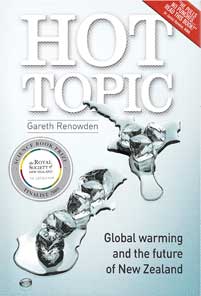 An item of minor import to the world, but some significance to the writer: the PDF edition of Hot Topic is now available for a mere NZ$10 (all the words and pictures, none of the paper, half the original price) from the “