
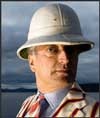
 Scrotum wiped his sweat-beaded brow and shut down Monckton’s computer. The laird, concerned that a decade’s worth of personal emails might be stolen by some Green-fingered socialist geek, had instructed his wrinkled retainer to install “something that the buggers won’t be able to crack” on his laptop, and Scrotum had been pleased to do so. Every time Monckton sent an email, a copy was now automatically forwarded to Climate Con headquarters, where the one they call Gavin would scan them for information. In special circumstances, CC operatives might be despatched to make the Laird’s life a little more difficult than he had foreseen, but the pompous peer’s missives were mainly forwarded around the CC elite to provide a little light relief. However, Scrotum hadn’t counted on Monckton’s evil twin getting in on the act.
Mycroft Monckton, the Laird’s younger brother by some 30 minutes, was a constant thorn in his sibling’s side. While Monckton the elder had been studying classics at Cambridge, Mycroft had skipped university to take up a career setting crosswords for The Times. There were rumours he occasionally took on “projects” for one of the more anonymous offices of the British state, but Mycroft always laughed when taxed with this suggestion, and was given to noting that military intelligence was an oxymoron whatever number might be attached. While Christopher struggled on Fleet Street, and touched his forelock to the Thatcher hem (”No Monckton will ever lick arse”, grandfather “Machine Gun” Monckton used to splutter over his port on one of those long damp Scottish Sundays when his overuse of an ancient Gatling gun had scared the deer into the next glen and winged a few servants, “but they’ll do just about anything else”), Mycroft seemed to make money without effort. Property or shares? He would never say…
Mycroft’s chief delight, in those heady days of Thatcher’s ascendance, was to feed his brother with absurd ideas to put before the PM. There was the matter of the outrigger second hull for the new Type 42 frigate, sketched on the back of a menu at L’Escargot, elaborated by Monckton the elder in a series of papers that made Margaret laugh so much she started calling him “my little Polynesian poppet”. Earned him a gruff bark or two from Dennis, but Monckton didn’t mind. At least she knew he was there.
Latterly, with his brother so deep into his climate efforts — “Got to save the world, you know, Mycroft. Those bloody socialist billionaires and crooked scientists will have us all in penury!” — Mycroft seemed to have been keeping a low profile. But this morning the Laird’s usual eruptive pre-breakfast bellow had been more of a hacking cough, and Scrotum had seldom seen the peer so pale, at least when raptors weren’t around.
“Scrotum.” It was a quiet summons this morning. “How did Mycroft get into my emails?” The laird looked quizzical, a face he normally kept for working on puzzle schemes.
Scrotum nearly fell backwards, his surprise entirely unfeigned.
“I, I, I, er, don’t know, your Lordship. I can’t imagine… What has he done?”
“It appears, you snivelling little wretch, that your security precautions are no better than those at the University of East Anglia. Mycroft must have hacked into my machine, obtained the short opinion piece I was working on for electronic distribution, and altered it. It’s out there on the interweb thingy, over my name, but it has been so deviously and fraudulently altered that it hides my real meaning. Indeed it reads like a parody of my thoughts.”
“May I see it, your Lordship?” Scrotum asked. Monckton gestured at his desk, where the laptop showed the pink portcullis with entwined tutu and pith helmet that was the peer’s favourite screensaver. Scrotum began to read…
This is what they did — these climate “scientists” on whose unsupported word the world’s classe politique proposes to set up an unelected global government this December in Copenhagen, with vast and unprecedented powers to control all formerly free markets, to tax wealthy nations and all of their financial transactions, to regulate the economic and environmental affairs of all nations and to confiscate and extinguish all patent and intellectual property rights.
This is beyond parody, Scrotum thought as he read. The laird’s willingness to find signs of global governance lurking everywhere had caused him trouble before. There was the sad affair in Sweden, when Monckton had attacked Abba for promoting world government based solely on a mishearing of the words of Dancing Queen. Rescuing him from the hordes of drunken blondes had been a challenge.
“In what way has this been altered, your Lordship?” Scrotum asked.
“He’s toned it down, of course. Taken out my reference to UN jackboots crushing the faces of the weak and defenceless rich. It’s a travesty. The Americans will think I’ve gone soft.”
Scrotum read on.
The tiny, close-knit clique of climate scientists who invented and now drive the “global warming” fraud — for fraud is what we now know it to be — tampered with temperature data so assiduously that, on the recent admission of one of them, land temperatures since 1980 have risen twice as fast as ocean temperatures.
“But your Lordship, are not land temperatures meant to warm faster than those of the ocean?”
“Precisely. Mycroft is trying to make it seem that I don’t know what I’m talking about.”
He doesn’t need to try very hard, then, thought Scrotum.
One of the thousands of emails recently circulated by a whistleblower at the University of East Anglia, where one of the world’s four global-temperature datasets is compiled, reveals that data were altered so as to prevent a recent decline in temperature from showing in the record. In fact, there has been no statistically significant “global warming” for 15 years — and there has been rapid and significant cooling for nine years.
Scrotum paused. He could never keep track of how long the world was supposed to have been cooling. Fifteen years seemed rather a long time, and “rapid cooling” for nine years a tad of an overstatement, perhaps it would be better to let this pass, but the peer was clearly incensed.
“You see, Scrotum, you see! Fifteen years! Ten years, eleven years, I have made both claims, but fifteen! This has Mycroft’s fingerprints all over it. He’s sabotaging my credibility.”
Scrotum had to turn aside to hide the grin that was creeping around the corners of his mouth.
Worse, these arrogant fraudsters — for fraudsters are what we now know them to be — have refused, for years and years and years, to reveal their data and their computer program listings. Now we know why: As a revealing 15,000-line document from the computer division at the Climate Research Unit shows, the programs and data are a hopeless, tangled mess. In effect, the global temperature trends have simply been made up.
“This section too, your lordship?”
“This too, Scrotum. Mycroft knows that I have to occasionally exaggerate to make my points — the threat of global climate conspiracy is so great that I have no option — but by putting these words into my mouth he makes me seem hippo, hippo…” He couldn’t get the word out. He was choking on it, turning red.
“Hypocritical, sir?” Scrotum offered gently.
“That too..”
Unfortunately, the British researchers have been acting closely in league with their U.S. counterparts who compile the other terrestrial temperature dataset — the GISS/NCDC dataset. That dataset too contains numerous biases intended artificially to inflate the natural warming of the 20th century.
“These are strong words, sir. Are they yours?”
“Yes, of course they are, but the original was in Latin.” Monckton looked peeved.
Finally, these huckstering snake-oil salesmen and “global warming” profiteers — for that is what they are — have written to each other encouraging the destruction of data that had been lawfully requested under the Freedom of Information Act in the UK by scientists who wanted to check whether their global temperature record had been properly compiled. And that procurement of data destruction, as they are about to find out to their cost, is a criminal offence. They are not merely bad scientists — they are crooks. And crooks who have perpetrated their crimes at the expense of British and U.S. taxpayers.
I am angry, and so should you be.
“What’s wrong with this section sir?”
“Nothing, nothing, just the subtle twisting of the style. He has removed my careful use of the Latin phrase cave canem, and the references to the data being conjured from their computers like the offerings before the oracle at Delphi.”
“Too straightforward then?” Scrotum asked.
“Not enough finesse, Scrotum. Finesse.”
What have the mainstream news media said about the Climategate affair? Remarkably little.
The few who have brought themselves to comment, through gritted teeth, have said that all of this is a storm in a teacup, and that their friends in the University of East Anglia and elsewhere in the climatological community are good people, really.
No, they’re not. They’re criminals.
Scrotum wondered if the laird had originally intended to libel the scientists of the world, or whether this was a Mycroft improvement, but the next section nearly made him choke.
With Professor Fred Singer, who founded the U.S. Satellite Weather Service, I have reported them to the UK’s Information Commissioner, with a request that he investigate their offences and, if thought fit, prosecute.
“Do you see that, Scrotum? He brings Singer into it. Fred’s a charming old buffer, a dab hand at the scientific sleight of hand, but even I wouldn’t use him as a reference. Too much tobacco money under the bridge to be taken seriously in the right circles – though the BBC seem happy enough to put him on. Just shows how standards have fallen there since the great days of the 1980s.” The laird’s eyes were beginning to glaze over.
But I won’t be holding my breath: In the police state that Britain has now sadly become, with supine news media largely owned and controlled by the government, the establishment tends to look after its own.
Police state! Scrotum could see Mycroft’s game. Hook the reader, lead them along, and then leave them gasping for breath. Would Rupert Murdoch take kindly to being portrayed as supine, his media an arm of government. And in a Britain where the Tannochbrae bobby had long since sold his bicycle and taken to riding around in a little white car, never to be seen unless it was closing time at the pub, it was clear that parody was spilling over into farce.
At our expense, and at the expense of the truth.
Scrotum closed the laptop. “Would your Lordship like me to check the security settings?”
“Check them! I want them quintuple checked, all security measures doubled, access to all but me denied. Use the usual password. And then see if you can sniff out how he did it.” Scrotum tugged his forelock and tried to look contrite.
The phone rang. Scrotum picked up the old-fashioned black Bakelite handset. “Tannochbrae Manor, Lord Monckton’s residence.”
“Has he worked it out?” Mycroft’s soft voice was unmistakeable.
“Yes,” Scrotum muttered. “He’s right here.” He covered the mouthpiece. “Your lordship, Mycroft is on the line. Do you wish to speak with him?”
Monckton snatched the phone. “Mycroft, what have you done? Are you trying to ruin me, make me a laughing stock, the butt of jokes around the American elite?”
Scrotum couldn’t hear the reply, but Monckton the elder turned a whiter shade of pale ale. He put the phone down in its cradle. “He’s got the lot, Scrotum. The whole bloody lot. All my email, all my research, the database of misleading references and the address of Fred Singer’s secret floating Kennebunkport lair. Everything. I am in his power…”
Scrotum tried to look serious, but knew his straight face would fail in moments. He took to clearing up the breakfast dishes — the untouched kidneys, black pudding and venison liver faggots gleamed in the morning sun, and all was right with the world.
 This is a guest post by Phil Scadden, a regular commenter at Hot Topic (bio at the end of the post). Phil’s interested in energy issues, and has spent a considerable amount of his personal time developing an overview of New Zealand’s energy issues, inspired by the approach used by Cambridge physicist David MacKay in his recent book Sustainable Energy – without all the hot air. I’m very pleased to say that Phil is making his work available via Hot Topic (PDF
  Who’s this supporting the NZ C”S”C’s idiotic attempt to cast doubt on the NZ temperature record? Why, it’s none other than
  Second essay in the new Scoop/Celsias/Hot Topic Imagining 2020 series is a very positive view from the