 Late last week Richard Treadgold, author and principal promoter of the recent attempt to cast doubt on the long term temperature record for New Zealand, popped up on Hot Topic to leave one of his typically rambling and pompous comments. Regular readers may recall that following the publication of his Climate Conversation Group/Climate “Science” Coalition “paper” last year, I told Treadgold (after a similar long comment) that he was no longer welcomeat Hot Topic:
Until you are prepared to withdraw and apologise for the incompetent analysis you released, and specifically apologise to the scientists whose good name you have felt free to smear, I will be forced to conclude that you remain a liar and a charlatan.
Until such an apology and withdrawal is made you are not welcome here.
His report has not been withdrawn, and no apology has been forthcoming. He therefore remains unwelcome here. I reminded him of this in an edit to his comment last week (the first he’s made since December), and deleted two subsequent attempted comments.
If you’re going to join the conversation at Hot Topic, you have to play by the house rules. Some of them are reasonably flexible — I like people to be polite, but I’m not too fussed if the language or argument are robust — but there is one thing that I don’t tolerate, and that is the casual smearing of working scientists, most of whom are in no position to defend themselves. Reputations are hard won things, and can be lost in a flash. Playing vicious politics with people’s careers is the worst aspect of the current campaign to delay action on climate change, and it’s a tactic Treadgold seems to have adopted with relish. Let’s look again at the CSC/CCG report Are we feeling warmer yet? and review some of his recent blog posts.
In a post titled Apologise? Why? back in February, Treadgold appeared to have forgotten my earlier remarks, and asserted that “there’s no reason for us to apologise”. Following my deletion of his comments last week, he posted this:
From the response, you’d think we’d committed a crime. The only crime I can identify is a certain bunch of public so-called “servants” in charge of NIWA engaging in pervasive obstruction and citing references to us and the New Zealand public which proved to be entirely empty. They said the material we sought was there and it was not there.
One day soon they must account for that. They must also account for misleading their minister in guiding him to false replies to the Parliament.
Note the language and the allegations, which border on the defamatory. A couple of days later, he attempted a tactical revision of history in this post, claiming that his paper had been misinterpreted:
The sceptics shouldn’t look to our paper to refute local warming, because it doesn’t. It presents no evidence on the quality of the national temperature graph — it merely questions the data, expresses strong doubts about their accuracy and wonders what adjustments were made to them.
What does the paper actually say?
- …the oldest readings have been cranked way down and later readings artificially lifted to give a false impression of warming…
- We have discovered that the warming in New Zealand over the past 156 years was indeed man-made, but it had nothing to do with emissions of CO2 — it was created by man-made adjustments of the temperature. It’s a disgrace.
- Using NIWA’s public data, we have shown that global warming has not yet reached New Zealand (and what does that say for global warming?).
[My emphasis]
No misinterpretation at all. The paper was designed to make the public and the world believe that there were “problems” with the NZ temperature record, that there was no real warming. The press release that accompanied the paper was quite clear about it. Here’s the headline and opening sentence:
NZ climate scandal: NIWA “adjusts” records to show warming
New Zealand may have its own “Climategate”, including manipulation of temperature readings […] researchers claim that temperature readings from seven weather stations throughout New Zealand have been adjusted to show a higher degree of warming than is justified by a study of the original raw data.
And what was that about not supporting “no warming”? Here’s the press release again:
Spokesman for the group, Richard Treadgold, said that recent claims that New Zealand is warming have been proved wrong. “Official information clearly shows that temperatures in New Zealand have actually been remarkably stable since 1850.”
And here’s the attempt to smear Jim Salinger…
“NIWA’s official graph (done originally by Dr Jim Salinger, who features also in the emails leaked from the Climatic Research Unit of the University of East Anglia) shows considerable warming, which they give as 0.92°C per century, saying this is consistent with global warming over the 20th century. But the actual temperature readings taken from the thermometers show an almost flat trend for 150 years.
Back to Treadgold’s attempt to rewrite history. Later in that post he dismisses calls for an apology:
Those apologists for NIWA who complain about our paper smearing the reputations of their scientists should reflect on this: that these changes were made in secret, are still, today, undisclosed (Hokitika has apparently been fully described, but we have not finished checking it) and, by NIWA’s own admission, these changes introduce warming to raw data that show no warming and NIWA have refused requests for them from bona fide scientists for decades.
That really is a disgrace.
The disgrace is Treadgold’s. Adjustments were never made in secret, the raw data is available, and the techniques used to combine station records are well-established in the literature and in the public domain. NIWA last communicated with the Climate Science Coalition on the subject of the adjustments made when homogenising station records in 2006, when Jim Salinger exchanged emails with Vincent Gray. Gray reviewed the CSC/CCG paper before release, according to Open Parachute blogger Ken Perrott, who has been diligently attempting to hold Treadgold to account in comments at his site. Here’s Treadgold, prompted by Perrott, talking about Gray’s review:
Please don’t use Dr Gray’s comment allegedly admitting a mistake. He was being his normal conservative self and I disagree with him. He, being a scientist, found it hard at first to grasp the essentially political objectives of our paper and looked at it from the normal scientific point of view. So he was of the view that we should be describing error limits, doing statistical analyses and quoting learned papers.
Those techniques were no help to us – they weren’t even necessary. We set out simply to motivate scientists to talk to us for the first time in 30 years.
Revealing, eh? The paper is admitted to be “essentially political”, so normal rules don’t apply. Let’s ignore the science, let’s not do the hard yards to understand the subject, let’s just fling mud. And then expect the scientists to cooperate…
This whole affair has never been anything other than a thinly disguised propaganda exercise, designed to capitalise on the noise about stolen CRU emails toplay politics in New Zealand. That it has been jumped on by parliamentary sceptics like Rodney Hide and John Boscawen is perhaps not surprising, given the fawning treatment of ACT and its luminaries by Treadgold. Here’s an exchange in comments at Treadgold’s blog this morning, apparently between Hide and Treadgold:
Hide: And on the basis of these numbers, and this advice, the government has committed to an ETS that will cost NZ conservatively a billion dollars a year.
We need to hold NIWA to account. Good work!
Treadgold: Yes, one’s tempted to call it shonky, but it isn’t. The ghastly thing is that AGW was created and the ETS introduced in the full light of consciousness to achieve ideological objectives.
We’re fortunate to have in high places men like you with the courage to speak the truth and to question error.
Thanks, Rodney.
Hide’s comment (if it really was Hide) is remarkable. Neither this government or the last committed to an ETS solely on the basis of NIWA’s New Zealand temperature record. The NZ numbers are just one tiny part of an immense jigsaw of evidence handily summarised by the IPCC, and accepted by every government involved in the IPCC process. Even if New Zealand were cooling, it would have no discernible impact on the global picture, either on the need for emissions reductions or for policy to encourage those reductions. The NZ temperature record is interesting — fascinating, even — but it is not crucial to anything, let alone national or international climate science or policy. And that fact, perhaps more than anything else, is what shows Treadgold to be little more than a tawdry propagandist for inaction.
Meanwhile, the taxpayers of New Zealand might want to know how much of NIWA’s time has been wasted dealing with frivolous freedom of information requests and ACT questions in Parliament. NIWA time is public money, and Treadgold and his courageous friend Rodney are wasting buckets of it. Perhaps there might be scope for a question in Parliament…?
Finally, unless and until Treadgold withdraws his paper, apologises for the attempt to mislead the public, and for the direct smears on Salinger and the scientists working at NIWA, he will take no further part in the climate conversation at Hot Topic.
[Elton John, before hair transplant]

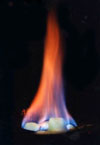 The latest estimate of methane release from the shallow seas off the north coast of Russia — the East Siberian Arctic Shelf (ESAS) — suggests that around 8 teragrams per year (1Tg = 1 million tonnes) of the gas are reaching the atmosphere. This is equivalent to previous estimates of total methane release from all oceans. The study, led by Natalia Shakhova and Igor Semiletov and published in this week’s Science (Extensive Methane Venting to the Atmosphere from Sediments of the East Siberian Arctic Shelf, Science 5 March 2010, Vol. 327. no. 5970, pp. 1246 – 1250 DOI: 10.1126/science.1182221), is based on fieldwork over 2003 – 2008. Over 80% of the bottom water over the ESAS was found to be supersaturated with dissolved methane, and 50% of the surface water. More than 100 “hotspots’ were discovered, where large quantities of methane are escaping from the sea-floor. Here’s Shakhova discussing the paper’s findings in a University of Alaska Fairbanks video (press release):
 Fred Pearce is obviously unrepentant over the unjust treatment he meted out to Phil Jones in his unfortunate series of artices on the UEA emails, one of which I commented on