
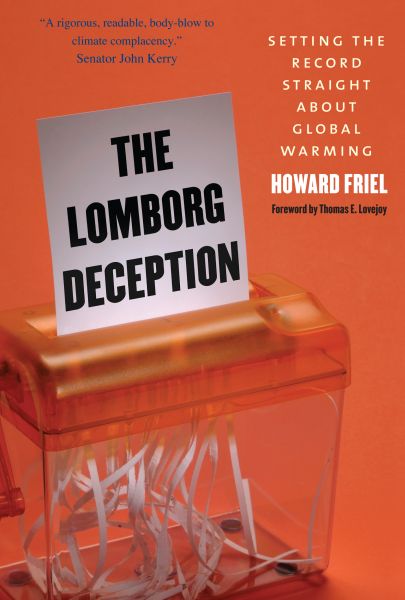
Is it worth spending a whole book dissecting the writing of Bjørn Lomborg, the “skeptical environmentalist”? Certainly not in terms of the quality of Lomborg’s argument, which simply doesn’t stand up to scrutiny. But Lomborg’s writing has been permitted to exercise a widespread and harmful influence. For that reason Howard Friel’s painstaking book The Lomborg Deception: Setting the Record Straight About Global Warming represents time well and usefully spent.
Friel identifies two strains in Lomborg’s work: his “theorem”, that though global warming is happening and is human-induced it is far from a catastrophe; his “corollary” that there is therefore little need to incur the costs of reducing greenhouse-gas emissions to the extent urged by concerned experts. Friel concentrates on Lomborg’s two books The Skeptical Environmentalist: Measuring the Real State of the World (2001) and Cool It: The Skeptical Environmentalist’s Guide to Global Warming (2007). The first book covered a range of environmental concerns presented as an exaggerated “litany” of bad news generated by environmentalists. The second focused exclusively on climate change.
Friel spends most of his space on a detailed examination of Cool It. Lomborg has no hesitation in claiming that scientists exaggerate the effects of global warming, and has a large number of end notes supposedly backing his claims with reference to the sources of his evidence. By examining those supporting notes and citations in considerable detail Friel exposes the flimsiness of Lomborg’s claims. They are grounded, to say the least, in bad data. Indeed if Friel’s tracking of the referencing is accurate they are hardly grounded at all.
Take Lomborg’s claim that there will be only 12 inches of sea level rise this century. Of this he attributes 9 inches to thermal expansion. He references the 9 inches to Figure 10.6.1 in Working Group 1 (WG1) of the 2007 IPCC assessment report (AR4). No such figure can be found, says Friel. But assume Lomborg meant Section 10.6.1. It contains three projections (using three SRES scenarios) of thermal expansion. They range between 4 and 15 inches. Lomborg apparently chooses a rough median and presents it as an unwarrantably precise estimate.
The remaining 3 inches of Lomborg’s 12 inch rise come from melting glaciers and ice caps. Here he references Figure 10.6.3 in WG1 of AR4. Again there is no such figure, and he probably meant Section 10.6.3 titled Glaciers and Ice Caps; nowhere in it or its subsections can Friel find any substantiation of the 3 inches claim. Lomborg then referenced a claim that Greenland is expected to contribute 1.4 inches by itself to, we assume, Section 10.6.4. With its subsections it spans five pages, which do not report any 1.4 inch expectation from Greenland. Lomborg’s further claim that Antarctica will be accumulating ice as a result of increased precipitation and consequently contribute a 2-inch reduction in sea level rise is also referenced to Section 10.6.4 which offers no such report.
“Thus,” writes Friel, “Lomborg referenced only these IPCC figures to itemize his assertion of a one-foot sea-level rise, even though none of these sources can be found in the IPCC assessment report.”
Friel finds similar loose sourcing to most of Lomborg’s claims. Polar bears are not threatened. Climate change will reduce human mortality due to an offsetting reduction in cold-related deaths. Extreme weather events will be much fewer than predicted by environmentalists. The WHO exaggerates excess fatalities due to global warming. Food concerns related to global warming are vastly overplayed – “we will be able to feed the world ever better”. $4 billion annually will be enough to bring water and sanitation to those in the world who lack these essential services.
Friel offers frequent useful statements of the scientific consensus on many of these issues against which Lomborg sets himself as an authority empowered in some extraordinary way to see the exaggeration of which he asserts a large scientific community is guilty.
The role of the IPCC, as set out in 1988 by the UN Environment Programme and the World Meteorological Organisation, emphasises scientific objectivity, policy neutrality, balanced geographic representation, and consensus. By the time its reports are issued, Friel comments, one might conclude that its product would embody a scientifically sound consensus middle ground among its 2,500 contributors and reviewers. He marvels that Cool It, which reflects none of these characteristics and which throughout asserts unsubstantiated claims that are completely at odds with the IPCC consensus can yet be described as representing “the practical middle” (Wall Street Journal) or “the pragmatic center” (New York Times). Lomborg has successfully competed with the IPCC in the US. Friel provides a telling analogy: “…the favourable coverage of Lomborg and his books are to global warming what the triple-A ratings for mortgage-backed securities were to the US financial system – misguided seals of approval with catastrophic consequences.” More catastrophic, he notes, in the case of climate change than in the case of financial systems which can presumably be repaired. His verdict on the part played by publishers and journalists: “Lomborg’s success largely reflects an ability of elite publishing houses and news organizations to contruct an alternative but counterfeit network of knowledge about an issue of the highest public importance.”
In the light of his thorough scrutiny of Lomborg’s claimed sources Friel considers it legitimate to maintain that Lomborg’s books are an assault on science, as Scientific American did when it convened a forum of distinguished scientists to write a rebuttal to The Skeptical Environmentalist in 2001. Friel reports this and other authoritative responses to Lomborg’s earlier book in some detail. He also asks whether the success of Lomborg’s books in a cultural sense is a manifestation of a broader “assault on reason”, described by Al Gore in his book of that title as a systematic breakdown of rational consideration of the major challenges facing the US and the world.
There’s probably little reason to expect that a book like Friel’s will put a dent in the popularity Lomborg commands. Denial is rampant at present. And the book is not a light read. However it has elicited a lengthy response from Lomborg himself, to which Friel has replied on his publisher’s website. He comments there that his previous experience in the hermeneutics of deception mostly dealt with books and texts that sought to justify war. “Lomborg’s books are no worse then those, but they are no better. Perhaps twenty or fifty years from now, if and when the fuller impacts of man-made global warming are more apparent, people might argue that they were worse. This is because at least wars usually end whereas global warming past a certain point probably won’t.” Which is all the more reason to persist with trying to focus public attention on the real science and expose the falsity of confident deniers and delayers. And good reason to welcome what Howard Friel’s book has contributed to that exposure.
 Fifth contribution to the Imagining 2020 series of essays comes from
  Blenheim company Aquaflow which works on the production of bio-fuel from algae, and whose progress Hot Topic has reported on several times (follow the Aquaflow tag) has announced a new venture, this time in the US. They will be working with a Honeywell company at an industrial site in Hopewell, Virginia. The aim of the project, supported by a $1.5 million cooperative agreement with the US Department of Energy, is to capture CO2 from exhaust stacks and use it to enhance algae growth in nutrient wastewater from the manufacturing facility.