
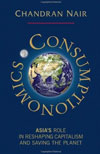
 Business pages don’t often carry articles about the need to forsake the growth model. I was somewhat startled to come across one prominent in the NZ Herald business supplement last week. Journalist Chris Barton wrote about the ideas of Chandran Nair, author of Consumptionomics and a speaker at this year’s Auckland Writers & Readers Festival There’s a Kindle edition of Consumptionomics so I was able to read it over the next couple of days, which I did with considerable interest.
Nair, a Malaysian of Indian descent, is founder and chief executive of the Asian think tank Global Institute for Tomorrow and writes for Asian audiences. His basic intent in Consumptionomics is to urge Asian countries not to follow the pattern of Western models of economic growth, consumption-driven and built on the exclusion of environmental and social costs. While the West may have got thus far by leaving those costs out of account there is no way in which the much larger populations of Asia can aspire to the same kind of economic development. The economic model only more or less worked when a relatively small proportion of the world’s population was using it, and then only by excluding the long-term damage to the world’s environment which now confronts us. It is folly to think that consumption-driven capitalism can be realised across the vast populations of Asia. Instead he calls for sustainable ways of living which will pass on to future generations an environment with rainforests, with biodiversity, with adequate resources, with fish in the oceans, with cities that are a pleasure to live in and with a climate that is not running out of control.
 There’s no reason why facing up to the challenge of climate change should not result in wide benefits to human society, including economic benefits. That’s the argument of the multiple authors of Reframing the Problem of Climate Change: From Zero Sum Game to Win-Win Solutions. The book is based on papers presented at a 2010 international conference in Barcelona. They cover a wide range of topics and disciplines but centre around the proposition that it is a mistake to think of action on climate change as though gains can only be made at the expense of losses.

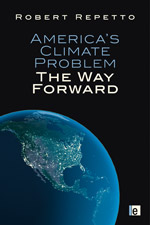 America is much better in technology than governance. That’s the sentence that leapt out at me and remained prominent throughout my reading of economist Robert Repetto’s book America’s Climate Problem: The Way Forward. I sought the book for review because, although its focus is on the US, what happens there will crucially affect the rest of us, in terms of both the level of greenhouse gas concentrations in the atmosphere and the likelihood of international agreement to limit them. The book doesn’t exactly inspire hope on either count, but it is constructive in the path it suggests for the US to follow and puts the ball squarely in the court of the policy makers.