NZ regions planning for climate change

I opened the latest Environment Waikato news update to discover that a Regional Policy Statement (RPS) is due, ten years after the last one. As I thumbed through the publication a heading leapt out at me: “Our climate is changing, so we must too.” Underneath came this statement:

“Even if all greenhouse gas emissions were stopped now, we will still be affected by greenhouse gas emissions already in the atmosphere, and will need to adapt to changes for generations to come.”


Following paragraphs mentioned some of the specifics for our region.  It was comprehensive. Agriculture and forestry, our major commercial land uses, could be directly affected by climate change and climate policy. We can expect rising sea levels, more extreme weather, more droughts in the east, more intense rain and increased winds in the west, warmer, drier summers, milder winters and shifting seasons, increased risks from natural hazards such as river and coastal flooding, coastal erosion and severe weather.

Examples were then given of the kind of responses Environment Waikato will focus on. Flood management, the use and development of natural resources, planning, building regulations, infrastructure design and location. All sensible and appropriate.

I was pleasantly surprised by the prominence being given to climate change in the policy statement. It is listed as the second of six key issues facing the region, the first of which is the pressure being put on natural resources.  The third issue is energy sources, and here again reference to climate change and the need to cut carbon emissions figures strongly. Even in the fourth issue, land use, the question of carbon footprint gets a look in.

Encouraged, I went looking for other regions’ ten-year plans. Not with a great deal of success.  However I found Greater Wellington’s which was approved last year. It too identifies climate change as a key issue (page 29). It was more discursive than Waikato’s, and introduces mitigation more prominently. What it seeks:

“A resilient community that, as far as possible, is reducing its greenhouse gas emissions to mitigate the effects of global warming, but is also adapting well to any changes caused by climate change.”

Among the likely changes it points to are increasing drought in the Wairarapa, increases in storm intensity across the region, increased fire danger and the serious implications of sea level rise for coastal areas.

In relation to mitigation measures it finds space to respond to the argument that because New Zealand is so small Wellington shouldn’t worry about reducing its emissions but simply concentrate on adapting to whatever results from the rest of the developed world’s activities:

“The countering argument is that if, to achieve a liveable future, we wish to persuade the rest of the developed world to mitigate the effects of global warming, we only acquire the moral right to do so by doing our bit.”

The counter argument seems to have won out, for the document goes on to set out the response of the regional body to the climate change issue:

“Greater Wellington is currently working with the city and district councils in the region and around New Zealand, and is leading the region’s planning for dealing with climate change. Local authorities have agreed to work collaboratively on developing goals and a shared plan for the region to reduce the region’s greenhouse gas emissions. We will also take the opportunity to develop strategies to support our communities to be resilient and adapt to the effects of climate change.”

It details steps which are under way or planned. Prominent  amongst them is the identification of potential renewable energy options for the region, such as marine and solar, and the intention to make Greater Wellington-owned land available for private developers to construct wind farms at Puketiro in the Akatarawa Forest and Stoney Creek in the Wairarapa.

Whether these two regional councils are representative of the long-term thinking of all the regions is unclear. Auckland’s planning is on hold pending the new governance set-up there. Canterbury, the other major centre of population, surprisingly doesn’t seem to address climate change specifically in its draft statement or identify it as a major issue. However, the major attention given to the matter in the Waikato and Wellington statements indicates that it is becoming integrated into their thinking and that they are being guided by the predictions of the science.  The Waikato draft notes that New Zealand’s response in terms of actions to reduce climate change is primarily a central government rather than a local government role, but nevertheless expresses some interest in emissions reduction within its bailiwick, particularly in relation to renewable energy generation and more climate-friendly transport. Wellington is quite bullish on the contributions it can make to mitigation as well as adaptation.

It is clearly worth keeping an eye on local government while agonising over the continuing evasiveness of central government.  Engagement with adaptation issues locally must surely impress people with the reality of climate change and the need to mitigate further damage. There’s an irony that the Minister of Local Government, Rodney Hide, should be a vocal climate change denier who laments what he describes as the massive costs inherent in climate change policy. He even goes so far as to say that the policy is designed to upend society and stifle industrial processes and progress. Fortunately there are limits to his authority.
Prepare for business as unusual

[youtube]cJ-J91SwP8w[/youtube]

Here’s something thought provoking for a Friday: The ultimate roller coaster ride: a brief history of fossil fuels, a five minute encapsulation of humanity’s flirtation with coal and rock oil. Narrated by Richard Heinberg of the Post Carbon Institute, animated by Monstro Design. Worth five minutes of your day.

Merapi, volcanoes and cooling

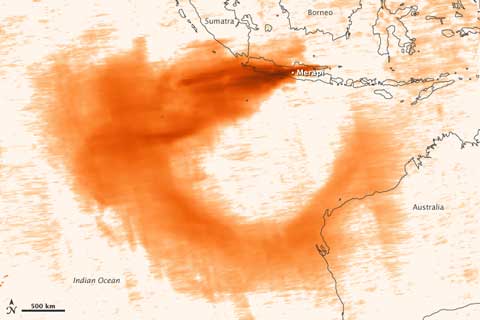
Back in April, when Eyjafjallajökull in Iceland was erupting and causing much disruption to air travel in Europe and the North Atlantic, there was some concern that the volcano’s ash and aerosols could cause global cooling. As I said at the time, there was little chance of that happening because volcanoes need to be near the equator to cause global cooling events. However, we now we have an eruption in Indonesia that has the potential to cause a noticeable global cooling. Merapi is Indonesia’s most active volcano, and the eruptive sequence which began at the end of October has already killed at least 153 people and emitted a considerable amount of sulfate aerosols as this NASA Earth Observatory image shows:

merapiso2_omi_2010312.jpg

At the time of writing the eruption was showing signs of easing off, and the amounts of sulfur emitted to date haven’t been sufficient (or reached high enough altitudes) to cause a significant cooling. However, as Jeff Masters notes, Merapi’s volcanic history indicates that it is capable of very powerful eruptions which could mimic or exceed the Pinatubo eruption in 19941991 which caused a 0.5ºC cooling over the following 18 months. As ever, the best place to follow events is at vulcanologist Erik Klemetti’s Eruptions blog (note: new web address). Definitely one to watch.

Island life

The small Pacific Island states are doing their best to keep the developed world aware of what is happening to them and other vulnerable states under the impacts of climate change. Kiribati this week hosted the second session of the Climate Vulnerable Forum, a forum initiated by the Republic of the Maldives in 2009 to bring together countries that were particularly susceptible to the adverse impacts of climate change.

Nineteen nations, both small island states and larger economies, attended this week’s Tarawa Conference and after what sounded like tough negotiation agreed on the Ambo Declaration, named after the village in Kiribati where parliament sits. It’s not a legally binding agreement, but is intended for presentation at the upcoming Cancun conference.


The text of the Declaration has not at the time of writing been published. It will appear on the climate change website of the Office of the President of Kiribati but in the meantime the news report provided there summarises it:

“The declaration covers the urgency of addressing the immediate effects of climate change, the need for fast funding to combat these concerns in vulnerable nations, and agrees upon an aim to make concrete decisions at the meeting in Mexico kicking off late this month.”

It doesn’t sound startling. Kiribati President, Anote Tong, said the meeting tried to focus on where delegates would find agreement “rather than fight and debate over our different positions”. The Maldives Minister for Foreign Affairs, Ahmed Naseem, facilitated the meeting and spoke of the need to negotiate when a clause gives even marginal reference to a sensitive issue.  He instanced the sensitivity of such questions as how emissions are limited and how they are monitored without infringing a country’s sovereignty.

One has to feel for the predicament of the vulnerable states. What they most need, and must strongly call for, is a legally binding international agreement which will drastically reduce greenhouse gas emissions. But they also need help from the countries most responsible for emissions to enable them to cope with the changes they have begun to experience and are set to get worse.

This double bind is reflected in the somewhat convoluted comments of President Tong to reporters at the conference:

Tong told reporters he was still pushing for a legally binding agreement treaty to promote long-term action to reduce greenhouse gas emissions – a bid that was snubbed at last year’s summit in Mexico in favour of the Copenhagen Accord.

However, he knows this is a big call and would settle on short-term solutions and dedicated funding boosts.

“It’s unrealistic to think that we can resolve these issues in a couple of sessions; it’s going to take the next few decades,” Tong said.

“There are certain issues which must not take that long.

“The longer we wait the more costly it’s going to be.”

However there was more to the conference than the Declaration. The President said in a Radio Australia interview before the conference opened:

“I think this will be the first opportunity for the large countries to actually see first hand what it is we have to contend with. To actually experience the high tides and the very marginal rise in elevation and land when the tide is coming in at the very highest level. And so this is an experience which not many people truly understand, and hopefully this will be an opportunity for, particularly the countries which are making the largest contributions to greenhouse gas emissions to truly appreciate what it is we are talking about.”

Asked by the interviewer to enlarge on the differences which he was hoping the conference might find a way round he replied:

“Well we continue to argue, vulnerable countries, about our survival. The developing countries, the large developed countries continue to argue about economic growth, the poverty and what have you. I think we must believe that there are common grounds, we must believe that there is a way forward.”

The interviewer noted that in Kiribati people are having to move further and further inland because of the inundation of water on their produce gardens. She asked how much further inland they can keep going before there’s nowhere else for them to go. Tong replied:

“Well that’s precisely the point, there is no inland for us. But I think this is also something that we want to demonstrate, that in some parts of the island you throw a stone and you actually hit the other side of the island. So there is no inland. And these are the issues and these are things that we want people to be able to appreciate.”

The interviewer asked whether this means there’s now is a need for more talk about environmental refugees, suggesting that what he’s saying is that the people on Kiribati will have to move eventually.

“Well I always make the point that I reject the notion of environmental refugees. I think what we want to be able to be prepared for is all possible eventualities, one of which may be the need to relocate our people. And in order to relocate we must begin to address these issues now, and part of the process of addressing them is referring for that process. And so it requires a very well planned and a long-term process. If we know it’s going to happen, we have the time to plan it, then there is no reason why we should not begin planning it now.”

That’s the ultimate in adaptation. But if we won’t listen to the call for no more than a 1.5 degree global temperature rise or 350 ppm carbon dioxide in the atmosphere justice will demand that we at least enable such relocation as proves necessary.

[youtube]GDMpmRjCIQE[/youtube]

[Divine Comedy]

NZ glaciers holding their own (just)

NIWAParkPass2010.jpg

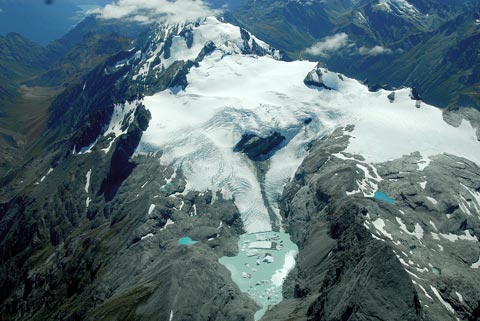
New Zealand’s glaciers just about held their own over last summer, showing a very slight gain in mass on average according to NIWA’s annual end of summer snowline survey, released today. The Park Pass glacier (above) in the Mt Aspiring National Park between the Hollyford Valley and the head of Lake Wakatipu (map) is one of the 50 index glaciers in the NIWA survey. From the press release:

“A moderate El Niño developed in the tropical Pacific in spring last year. This brought more southwesterlies, with normal to below normal temperatures through last summer and into autumn this year. The overall effect was to hold snowlines in a near steady state this year,” says [NIWA scientist] Dr Hendrikx. The previous two years (2007–08 and 2008–09) had seen end-of-summer snowlines rise significantly as not enough snow fell to compensate for melting.

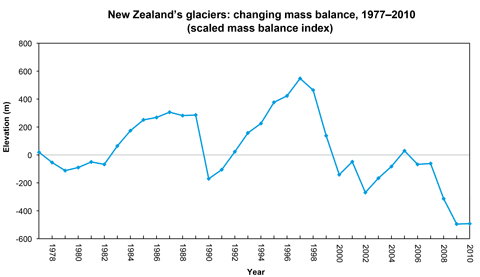
The impact of the El Niño shows as a (very) small uptick at the end of the ice mass graph, but the overall trend remains strongly downwards.

NIWAglaciermassbalance2010.gif

The full report (with lots of pictures from the aerial survey) can be downloaded from the NIWA web site. The Park Pass photo above was taken on March 6th this year on the fourth leg of NIWA’s alpine flight, and shows some spectacular icebergs in the proglacial lake. The extent of the glacier’s retreat can be seen in the Google Earth imagery at Mauri Pelto’s From A Glacier’s Perspective blog post on the nearby Donne Glacier. With a strong La Niña now influencing weather patterns in NZ, it’ll be interesting to see how the glaciers fare. I wonder if I can blag a seat on the 2011 flight? ;-)