
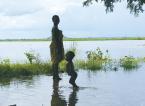
As we watch the devastation of the Queensland flooding it’s timely to be reminded of climate change impacts being experienced and anticipated in other parts of the world. In the latest issue of The Scientific American three researchers have written an article — Casualties of Climate Change — in which they suggest that climate-forced migration and displacement may be the defining humanitarian challenge in coming decades. They begin with some general observations on the threat of rising sea level not only to small island nations, but also to a country like India where a metre of sea level rise will displace 40 million people. South Asia is in addition particularly threatened by the likelihood of more intense rainfall – more monsoon rain combined with a decrease in frequency is what some models are suggesting. Shifts in seasonality of river flows as glaciers shrink is also likely to impact on the agricultural livelihoods of several hundred million rural Asians, as well as the food supplies of an equal number of Asian urbanites.
There’s a lot to understand yet, but the increase in climate-related catastrophes is already a fact.
“The frequency of natural disasters has increased by 42 percent since the 1980s, and the percentage of those that are climate-related has risen from 50 to 82 percent. The United Nations Office for the Coordination of Humanitarian Affairs and the Internal Displacement Monitoring Centre estimates that in 2008, climate-related calamities drove 20 million people from their homes—more than four times the number displaced by violent conflict.”
The article then selects and comments on three regions of the world where there are initial signs of population movements impelled by climate change: Mozambique, the Mekong Delta, and Mexico and Central America. The writers look briefly at the factors which are at work in each region to cause relocation of population, treating them as case studies which might spur further analyses of regions where mass migrations are likely to occur.
In 2000, 2001 and 2007 disastrous floods in the Zambezi and Limpopo river basins in Mozambique displaced hundreds of thousands of people. In the past people have moved periodically out of the floodplains to avoid floods, but in this last decade as the severity and frequency of flooding has increased the government has encouraged permanent resettlement and has initiated a work-for-assistance programme to help the resettlement. The resettlement schemes remain heavily dependent on governmental and international aid however because of the lack of infrastructure and frequent crop failure in the areas to which people have been moved.
Mozambique is threatened by a double whammy, flood in the north and drought in the south, as the climate turns ever more unforgiving. They can be simultaneous, as in 2007 when the south was in drought even as the Zambezi further north was overflowing its banks. Models suggest that rainfall levels may increase in the north while decreasing in the south. Much depends on the spacing and intensity of the rainfall: further intensification will mean a continuation of the catastrophic flooding experienced throughout the past decade. Without continuing humanitarian assistance it appears likely that resettled people will need to migrate longer distances or across borders – the capital city Maputo or the neighbouring South Africa are the most likely destinations for such population movement.
The Vietnamese portion of the Mekong Delta is home to 18 million people, or 22 percent of Vietnam’s population.
“It accounts for 40 percent of Vietnam’s cultivated land surface and more than a quarter of the country’s GDP. Its residents grow more than half of Vietnam’s rice, produce 60 percent of its fish and shrimp haul and harvest 80 percent of its fruit crop.”
All that is under threat. A one metre sea level rise this century would displace 7 million people in the Delta, a two metre rise 14 million, or 50% of the Delta’s population. Flood cycles are part of life in the area, and ‘nice floods’ range between half a metre and three metres. In recent decades however both the frequency and magnitude of floods exceeding the four-metre mark have increased. This has already led to migration by some to cities. The government is furthering a programme to adapt farming methods to the changes, and to relocate some of the poor landless to new residential clusters, but clearly there is a prospect of large population displacement ahead.
In Mexico and Central America it’s drought and storms which are driving population relocation. The area is home to 10 million farmers who struggle to meet their basic needs by growing traditional staples. They need moderate rainfall, not droughts and tropical storms which are increasing and driving people into the cities or to El Norte (“The North”). The great majority of migrants to the US come from these poor rural areas. Many environmental and social factors contribute to the problems farmers are encountering, but climatic factors are adding to the distress. One farmer:
“My grandfather, father and I have worked on these lands. But times have changed…. The rain is coming later now, so that we produce less. The only solution is to go away [to the U.S.], at least for a while.”
The article wonders about allowing seasonal migration to the US and Canada on temporary work visas when climate disasters such as drought or flooding occur, while for the longer term regional planners work out water-saving irrigation technologies and alternative livelihoods.
These three regions are indicators of what migratory pressures may lie ahead as the effects of climate change begin to bite. Increases in flooding, drought and sea level rise will put pressure on many populations. The authors of the article want to urge the international community to prepare for the humanitarian challenge. Their recommendations in conclusion are sensible and civilised.
- Reduce greenhouse gas emissions to safe levels.
- Invest in disaster risk management, which has been shown to decrease the likelihood of large-scale migration.
- Recognise that some migration will be inevitable and develop national and international adaptation strategies.
- Establish binding commitments to ensure adaptation funding reaches the people who need it most.
- Strengthen international institutions to protect the rights of those displaced by climate change.

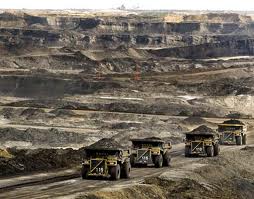 Ethical oil. That’s what Canada is producing from its massive tar sands operation, according to the newly appointed Environment Minister Peter Kent. I admit to having missed that dimension in what I have read of the oil extraction from tar sands. I understood that when the CO2 emissions from its production is added to the CO2 from its combustion it emits between 10 and 45 percent more than conventional crude. I also understood that the environmental effects of the mining and extraction process are appalling, that restoration undertakings are more promised than real and that First Nation communities are gravely affected. Most telling of all I understood that according to James Hansen if the world wants to have a chance of avoiding dangerous climate change it must not only rapidly phase out coal emissions but also leave unconventional fossil fuels such as oil from tar sands in the ground.
 I decided to read Fen Montaigne’s book