Climate scientists of any public prominence these days are likely to be on the receiving end of hate mail. When they are also activists, as James Hansen acknowledges himself to be, it’s no doubt worse. He has written on his website, under the intriguing title Singing in the Rain, of a recent “deluge of nasty-language messages saying that I should be fired, deported, run over, etc.” He comments dryly that such a sudden burst of malice seems unlikely to be spontaneous, and wonders whether a couple of pieces of recent writing aimed at him may have provided the stimulation.
One is by Patrick Michaels in the Washington Times. He had caught up with what Hansen had to say about China, something I covered in Hot Topic last November. Michaels talks of anti-democracy rants, presumably referring to this sentence:
“Democracy of the sort intended in 1776 probably could have dealt with climate change, but not the fossil-money-’democracy’ that now rules the roost in Washington.”
Michaels goes on to accuse Hansen of advocating a ruinous boycott of the US economy, and adds for good measure the old and false accusations that Hansen was wrong in his 1988 climate predictions anyway.
The other piece is a blog by Richard S Courtney which includes the following relating to Hansen’s appearance as an expert witness in the Kingsnorth trial in the UK:
“So, as a result of Dr Hansen speaking to that law court, eco-terrorists have a legal right to attack power stations in the UK. And that right will remain unless and until the UK Parliament alters the law.
“Dr Hansen is an employee of US Government and the US is supposed to be an ally of the UK: n.b. he is de facto an agent of the US. Therefore, Dr Hansen’s actions in this UK legal case are tantamount to an act of war by the US on the UK. For this reason, if for no other, he should be sacked.”
Apart from noting that the Courtney statement mischaracterizes his testimony at the trial, Hansen doesn’t address it but instead uses it as an opportunity to elaborate on an issue which is very much on his mind these days: the intergenerational injustice of human-made climate change. He comments that his testimony at both the Kingsnorth trial and later the Ratcliffe-on-Soar trial (which incidentally, contrary to Courtney’s implication, was in his own time at his own expense) was given at the request of young people on trial. That’s a request he finds hard to decline, recognising himself as part of the generation causing the problem that the young people are beginning to recognize and protest against.
He considers the two different verdicts – acquittal of the Kingsnorth defendants, a guilty verdict for the Ratcliffe-on-Soar defendants.
“The Kingsnorth jury, nine women and three (some young) men were intently interested – you could have heard a pin drop during my testimony. I anticipated acquittal. Nottingham had a different feel…No doubt the jury in Nottingham was fair-minded, but they were more severe in their judgment about whether young people were justified in taking actions to draw attention to the urgency of the situation and its intergenerational injustice.”
He notes also that the Ratcliffe jury were older than the defendants, were members of the generation most responsible for creating the climate problem that young people will need to deal with. But that fact didn’t prevent their voting for conviction.
He considers that part of the reason may be change of public perception of this topic between the Kingsnorth and Ratcliffe trials.
“Media and governments allowed science and pseudo-science to have equal weight, ‘fair and balanced’. Relentless repetition of minor flaws in telephone-book-thick IPCC reports created the public impression that the science may be flawed, even while observations of climate change strengthened and the urgency of action increased.”
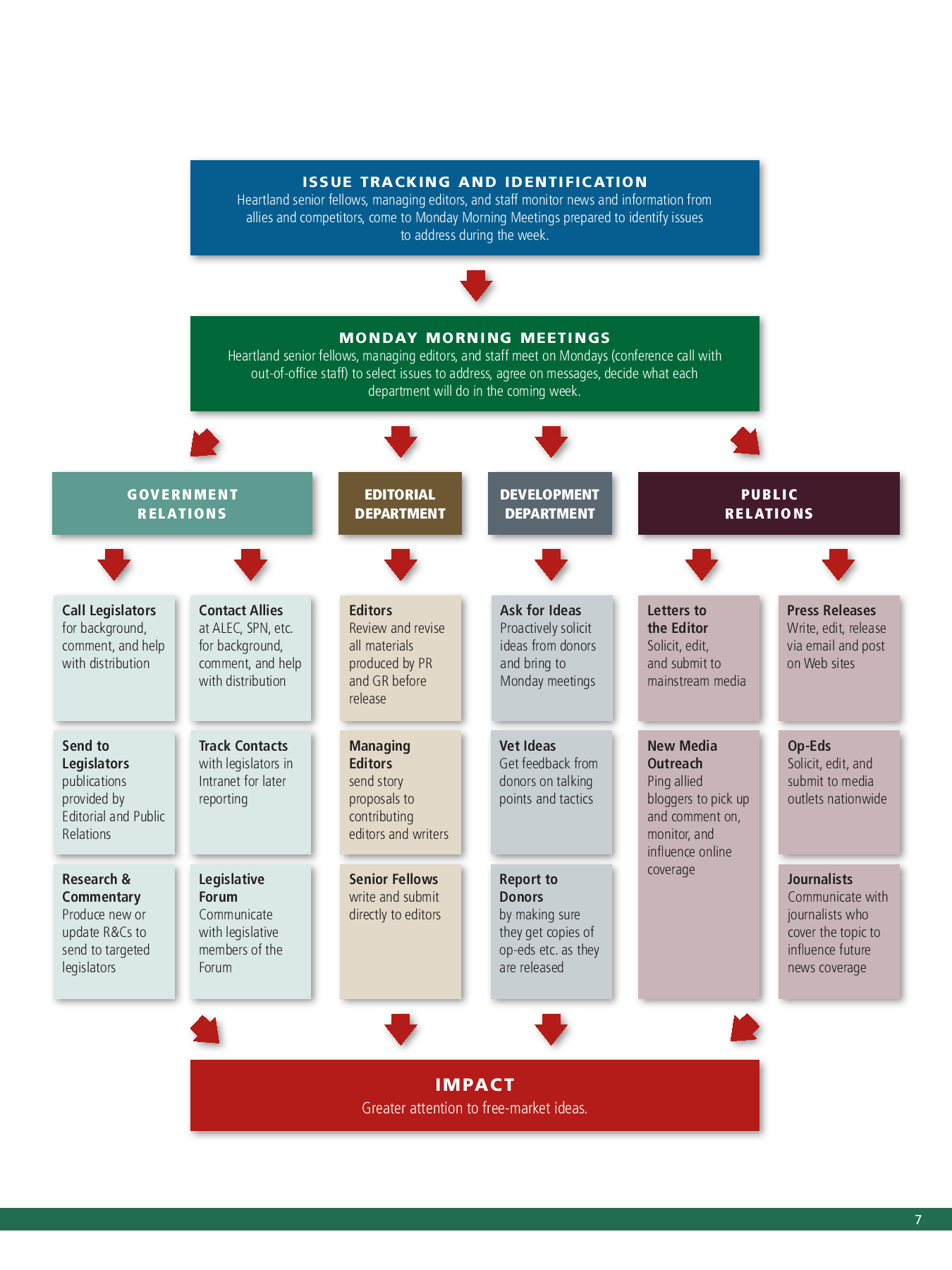
To the argument that young people are free to influence public opinion he offers a striking Heartland chart as an example of what they are up against.
“People carrying out these [Heartland] tasks are professional warriors for special interests, well-funded to make the case that global warming and climate disruption are a hoax. Their message is repeated relentlessly. Note that the ‘free market ideas’ phrase in the Heartland bottom line is Orwellian double-speak. They mean the opposite, they want business-as-usual, with fossil fuels subsidized and not required to pay their costs to society.”
His conclusion is tinged with resignation:
“Dear grandchild, this is a monster that you must face. You will need to figure it out. I am sorry. But it is the shape of our democracy today, which we bequeath to you.”
Nothing so far related to singing, but Hansen goes on to speak of Lester Brown putting him in touch with Canadian singer Raffi Cavoukian, suggesting that Raffi’s work on child honouring and Hansen’s book, Storms of My Grandchildren, share a common theme. Hansen recommends a recent essay Raffi has written, The Right to a Future. A shortened version of the essay has appeared on Huffington Post.
“The young have the strongest moral claim on climate action. It’s their future on the line. And they may hold the key to inspiring an emotional tipping point for critical mass.
“We urgently need to embrace social and economic systems that constitute a culture of respect for children and their planetary habitat.”
To finish, here’s Raffiâ’s global cooling song:
[Youtube]zSn9KrK0peM[/Youtube]
[And Gene Kelly]


 Nick Smith, NZ’s climate change minister, told the