Here comes the flood

News today of interesting new research on the effect of rising sea levels on 180 US coastal cities by the century’s end. University of Arizona scientists will be publishing a paper this week in Climatic Change Letters which sees an average 9 per cent of the land within those cities threatened by 2100. The Gulf and southern Atlantic cities, Miami, New Orleans, Tampa, Fla., and Virginia Beach, Va. will be particularly hard hit, losing more than 10 per cent of their land area.

The research is the first analysis of vulnerability to sea-level rise that includes every U.S. coastal city in the contiguous states with a population of 50,000 or more. It takes the latest projections that the sea will rise by about 1 metre by the end of the century at current rates of greenhouse gas emissions and thereafter by a further metre per century.  The researchers examined how much land area could be affected by 1 to 6 metres of sea level rise.   At 3 metres, on average more than 20 per cent of land in those cities could be affected. Nine large cities, including Boston and New York, would have more than 10 per cent of their current land area threatened. By 6 metres about one-third of the land area in U.S. coastal cities could be affected.


The study has created digital maps to delineate the areas that could be affected at the various levels. The maps include all pieces of land that have a connection to the sea and exclude low-elevation areas that have no such connection. Rising seas do not just affect seafront property – water moves inland along channels, creeks, inlets and adjacent low-lying areas.

“Our work should help people plan with more certainty and to make decisions about what level of sea-level rise, and by implication, what level of global warming, is acceptable to their communities and neighbours,” said one of the co-authors.

An interesting notion, that of deciding how much sea level rise is acceptable. Shades of King Canute? It’s presumably the speaker’s way of pointing out that it may still be within our power to keep it manageable if we begin an urgent and drastic reduction of greenhouse gas emissions. Or perhaps he’s hinting at a time where only relocation will serve. For the present some adaptation measures are now unavoidable and should be planned for, but hopefully the digital maps of this study will help convince people that mitigation is also essential. Not seemingly the Republican majority in the House which bizarrely rampages on as if human-caused climate change isn’t happening, let alone in need of mitigation.

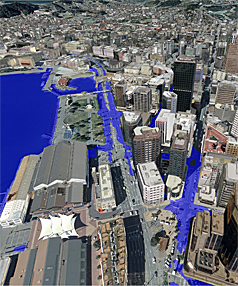
I wonder how much similar mapping has been done in the case of New Zealand coastal cities. The Wellington City Council has gone so far as to consider a computer-generated graphic (pictured) which visualised the effect of a one metre rise in sea level on the city. Nelson has considered a commissioned report on climate change effects which warned that a 1 metre sea level rise would have water lapping at the airport. I don’t recall seeing anything which indicates that Auckland has seriously looked at the effect. Christchurch is planning for a 50 cm sea level rise this century with the recognition that it may be higher and presumably that means they are undertaking detailed consideration of vulnerable areas. Dunedin has had the benefit of some University of Otago modelling of a 1.5 metre sea level rise, reported here, with assurance from the new Carisbrook stadium that they’re 3.7 metres above mean sea level.   I’ve written earlier on encouraging signs that local body government in New Zealand, at least in some areas, is facing up to the responsibilities for adaptation. In some cases this has meant taking on mitigation measures as an obvious consequence, though Environment Waikato’s Proposed Regional Policy Statement states that the Council’s role is to prepare for and adapt to the coming changes and that response in terms of actions to reduce climate change is primarily a central government rather than a local government role. I’ll be challenging that in my submission, since it seems to me that engaging people locally in mitigation effort is both possible and sensible, especially when they can see locally what the prospects will likely be without it.

The costs of coping with sea level rise look likely to be enormous. If in fact that is what future populations have to do they will look back in wonderment on the argument represented by such as  our present government that we were unable to do anything deeply serious about mitigating the effects of climate change because we thought it might affect our economy adversely. True, we might have to acknowledge, there was a Stern review which pointed out that the costs facing you, our descendants, would dwarf the adjustments required of us, but somehow we couldn’t get over our hump to reduce your mountain.

[Peter Gabriel]

Lessons from a drowning continent: no time like the present to invest in our future

Jim Salinger’s spending the summer at the University of Tasmania in Hobart. This reflection on the lessons of Australia’s recent floods first ran in the Waikato Times at the beginning of the month, but I felt it deserved a wider audience and so with Jim’s permission reproduce it here.

As I watch from my summer roaring forties perch in Hobart, Tasmania the somewhat unprecedented rains that are deluging parts of Australia raise some pertinent lessons on climate and risk management for New Zealand. Firstly let’s look at some figures and ask the question of what are the climate mechanisms behind the deluges.

For December 2010 the Bureau of Meteorology figures show that eastern Australia (the states of Queensland, New South Wales, Victoria and Tasmania) had its wettest December on record, with an average area total of 167 mm (132% above normal). What caused Brisbane to flood were the heavy falls to the north and west between 10-12 January with totals for the three days exceeding 200 mm. In Toowoomba over 100 mm fell in less than an hour.

Further south in Victoria heavy rainfall and flash flooding occurred between 10 to 15 January, with more than 100 mm of rain across two thirds of the state. Bureau of Meteorology figures show many weather stations in Victoria have now broken their all-time January records in over 100 years of observationd: 259 mm fell on Dunolly (the previous record was 123 mm), and the 282 mm of rain that fell in 1 day at Faimouth in the north east of Tasmania – the highest 1-day total for any gauge on record for the state.

The extremely wet December had eastern Australia primed for the record floods that were to follow in January. The soil could not take any more moisture and the heavy rains turned into runoff, with record floods in some parts.


The causes of these floods have been laid at the feet of the La Niña climate pattern – the sister of El Niño. La Niña brings strengthened moisture-laden easterly winds on to the Australian continent. This year the La Niña event is strong, with it being amongst the top three in magnitude, ranking with the 1918/19 and 1973/74 events. However there is one distinct difference this season: temperatures in Australia this past decade have been 0.5 deg C warmer than in the 1970s, and 0.9 deg C warmer than in the 1910s, all as a result of global warming. And during the 2010/11 season, La Niña seas off eastern Australia have been much warmer than average, being 1 to 2 deg C above the 1985-1998 average.

It is a simple law of physics that a warmer atmosphere holds more moisture. With the long term heating of the oceans more moisture has been measured in the atmosphere during the last decade. The consequence is that global warming leads to an increase in the magnitude and incidence of heavy rainfall, and the resultant floods.

Global warming has arrived, and the climate has warmed. Global warming is no longer a theory…

The first lesson from the Australian flooding events is that global warming has arrived, and the climate has warmed. Global warming is no longer a theory based on abstract calculations of what the climate is very likely to do in future decades. In 2007 the Intergovernmental Panel on Climate Change (IPCC) concluded that “It is very likely that hot extremes, heat waves and heavy precipitation events will continue to become more frequent.”

The second lesson — the canary in the coal mine — is that because of global warming the frequency of these extreme weather events is only going to increase. Thus the one in 100 year high rainfall event will become far more common, with highest-ever totals being exceeded more and more often in the future.

The third lesson is that there needs to be better preparation for these events by civil society. The responsibility in New Zealand falls on local bodies through the Civil Defence and Emergency Management Act (CDEM). It’s local government that is responsible for district plans and granting developers the permission to build. Firstly should major towns be located on river floodplains? This is where there is pressure from developers. A solution is to build higher and higher flood levees but should the cost be borne by the community? Perhaps the full costs should be placed on the developer. Another option is to ban development in flood-prone areas.

However New Zealand is the lucky country in regard to the fourth lesson. We have an Earthquake Commission that covers citizens for flood damage, which Australia does not have. But insurance should be compulsory for all dwellings, to share the cost of these disasters between all citizens.

Global warming is here, now — and not a phenomenon for future generations to deal with. Thus we must embark on a course of emissions reductions targets as soon as possible, to claw back rapidly rising greenhouse gas levels in the atmosphere. If we do not act now the severity of such floods, and the subsequent loss of life and property — let alone the effect on the economy — will increase dramatically. There is no time like the present to invest in our future wellbeing.

Institutional lemmings

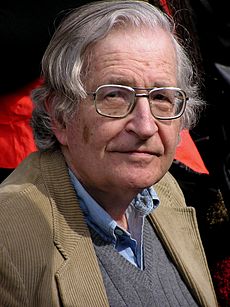
I was struck by a passage in Noam Chomsky’s conversational remarks on climate change in the video clip Gareth recently posted. Commenting on the campaign waged by powerful business lobbies to convince the public that global warming is a liberal hoax, he pictures the people responsible as trapped by their functions in the institutions they work for. He put it rather starkly:

“Those same CEOs and managers who are trying to convince the public that it’s a liberal hoax know perfectly well that it’s extremely dangerous. They have the same beliefs that you and I have. They’re caught in a kind of institutional contradiction. As leaders of major corporations, they have an institutional role – that is, to maximise short-term profit. If they don’t do that they’re out and someone else is in who does do it, so institutionally speaking it’s not a choice that’s going to happen in the major institutions.


“So they may know that they’re mortgaging the future of their grandchildren and in fact maybe everything they own will be destroyed, but they’re caught in a trap of institutional structure. That’s what happens in market systems.

“The financial crisis is a small example of the same thing. You may know that what you are doing is carrying systemic risk but you can’t calculate that into your transactions or you’re not fulfilling your role and someone else replaces you…and that’s a very serious problem. It means we’re marching over the cliff and doing it for institutional reasons that are pretty hard to dismantle.”

Chomsky was speaking with a degree of informality, and I don’t want to put his statement under close scrutiny. Nor am I necessarily expressing agreement with all that he says. But I thought the general drift of his remarks had point. Something happens in the very structure of society to prevent a rational response to the threat of climate change.

I often find myself wondering what is going on in the minds of people whom one would normally expect to be respectful of major scientific endeavour but who when it comes to climate change seem to be able to relegate that respect, if not to the point of denial at least to the level of a secondary consideration, which in reality it clearly isn’t.

I’ll leave the corporate field to Chomsky and take a look at what the New Zealand government has to say about the 2050 emissions target which they propose gazetting and for which they are inviting public submissions by the end of this month. The Minister, Nick Smith, has put out a position paper in support of the target of a 50 per cent reduction from the 1990 level by 2050. The paper acknowledges and accepts the basic science and the impacts predicted by the IPCC 2007 report.  There’s no suggestion of denial. But nor is there any acknowledgement of how serious those future impacts will be for humanity. Nor any hint of the possibility that on such a question as sea level rise this century the IPCC estimate appears likely to be exceeded, perhaps considerably. The language outlining the science is flat. The paper moves to indicate that New Zealand has a unique emissions profile by comparison with other developed countries, mentioning the high level of emissions from livestock farming, the lower than normal level of CO2 emissions from electricity generation, and the significant impact of forestry planting and harvesting on our emissions level. From there the emphasis is on where we fit into the international picture, not at all on the imperative posed by climate change.  This sort of statement:

“The world is changing and other countries are recognising the reality of a carbon-constrained future. It is in New Zealand’s long-term interests to begin taking steps towards a low-carbon future.”

Emphasis is given to how it is more challenging for us than for most other developed countries to reach a given level of emissions reduction because of our unique emissions profile. Satisfaction is expressed that a 50 per cent reduction by 2050 is nevertheless in line with what most other developed countries are aiming for and the conclusion drawn that we are certainly doing our fair share.

By now the statement has left far behind any consideration of what the science demands, not only of us but of the community of nations. It has become an exercise in positioning ourselves, doing enough to satisfy our international partners but nothing that might seriously disturb the economy we are used to.

“Setting a target is a balance between achieving the reductions in greenhouse gases we want and the impact on the economy and our lifestyle. Achieving the 2050 emissions reduction target could mean higher costs for consumers and businesses as we transition to a low-carbon economy. However, a less ambitious target would undermine New Zealand’s clean, green environmental reputation. The proposed 2050 emissions reduction target balances these demands and reflects a fair contribution by New Zealand to the international effort to reduce greenhouse gas emissions.”

Nick Smith and Tim Groser must be aware of the science and of the seriousness of the danger ahead if emissions are not far more drastically reduced than the international scenario they relate us to. No one will argue that the economy and lifestyle don’t matter. But how can they somehow ‘balance’ the need for action to reduce emissions?  This looks very like what Chomsky identifies as institutional contradiction. It’s not as gross as short-term corporate profit, or as the anti-science denial seemingly rampant in the US Republican party, but in a lesser way does it not reflect the same phenomenon? The role of the politician is restricted by the need to keep happy those vested interests resistant to changes to the economy and those citizens judged incapable of facing reality. Protecting future generations, let alone those poorer populations already being impacted by climate change, is not part of the role and is not rewarded. Chomsky acknowledges those institutional reasons are hard to dismantle, but meanwhile, as he says, we’re marching over a cliff. Reason enough for the dismantling to begin.

Something for the weekend: poles, podcasts and Chomsky

Casanova - 1996Something for everyone this weekend: a few podcasts to grab, ice news from both ends of the planet, interesting reading, and a great interview with Noam Chomsky. Audio first: Radio NZ National’s Bryan Crump interviewed Prof Jean Palutikof, Director of the National Climate Change Adaptation Research Facility at Griffith University in Queensland at the beginning of the week. It’s a wide-ranging discussion: Palutikof is an engaging speaker and frank about the dangers we confront. Grab the podcast now, because it’ll disappear from the RNZ site on Monday.

Continue reading “Something for the weekend: poles, podcasts and Chomsky”

Russian roulette with a rainforest

I reported in a November post that it appeared likely that the 2010 Amazon drought was even more severe than the 2005 drought, itself identified as a 1-in-100-year event. Now Simon Lewis of Leeds University and Paulo Brando of Brazil’s Amazon Environmental Research Institute (IPAM) and others have published a paper in Science with rainfall analysis showing that the 2010 drought was indeed more widespread and severe than that of 2005.

The 2005 drought killed billions of trees within the rainforest. On the ground monitoring showed that these forests stopped absorbing CO2 from the atmosphere, and as the dead trees rotted they released CO2 to the atmosphere.


The press release reports that this new research, co-led by Dr Lewis and Brazilian scientist Dr Paulo Brando, used the known relationship between drought intensity in 2005 and tree deaths to estimate the impact of the 2010 drought.

They predict that Amazon forests will not absorb their usual 1.5 billion tonnes of CO2 from the atmosphere in both 2010 and 2011, and that a further 5 billion tonnes of CO2 will be released to the atmosphere over the coming years once the trees that are killed by the new drought rot. For context, the United States emitted 5.4 billion tonnes of CO2 from fossil fuel use in 2009.

They can’t be sure, of course, until they have completed forest measurements on the ground and they describe their results as an initial estimate, one which incidentally does not include any emissions from fires which can be extensive during hot and dry years.

The danger is that this could be a precursor of the Amazon rainforest no longer playing the part it does in regulating atmospheric CO2. Simon Lewis:

“Two unusual and extreme droughts occurring within a decade may largely offset the carbon absorbed by intact Amazon forests during that time. If events like this happen more often, the Amazon rainforest would reach a point where it shifts from being a valuable carbon sink slowing climate change, to a major source of greenhouse gasses that could speed it up.”

Of course it is possible that the two droughts are just an unusual natural variation, but Lewis points out that they are consistent with climate models which project a grim future for Amazonia.

Tropical ecologist Daniel Nepstad  is Director of International Programs at IPAM and one of the paper’s authors. He was  interviewed a couple of months ago during the Cancún conference.

“It’s about as bad as we’ve seen. I’ve been working in the Amazon for about 25 years now, and I haven’t seen anything like it. We thought we had the worst drought of the century in 2005, and this one is worse.”

The interviewer comments that the drought in 2005 was called a once-in-a-century drought, just five years ago.

“I know. And, there was a drought in 2007 that didn’t even capture any immediate attention, it wasn’t even worth it because drought is really becoming part of the fabric of the Amazon.”

The cause?

“You know, statistically, it’s just very hard to take an individual event like this mega-drought of the Amazon, and say that it is a direct cause of climate change. But, with both this and the 2005 and the 2007 drought, they’re all consistent with the scenario of increasing accumulation of greenhouse gasses in the atmosphere.”

How does the drought affect the rainforest?

“The forest actually makes the rain in the Amazon. By the end of the dry season, a lot of Amazon trees are sucking water from the soil- it could be 60 feet beneath the ground surface. So, they’re going way down deep to get that water, so that they can keep their green lush canopy, even though they’ve been deprived of water for a few months. And, that water going into the atmosphere makes the clouds that make the rain. Similarly, the rain coming down, if it weren’t for that rain, if those dry seasons got longer on a permanent basis, then that forest would cease to be. It would be replaced by grassy vegetations, savannahs, woodlands and scrub that would burn periodically, and that would look very different and have far fewer species.”

What are scientists supposed to think when confronted with possibilities such as those represented by recent Amazon droughts? That it will be interesting to see whether this is the start of a trend which would confirm predictions of the impacts of increasing greenhouse gases? That without further evidence they must be careful not to sound alarmist? In fact Simon Lewis and Daniel Nepstad are properly cautious, acknowledging that as scientists they can’t say with certainty that these droughts are part of human-caused climate change. But they are also very aware of the magnitude of the danger represented by the droughts if they are the result of increased greenhouse gas emissions. A statement by Lewis reported in a Guardian article expresses succinctly why we can’t just wait to see whether further evidence accumulates.

“We can’t just wait and see because there is no going back. We won’t know we have passed the point where the Amazon turns from a sink to a source until afterwards, when it will be too late.”

In other words the possible consequences are so dire that it is reckless to risk them.

“If greenhouse gas emissions contribute to Amazon droughts that in turn cause forests to release carbon, this feedback loop would be extremely concerning. Put more starkly, current emissions pathways risk playing Russian roulette with the world’s largest rainforest.”

That’s a serious warning from a scientist. And the Amazon is not an isolated case.  Ove Hoegh-Guldberg, in the presentation Gareth has recently posted, is convinced with good reason that ocean ecosystems are already being seriously impacted under current elevated levels of atmospheric CO2 and that a 450 ppm level will be disastrous for ocean life and consequently for us. The world’s ice is clearly under assault from warming, with the likelihood of sea level rise of fearful consequence to human populations, as scientists like James Hansen now regularly warn. The list is long.

We’re playing Russian roulette with more than the rainforests, and the revolver has more than one chamber loaded. The longer we take to start reducing emissions the more we shorten the odds