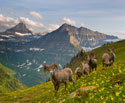
Magical thinking is wonderful. Sprinkle a little oofle dust, twitch your nose, and the world can be put to rights. Joe Read certainly believes in magic. He’s just introduced a bill into the Montana state legislature which will solve the global warming problem at a single stroke:
(2) The legislature finds:
(a) global warming is beneficial to the welfare and business climate of Montana;
(b) reasonable amounts of carbon dioxide released into the atmosphere have no verifiable impacts on the environment; and
(c) global warming is a natural occurrence and human activity has not accelerated it.
Peter Gleick and Josh Rosenau have more, and Brad Johnson at The Wonk Room phoned him up for a chat, with extraordinary results. It’s clear that ideology trumps physics in Joe Read’s Montana. A pity he hasn’t told the glaciers in Glacier National Park. But Read’s wishful thinking is a minor thing, compared to the heroics indulged in by Ray “Singularity” Kurzweil…
Kurzweil is well known for his contention that exponential growth in technological capabilities (generalising from Moore’s Law) will lead to a merging of human and machine intelligence that will amount to a singularity — an event horizon beyond which we cannot envisage what will happen (though it’s a fertile field for SF writers like Charles Stross). He puts the date of this event in the not too far distant future (mid century or thereabouts), and is doing his best to stick around to see it happen. In this interview with Lauren Feeney at The Daily Need, he applies his exponential vision to developments in solar power:
So right now it’s at half a percent of the world’s energy. People tend to dismiss technologies when they are half a percent of the solution. But doubling every two years means it’s only eight more doublings before it meets a hundred percent of the world’s energy needs. So that’s 16 years. We will increase our use of electricity during that period, so add another couple of doublings: In 20 years we’ll be meeting all of our energy needs with solar, based on this trend which has already been underway for 20 years.
It’s a seductive concept, this idea that technology will advance so rapidly that it will amount to a get out of jail free card for human civilisation. It’s a view that underpins the Lomborg/Breakthrough Institute position that what is needed is not cuts in emissions, but investment in technology. We’re smart, right? We can figure a way to solve this problem.
Kurzweil is quite explicit in the interview. We have “plenty of time”:
Feeney: A lot of climate scientists say that we have about 10 years to turn the situation around, otherwise we’re going to hit this tipping point and we are all doomed. So you think we’re going to make it?
Kurzweil: Even if those timelines were correct, there will be quite a transformation within 10 years and certainly within 15 or 20 years. The bulk of our energy will be coming from these renewable sources. So, I think we have plenty of time. I think we can make it to the point where these renewables are taking over.
Set aside for a moment that Feeney’s question is ill-posed (Stoat will be having kittens, to miscegenate freely). Kurzweil’s answer betrays a fundamental lack of understanding of the nature of the climate problem — not least the climate commitment, the inevitable warming in the pipeline. If we wait for solar power to take over, but carry on emitting vast quantities of carbon in the meantime, the end result — even with 100% renewable energy on tap — will be warming well beyond two degrees, and a planet making a transition towards its own version of a singularity.
I have a more general objection to Kurzweil’s technological optimism, but I first want to make it clear that I find his vision of the future beguiling, interesting and in some respects feasible. It appeals to the boy in me, the one who read The Eagle in the 60s. It helps me to maintain a degree of optimism in the face of what any sane human might regard as an endless stream of bad news. The real problem is that this vision of accelerating “progress” is rapidly running into the buffers of ecological and planetary limits (which include climate impacts). Yes, we may well be smart enough to design and build superior solar energy capture and distribution systems, but can we do it for everyone — for the nine billion who are likely to be around in 2050, when the singularity will be overdue? Kurzweil glosses over this issue in the interview, but I suspect that reality will be a little more demanding than his interviewer. In fact, we already have the technology to “solve” the climate problem, just as we already grow enough food to feed everyone on the planet. The answer lies in fair distribution and getting things done, and we haven’t found it yet.
I want Kurtzweil to be right. I’d like Joe Read to be right too, but it ain’t gonna happen. I might as well move to Montana and become a dental floss tycoon.
[Dental floss and Dusty (something for everyone!)]


 No doubt the New Zealand climate change minister will point out that the New Zealand’s emissions profile is different from that of the EU and that the exchanges about reduction targets that have been taking place in Europe in recent days therefore have little relevance for us. Nevertheless I have taken heart from reading about them in their own right, whether they have relevance to us or not, though I think they do have at least some.
 Two items during this week highlighted the continuing progress of Solid Energy’s intentions to develop the Southland lignite fields. I therefore provide this depressing update to two Hot Topic