Garnaut update on climate science: avoiding high risks will require large changes

Ross Garnaut, the Australian government’s climate change adviser, today published the science update [PDF] to his 2008 report. It warns that recent research has “confirmed and strengthened” the view that the earth is warming and humanity is to blame. Temperatures and sea level continue to rise, and there are worrying signs that a 2ºC target may no longer be “safe”. Garnaut comments that it is an “awful reality” that his 2008 review did not overestimate the risks of climate change. Most telling, though, are the update’s final lines. After a section discussing scientific reticence as a possible reason (pace Hansen) why published science appears to systematically underestimate the extent and dangers of probable climate change, Garnaut states:

We should, however, be alert to the possibility that the reputable science in future will suggest that it is in Australians’ and humanity’s interests to take much stronger and much more urgent action on climate change than might seem warranted from today’s peer-reviewed published literature. We have to be ready to adjust expectations and policy in response to changes in the wisdom from the mainstream science.

In other words, don’t bank on getting an easy ride. Full details below the fold.

Continue reading “Garnaut update on climate science: avoiding high risks will require large changes”
On an island: coping with sea level rise

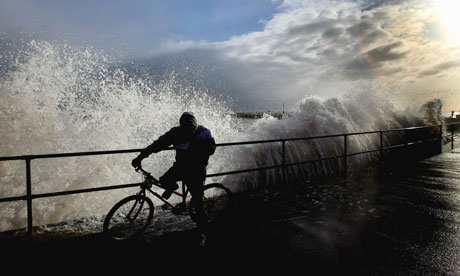
A recent Rowntree Foundation report on the vulnerability to the effects of climate change by mid-century of Britain’s coastal communities has attracted some media attention. It struck me as underlining the relevance of one of the chapters in the book Adapting to Climate Change which I recently reviewed on Hot Topic. The chapter, on adaptive governance for a changing coastline, noted a strategic shift in national coastal management policy in England away from investing in expensive ‘hard’ engineered defence towards designing a more naturally functioning coastline. This means that many coastal communities now face great unease and anxiety about their future, since the new policy preferences for retreat and realignment mean no future guarantees for protection.

[See end for comments by Gareth.]

Continue reading “On an island: coping with sea level rise”

Shake your berg thing

TasmanNASAbergs

This astonishing view of the Tasman Glacier from space, captured by NASA’s Terra satellite on March 2nd, shows the bergs in the glacial lake — the remnants of the 30 million tons of ice that broke off during the Christchurch earthquake on Feb 22nd. It’s a false colour image — red means vegetation, and the grey-browns are bare rock (and the rock debris covering the glacier itself). There’s more information at the NASA Earth Observatory. The Tasman’s near neighbour the Murchison Glacier has recently featured at Mauri Pelto’s From A Glacier’s Perspective. Both are retreating strongly.

[Update 9/3: The Earth Observatory’s latest image of the day is a stunning satellite picture of the Christchurch region, with an overlay showing shaking intensities.]

[The Chipmunks]

Riders on the storms

I listened with interest to Kevin Trenberth on the latest Climate Show describing how the increased water vapour in the atmosphere resulting from human-caused global warming is leading to greater extremes in weather events. It sent me back to take another look at the section in James Hansen’s book Storms of My Grandchildren where he explains the greatly increased strength of storms we can expect as the century unfolds, unless we leave most fossil carbon in the ground. I reviewed the book a while back on Hot Topic and thought it worth outlining more closely here, as an extension of my review, Hansen’s argument in the ten pages where he specifically addresses the storms of which the book’s title speaks.

Continue reading “Riders on the storms”

The Climate Show #8: Kevin Trenberth and our shaky future

[youtube]yKF1w_ks_Vc[/youtube]

The Climate Show returns with a packed show, featuring one of the world’s best known climate scientists, NZ-born, Colorado-based Dr Kevin Trenberth — star of the Climategate “where’s the missing heat” emails. He’s been in New Zealand to visit family (experiencing the Christchurch quake in the process) and to attend a conference, and his comments on the state of our understanding of climate change should not be missed. John Cook of Skeptical Science returns with his new short urls and an explanation of why declines have never been hidden, and Gareth and Glenn muse on Arnie “Governator” Schwarzenegger riding to the rescue of climate science, cryospheric forcing and carbon cycle feedbacks from melting permafrost, and a new paper that suggests that current policies are pointing us towards extremely dangerous climate change. All that and hyperbranched aminosilica too…

Watch The Climate Show on our Youtube channel, subscribe to the podcast via iTunes, or listen direct/download here:

The Climate Show

Follow The Climate Show at The Climate Show web site, on Facebook and Twitter.

Show notes below the fold.

Continue reading “The Climate Show #8: Kevin Trenberth and our shaky future”