
Here’s the latest update on the Jim Salinger, Rod Oram and Caroline Saunders road show. It contains more complete information on venues and two or three additions to the list we published three weeks back. By the time the tour finishes in November they will have given 35 seminars. That’s a sterling effort which hopefully will have engaged interest from the farming community. I detected, when watching a TV panel discussion recently which included the new Federated Farmers president, reason to hope that under its new leadership Federated Farmers will be more willing to understand and share the concern over climate change than has been the case heretofore. As the road show makes clear there is economic benefit for them in facing the reality. Continue reading “SOS Roadshow: Final Days”
Category: Climate science
Jolting Contrasts
 I read this morning yet another dismal report on the extraordinary lengths to which Republican politicians hopeful of nomination as presidential candidate in America are going in their denial of climate change. Then I watched an excellent PBS television interview with a couple of intelligent and knowledgeable American scientists which regular Hot Topic commenter Bill had recommended.
It was an extraordinary juxtaposition, all the more surreal because both relate to Texas. How does a country like the US, with scientists and scientific institutions so advanced, manage to throw up leading politicians so wilfully ignorant? (That’s a rhetorical question unless your answer has nothing to do with money.) Continue reading “Jolting Contrasts”
John Cook Wins Eureka Prize
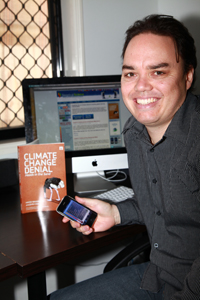 Our warm congratulations to John Cook, the creator of the widely respected SkepticalScience website, co-author of Climate Change Denial: Heads in the Sand, and a regular on The Climate Show with Gareth and Glenn. He has won the NSW Government Eureka Prize for Advancement of Climate Change Knowledge. Here’s the statement put out by the University of Queensland (UQ):
UQ alumnus Mr John Cook, the creator of SkepticalScience.com and a new appointment to UQ’s Global Change Institute (GCI), won the NSW Government Eureka Prize for Advancement of Climate Change Knowledge.
The prize is awarded to an Australian individual, group or organisation for work that motivates action to reduce the impacts of climate change.
Mr Cook is Research Fellow in Climate Change Communication at the GCI and won the Eureka Prize for his work in communicating science to an online audience.
In his new position at UQ, Mr Cook will focus on the effective communication of the science around climate change and, working with the GCI team, enhance the delivery and use of evidence-based information by business, government and the wider community.
A longer statement from the Australian Museum can be found here. I particularly liked this piece from a local newspaper which had interviewed John when he was shortlisted for the award:
The co-author of the book Climate Change Denial: Heads in the Sand said his interest in climate change was also motivated by “social justice”.
“Once I started looking into the science about what climate change means I found the impacts of climate change has the greatest effect on the poorest developing countries, while they’re the countries that contribute to it the least,” Mr Cook said.
“That’s what made me so interested and passionate about the subject, the social justice element to it.”
Joe Romm at Climate Progress has described the award as richly deserved. We couldn’t agree more.
Latest Arctic Sea Ice Report
The latest from the National Snow and Ice Data Center.
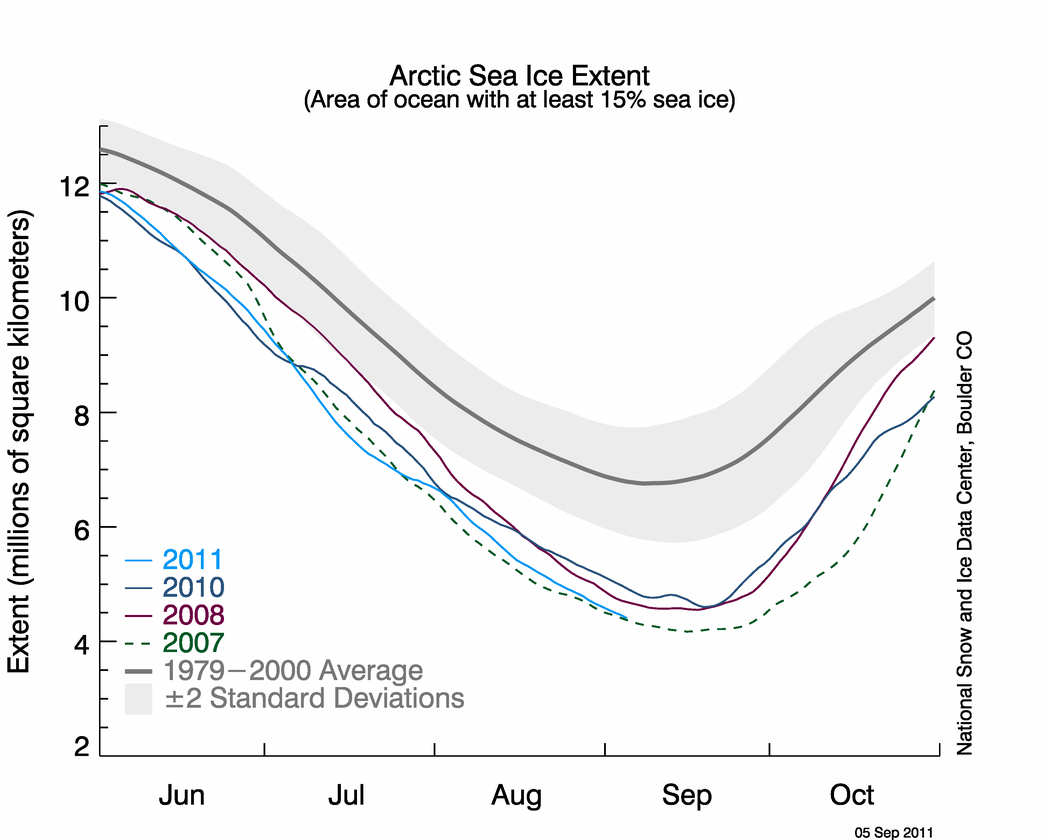
The graph above shows daily Arctic sea ice extent as of September 5, 2011, along with daily ice extents for previous low-ice-extent years. Continue reading “Latest Arctic Sea Ice Report”
What Motivates the Scientist Deniers?
 There wasn’t room in my review of James Powell’s book The Inquisition of Science to comment on one or two aspects of the book in the detail I’d have liked, and I’ll take up one in particular in this supplementary post. In a chapter titled The Anatomy of Denial he has an interesting short discussion on the motivation of the scientist deniers. The denial campaign depends on having some scientists to whom it can point in confirmation of its arguments, and they have duly been forthcoming, albeit few of them actively engaged in climate science. Powell’s analysis confirms what others have discovered, but he puts it freshly and it’s worth highlighting regularly.
Some of the scientist deniers he sees as simply contrarian by nature, revelling in being different. Every field of science has had its contrarians with provocative ideas. Most of the ideas may be wrong, but even so they can advance the science by stimulating new experiments and new questions. Contrarians may sometimes play a valuable role as devil’s advocate, but they may also simply and repeatedly be wrong. He notes wryly that if Freeman Dyson were to accept global warming no one would pay any attention to him since he would merely be one of tens of thousands contributing to the scientific consensus, almost any one of whom would know as much as he. By denying it, he lands on the cover of the New York Times Magazine and is lauded for intellectual courage. In Powell’s extended discussion of Dyson’s denial in an earlier section of the book he quotes Dyson acknowledging that Hansen, whom he accuses of consistently exaggerating the dangers of global warming, has all the credentials established by his hundreds of published papers. Continue reading “What Motivates the Scientist Deniers?”