
Moon-walking with due legal process to a very hot place – Neil Armstrong, coal mining & global warming

EarthApollo8.jpg

On the same day as the death of Neil Armstrong, the first astronaut to step onto the Moon, became public, the NZ High Court moonwalked its way to an off-the-world moment. It decided that greenhouse gas emissions and global warming are off-limits in the planning for an open cast coal mine. That’s as just as ‘out of this world’ as denying that the Moon landings ever happened, argues Simon Johnson.

On Saturday, two bits of news struck home to me very strongly. The first was the death of moon-landing astronaut Neil Armstrong. The second was the High Court decision that open-cast coal mines and global warming are legally and jurisdictionally unrelated in the Resource Management Act.

The moon landing in 1969 I remember very well. As a seven year old, I listened attentively to the ‘one small step’ broadcast. The whole class was silent under the spell of our teacher’s scratchy transistor radio. It’s one of my most strongly held memories of those days. I guess that reflects quite well on that class of seven year olds. They stopped playing bullrush, sniffing with colds, and fighting over lunches to listen attentively to the unfolding of one of humanity’s most historic moments.

While I was still fondly remembering the Moon landing, the next news item struck.

Continue reading “Moon-walking with due legal process to a very hot place – Neil Armstrong, coal mining & global warming”

Why Arctic sea ice shouldn’t leave anyone cold

In this guest post Neven Acropolis, the man behind the excellent Arctic Sea Ice blog, looks at the reasons why we need to pay attention to the rapid loss of sea ice in the Arctic Ocean.

Arctic sea ice became a recurrent feature on planet Earth around 47 million years ago. Since the start of the current ice age, about 2.5 million years ago, the Arctic Ocean has been completely covered with sea ice. Only during interglacials, like the one we are in now, does some of the sea ice melt during summer, when the top of the planet is oriented a bit more towards the Sun and receives large amounts of sunlight for several summer months. Even then, when winter starts, the ice-free portion of the Arctic Ocean freezes over again with a new layer of sea ice.

Since the dawn of human civilisation, 5000 to 8000 years ago, this annual ebb and flow of melting and freezing Arctic sea ice has been more or less consistent. There were periods when more ice melted during summer, and periods when less melted. However, a radical shift has occurred in recent times.

1 kinnard2011

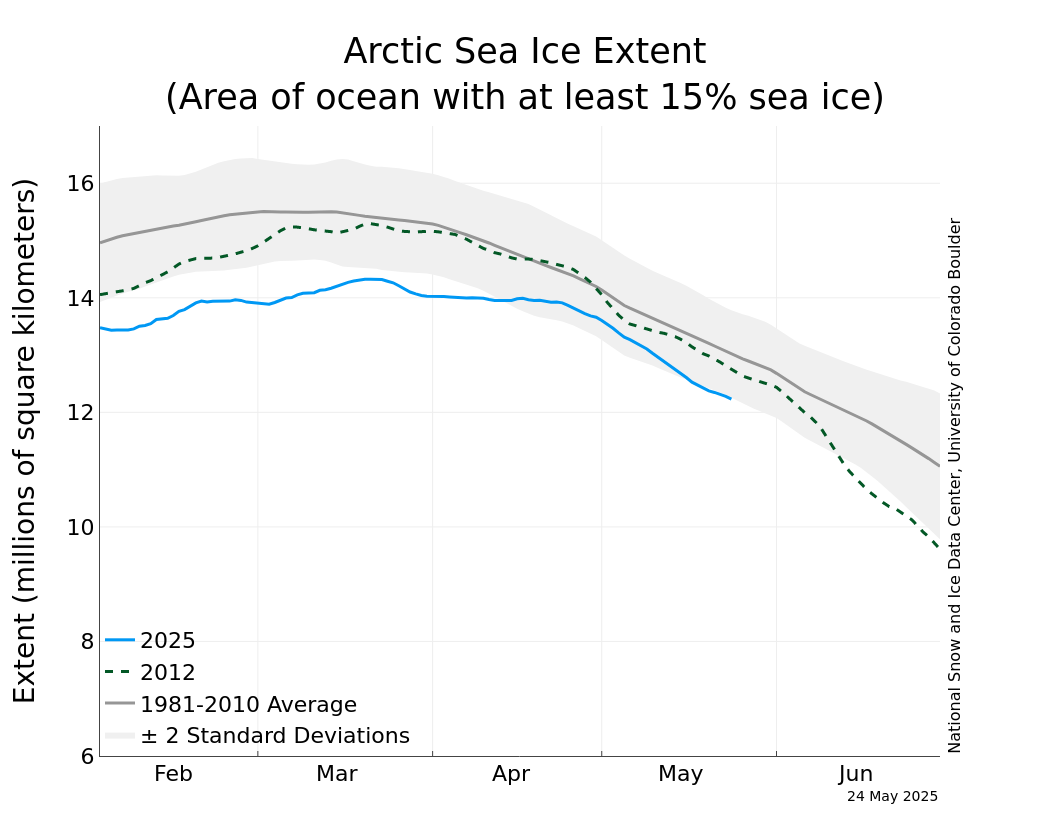
Ever since satellites allowed a detailed view of the Arctic and its ice, a pronounced decrease in summer sea ice cover has been observed (with this year setting a new record low). When the IPCC released its Fourth Assessment Report in 2007, it was generally thought that the Arctic could become ice-free somewhere near the end of this century. But changes in the Arctic have progressed at such speed that most experts now think 2030 might see an ice-free Arctic for the first time. Some say it could even happen this decade.

2 albedofeedbackWhat makes this event significant, is the role Arctic sea ice plays as a reflector of solar energy. Ice is white and therefore reflects a large part of incoming sunlight back out to space. But where there is no ice, dark ocean water absorbs most of the sunlight and thus heats up. The less ice there is, the more the water heats up, melting more ice. This feedback has all kinds of consequences for the Arctic region.
Continue reading “Why Arctic sea ice shouldn’t leave anyone cold”

A change is gonna come: no Arctic sea ice and our planet with a different climate

The crunch is coming. Before the end of this month, or very soon after, the Arctic sea ice will set a new record summer minimum for area and extent, by any measure. The only question remaining is by how much 2007’s record will be beaten. For the rest of the world, those of us who aren’t habitually glued to the Arctic Sea Ice Blog (where Neven’s counting the dominoes as they fall — one, two, three, four, five, six so far), or who aren’t checking the wonderful images from space that NASA assembles into an Arctic mosaic, or in the Greenpeace team hanging on to a Russian oil drilling rig, we have a simple lesson to learn. The climate of the northern hemisphere has changed, and with it the climate of the planet. And we have precious little idea of how that change is going to affect all of our futures.

Continue reading “A change is gonna come: no Arctic sea ice and our planet with a different climate”

Ice, Mice and Men

Geoff Simmons and Gareth Morgan, with help from John McCrystal, have produced a book which one hopes will be read by many New Zealanders.  Ice, Mice and Men: The Issues Facing our Far South not only carries illuminating scientific information about the islands and seas to our south and the Antarctic continent beyond them, but it communicates it in a relaxed and engaging style which should ensure a wide general readership. The more people understand what is happening in this vital region the better, and it’s easy to see this book adding to their number.
The opening section explains why the region is important, breaking it into three zones: first, the subantarctic islands, “liferafts” of the Southern Ocean; second, the Southern Ocean itself, home to the Antarctic Circumpolar Current (ACC) and “the engine room of the global ocean and the world’s climate”; third, Antarctica, including the sea ice that surrounds it which helps drive the marine food chain and affects the transport of nutrients essential for marine life around the world. The section provides a detailed account of the function of the three zones not just in relation to each other but in crucial relation to the globe as a whole.

Continue reading “Ice, Mice and Men”

Greenland’s extraordinary summer #3: new record melt year, and summer’s not over yet

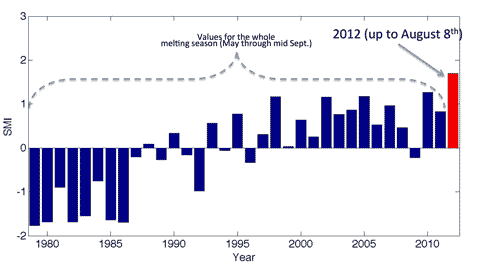
Greenland’s amazing summer continues, with news today that the ice sheet has already set a new record for surface melting — with four weeks of the melt season still to run. The ice sheet surpassed the previous record year, 2010, on August 8th. Marco Tedesco of the City College of New York said:
“With more yet to come in August, this year’s overall melting will fall way above the old records. That’s a goliath year – the greatest melt since satellite recording began in 1979.”

Tedesco and his team calculate the duration and extent of melt over the ice sheet, using satellite data to develop a ‘cumulative melting index’. The index is defined as the number of days when melting occurs multiplied by the total area subject to melting, and is a measure of how much melting has occurred in a season that normally runs from June to September. As the chart below demonstrates, by August 8th the melt was already well ahead of 2010.

TedescoSMI2012

So far this year Greenland has experienced extreme melt in virtually every corner of the ice sheet, and especially at high altitudes. When summer’s over, and the research teams ponder the data they’ve gathered on the ice, it seems pretty clear that there are going to be some interesting figures to consider, with consequences for everyone with beachfront property… Follow Tedesco’s work, and that of other teams working on Greenland on his Greenland Melting site.