
The long history of hot air and inaction

In a comment on Tom Bennion’s recent post on the water crisis in Tuvalu and Tokelau Gareth drew attention to an article in the Economist which sounded similar themes. Small island states are well aware of the danger in which they stand and of how grudging any help is likely to prove:

Australia has turned down Tuvalu’s request for an emergency migration programme that would resettle the islanders. Even a €90m ($119m) aid package to tackle regional climate change pledged earlier this year by the European Union has done little to tamp down its fears.

The leaders of countries as far afield as Barbados and Grenada joined Tuvalu in raising the alarm over the issue in a series of impassioned speeches to the United Nations General Assembly last month. Ralph Gonsalves, the prime minister of Saint Vincent and the Grenadines, laid the blame for the current debacle squarely at the feet of developed economies.

He was “baffled” he said, “by the intransigence of major emitters and developed nations that refuse to shoulder the burden for arresting climate changes that are linked to the excesses of their own wasteful policies.” As it happens, the first states to experience the effects of climate change as an existential threat are among the world’s smallest, most isolated and least powerful.

What particularly caught my attention in the Economist article was a link back to a past story published in the magazine in 1997. It was revealing both of how long the island states have been anxious and of how summarily those concerns have been treated by the more powerful.

Continue reading “The long history of hot air and inaction”

Climate Change and the End of Exponential Growth

An intriguing title for what promises to be an interesting seminar in Wellington later this month. Pieter Tans of NOAA’s Earth Systems Research Lab in Boulder — a carbon cycle specialist and winner of the Roger Revelle Medal at the 2010 Fall AGU — will be the guest of the NZ Climate Change Research Institute. Here’s a flavour of what he’ll be talking about:
Man-made climate change is a clear manifestation that we have reached limits of resource consumption by our species, and that continuing business‐as‐usual has a substantial chance of destroying civilization. It is also likely that fossil fuel resources will not remain cheap for much longer, with high energy prices becoming an impediment to development. Vigorous policies to decrease our dependence on fossil fuels are necessary to continue enabling development and to safeguard it by reducing the risk of catastrophic climate change.

Tans’ talk is scheduled for Wednesday 26 October at 6:00 pm in Lecture Theatre 1, Old Government Buildings. I’d be there, if I were in Wellington. I’m not, so I’d welcome first hand reports. For more information, contact Liz Thomas at the CCRI.

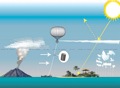
Geoengineering down under: Is Stratospheric Sulphate Injection Completely Reversible?

This guest post is by Simon Terry, Executive Director of the Sustainability Council of New Zealand. The risk rating on stratospheric sulphate injection went up another notch on the basis of material presented at a recent geoengineering symposium in Australia organised by the Australian Academy of Science, while the existing climate change risks did not get any better. The event made a useful contribution to the understanding down under of so called ‘geoengineering’ and delivered some perspectives that will be useful internationally, including a review of sulphate injection that raised a new issue: is it completely reversible? More on that below.

While not exactly the “southern hemisphere perspective” that was billed (as the contributors barely exceeded Australia’s borders), it nonetheless delivered strong presentations and discussion — partly as a result of most speakers being specialists in the field related to each technique reviewed but not technique proponents themselves.

Continue reading “Geoengineering down under: Is Stratospheric Sulphate Injection Completely Reversible?”

Another planet (3.0)

There’s a new kid on the climate block: a sustainability news blog/portal called Planet 3.0. Prime mover behind the initiative is long-time Only In It For The Gold blogger Michael Tobis, and he sets out the stall for the site in an introductory post titled (quoting Sartre) The Future Is Not Yet Written:

It is time for us to start writing it [the future]. We cannot do so if we limit the discussion by imposing the interests of any particular culture or interest or institution. We need to take the discussions that the cleverest of us occasionally manage to have over beer at midnight, and put them front and center, into the public sphere. A cold, hard look at the present and the future can be frightening, but it also can be exhilarating. It is time for us to be willing to say what mustn’t be said, and consider doing what mustn’t be done. This is no time for an excess of propriety. But the time for blame and recriminations is over. We can’t afford them anymore. Let’s move on.

Let’s look reality in the face and decide what needs to be done.

The tag line for Planet 3.0 is Beyond Sustainability. That can be taken two ways: as a statement of the fact that we are living well beyond the planet’s means, eating natural capital; and as a pointer to where we need to go – -beyond traditional ideas of sustainability to design ourselves a system that will enable the survival of our civilisation.

The conversation Tobis wants to spark is vital. Go and have a poke around Planet 3.0, and contribute to the discussion. We’ve only got the one planet to play with. Time to start treating it right. The current paradigm is getting us into trouble. What might a new paradigm for benign development look like?

Hot Topic is very pleased to support Planet 3.0. You can find a full list of the supporting blogs here. It’s an honour to be in such distinguished company. Good luck to all who sail in her…

[The Only Ones]

A fighting chance?

Bill McKibben has a striking article this week in Yale e360 in which he explains why the protest against the pipeline to carry tar sands oil from Alberta to the US may be the start of “something big and desperate”. The desperate part is easy to understand. Three converging factors contribute to it, political, meteorological and geological.

Politically the US administration has failed to secure carbon legislation, or even to show much resolve to do so, with the result that there isn’t going to be a price on carbon in America, and hence not in most of the world, any time soon. The hope that surrounded Obama’s election in that respect has evaporated.

That hope was perhaps always excessive — but then, the man himself had done all that he could to encourage it. On the night he clinched the nomination he said that during his presidency “the rise of the oceans will begin to slow and the planet begin to heal.” Waiting for a messiah, we managed to convince ourselves we might have found one.

Meanwhile the climate is changing. Continue reading “A fighting chance?”