
 Duncan Stewart manages the Pure Advantage programme and in this personal guest post addresses Simon Johnson’s criticism earlier this week that the new green growth report, New Zealand’s Position in the Green Race, fails to take carbon emissions reductions as seriously as necessary. Duncan is a director of investment and advisory firm The Greenhouse, an executive director of environmental compliance software company CS-VUE, and a board member of New Zealand’s electric vehicle association APEV.
The report is “good in parts” eh…? Well partly thank you. The headline provides some insight into your analytical approach; focus on carbon and dismiss the other environmental issues. OK, but in doing so you may have missed the point. NZ’s environmental performance is characterised by many different metrics — greenhouse gas emissions are just one of them. It’s certainly an important one, but no one is going to argue that the loss of native biodiversity is less important, or that methane trumps water quality.
These issues are all interconnected and need to be dealt with through a systemic change in the way we value and manage our natural capital.
Will the ETS fix declining water quality? I doubt it.
Will it provide healthier homes for kiwis? Probably not.
Therefore if clean/green New Zealand is an aggregate of a range of environmental performance metrics, it makes sense for Pure Advantage to identify and focus upon all of the key problem areas. The appropriate green growth solutions may be quite different for each, which is why it makes sense to use a cluster model to deliver these (or butterflies emerging from a chrysalis — whatever is easier to understand). Crosscutting issues such as education also need to be applied to address problems collectively.
Continue reading “Pure Advantage: green growth is bigger than just carbon”
 Mr February (aka Simon Johnson) examines the latest Pure Advantage report promoting green economics. It’s all great sustainability stuff except that it fails to mention carbon pricing (emissions trading schemes or carbon taxes). How seriously can we take the Pure Advantage “green growth” message on climate change, when they are not upfront about their position on a price on carbon?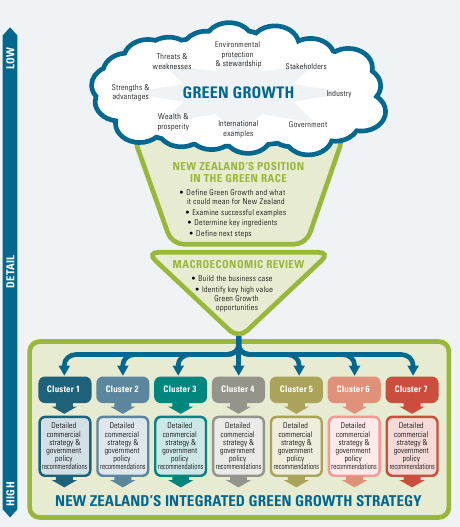
 It’s been a long time, as
  “Will we look into the eyes of our children and confess that we had the opportunity, but lacked the courage? That we had the technology, but lacked the vision?” These words preface the report
  A recent