
Moon-walking with due legal process to a very hot place – Neil Armstrong, coal mining & global warming

EarthApollo8.jpg

On the same day as the death of Neil Armstrong, the first astronaut to step onto the Moon, became public, the NZ High Court moonwalked its way to an off-the-world moment. It decided that greenhouse gas emissions and global warming are off-limits in the planning for an open cast coal mine. That’s as just as ‘out of this world’ as denying that the Moon landings ever happened, argues Simon Johnson.

On Saturday, two bits of news struck home to me very strongly. The first was the death of moon-landing astronaut Neil Armstrong. The second was the High Court decision that open-cast coal mines and global warming are legally and jurisdictionally unrelated in the Resource Management Act.

The moon landing in 1969 I remember very well. As a seven year old, I listened attentively to the ‘one small step’ broadcast. The whole class was silent under the spell of our teacher’s scratchy transistor radio. It’s one of my most strongly held memories of those days. I guess that reflects quite well on that class of seven year olds. They stopped playing bullrush, sniffing with colds, and fighting over lunches to listen attentively to the unfolding of one of humanity’s most historic moments.

While I was still fondly remembering the Moon landing, the next news item struck.
Continue reading “Moon-walking with due legal process to a very hot place – Neil Armstrong, coal mining & global warming”

Offshore wind: a huge resource

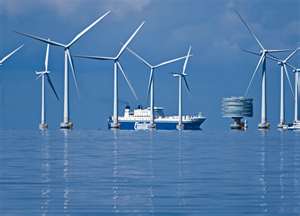
Two wind energy items arrived in my inbox in close proximity recently. One was from the NZ Wind Energy Association (NZWEA) congratulating Meridian Energy on turning the first sod at Mill Creek wind farm in the Ohariu Valley north-west of Wellington. It’s a 60 megawatt farm of 26 turbines. The project will cost $169 million and is expected to be commissioned by mid-2014. It will increase NZ’s installed wind capacity from 623 megawatts to 683 megawatts.

NZWEA’s chief executive made appropriate remarks to accompany the announcement, reiterating the expectation that at least 20% of NZ’s electricity will be generated from wind by 2030 and noting the technology advances in harnessing wind which is now one of the lowest cost options for new generation in New Zealand.

It’s good to see the steady progress in the development of wind energy in NZ, although it seems to arouse little excitement in Government circles who reserve most of their interest for further  fossil fuel development. And a report in Saturday’s NZ Herald was a sobering reminder that the $7 billion invested in the oil and gas sector over the past five years puts it far ahead of any other local sector when it comes to investment in new productive capacity. NZ is hardly on the brink of transition from fossil fuels, hardly, it seems, even interested in the possibility while there’s money to be made from exploiting them.

Continue reading “Offshore wind: a huge resource”

Why Arctic sea ice shouldn’t leave anyone cold

In this guest post Neven Acropolis, the man behind the excellent Arctic Sea Ice blog, looks at the reasons why we need to pay attention to the rapid loss of sea ice in the Arctic Ocean.

Arctic sea ice became a recurrent feature on planet Earth around 47 million years ago. Since the start of the current ice age, about 2.5 million years ago, the Arctic Ocean has been completely covered with sea ice. Only during interglacials, like the one we are in now, does some of the sea ice melt during summer, when the top of the planet is oriented a bit more towards the Sun and receives large amounts of sunlight for several summer months. Even then, when winter starts, the ice-free portion of the Arctic Ocean freezes over again with a new layer of sea ice.

Since the dawn of human civilisation, 5000 to 8000 years ago, this annual ebb and flow of melting and freezing Arctic sea ice has been more or less consistent. There were periods when more ice melted during summer, and periods when less melted. However, a radical shift has occurred in recent times.

1 kinnard2011

Ever since satellites allowed a detailed view of the Arctic and its ice, a pronounced decrease in summer sea ice cover has been observed (with this year setting a new record low). When the IPCC released its Fourth Assessment Report in 2007, it was generally thought that the Arctic could become ice-free somewhere near the end of this century. But changes in the Arctic have progressed at such speed that most experts now think 2030 might see an ice-free Arctic for the first time. Some say it could even happen this decade.

2 albedofeedbackWhat makes this event significant, is the role Arctic sea ice plays as a reflector of solar energy. Ice is white and therefore reflects a large part of incoming sunlight back out to space. But where there is no ice, dark ocean water absorbs most of the sunlight and thus heats up. The less ice there is, the more the water heats up, melting more ice. This feedback has all kinds of consequences for the Arctic region.

Continue reading “Why Arctic sea ice shouldn’t leave anyone cold”

Do you want to fly or do you want to eat?

The title to this post may seem like an odd question, but I think it is an inescapable one, as I hope to demonstrate. The US Department of Agriculture has a mandate for a huge biofuel planting programme, the largest in the world in 2005. Currently around 13.5 billion gallons are produced per annum. The aim is to grow this to 36 billion gallons by 2022.

Then along came the US drought of 2012. US farmers are asking the USDA to forgo the biofuel mandate. It turns out that that they need all of that corn to keep food prices down.

The fact that biofuels compete with land for food crops and can produce food shortages has been noted by others. The US drought has simply demonstrated that the issue will affect rich and poor nations.

But the dream of using biofuels on a large scale for transportation has always been fanciful. US production targets for biofuels have been based on assumptions about technological developments and the availability and productivity of farmland. A recent report, using satellite data about climate, plant cover and usable land, showed that meeting current US biofuel production targets with existing technology would require “devoting almost 80 percent of current farmland in the US to raising corn for ethanol production or converting 60 percent of existing rangeland to biofuels.”

Continue reading “Do you want to fly or do you want to eat?”

Nick Smith: another fossil fuel fail

MP Nick Smith in a NZ Herald opinion piece this week uses the fracking debate to advance the cause of fossil fuel mining. He claims that fracking is important in the development of geothermal energy and then moves seamlessly to the notion that we are desperately in need of unconventional natural gas in order to save us from falling back on coal, which we will otherwise “inevitably burn”. In defending fracking he manages to nicely couple the fossil fuel natural gas with a renewable energy source, geothermal.

It’s not my purpose to argue here about fracking as a technology. What is dismaying about Smith’s article is the complacency with which he advances the cause of natural gas. Writing enthusiastically of the huge unconventional shale gas resources in the US, he claims gas emits one-third the greenhouse gas emissions of coal. I know its emissions are lower, but it was news to me that they were as low as that. I could find no source to substantiate that figure. A little over half is the best figure I have been able to locate, and there are big questions about methane leakage in the fracking process. However let that pass. The real issue is the unrestrained pursuit of unconventional fossil fuels, which as James Hansen has reminded us often enough will mean game over for the climate.

Continue reading “Nick Smith: another fossil fuel fail”