This better be good

Memo to self: finish polishing submission to the Emissions Trading Scheme Review committee, because it has to be delivered by Friday. It’s mostly done — I know what I’m saying — but it has to be put into proper form. I’ll have edited highlights up here on Thursday (with luck) after delivering the submission by email, but don’t let that stop you, dear reader, from making your own submission. The terms of reference are here, the guidelines on making submissions here, and a list of committee members here. I imagine the cranks will be out in force, and Rodney Hide angling to get them heard, so it makes sense to let the committee know that there’s a substantial body of opinion backing strong climate policy. Don’t delay, do it today!

[Update: The committee secretariat don’t seem to want PDF/email submissions, but will accept submissions postmarked Friday or earlier.]
[Fountains of Wayne]

The boatman’s call

Lovelock.jpg The Sunday Times has begun publishing a series of excerpts from James Lovelock’s new book, The Vanishing Face of Gaia: A Final Warning, due out at the end of this month. It makes bleak reading for climate optimists:

So are all our efforts to become carbon neutral, to put on sandals and a hair shirt and follow the green puritans, pointless? Can we go back to business as usual for a while and be happy while it lasts? We could – but not for long. Apart from a lucky break of a natural or a geo-engineered kind, in a few decades the Earth could cease to be the habitat of seven billion humans; it will save itself as it dispatches all but a few of those who now live in what will become the barren regions. Our greatest efforts should go to learning how to live as well as is feasible on the soon-to-be-diminished hot Earth.

Lovelock is riffing on the theme he developed in The Revenge of Gaia: it’s too late to stop rapid and highly damaging climate change, so we should concentrate on saving ourselves. Climate change will cull humanity: from seven billion down to one billion will deliver effective emissions reductions. Meanwhile, we should start looking for lifeboats.

Continue reading “The boatman’s call”

Games without frontiers

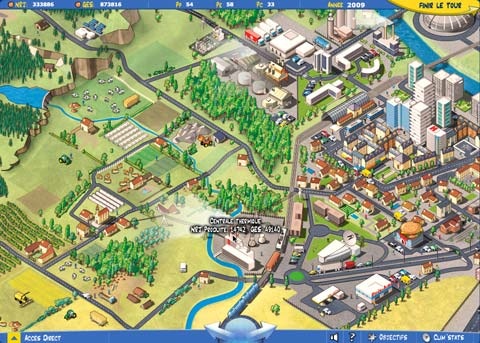
ClimCity.jpg

Jeux sans frontières realised in Clim’ City, an interesting learning game with obvious antecedents from Bordeaux’s Cap Sciences centre: reorganise the energy sources and economy of this French city and its surroundings – from ski field to beach resort – to reduce greenhouse gas emissions without crippling the economy. According to the Technology Review story, it’s not easy to “win”, but if you don’t speak at least a little French it’s impossible… 😉

I hope one of the English-speaking science centres does a translation: I can see this being a great teaching tool. Now, do I create an association des citoyennes or go straight to shifting the centrale thermique to burning biomass, but that means expanding the forestry sector, and perhaps I should make sure that the forests are protected against forest fires, what with the warming in the pipeline…

[Peter Gabriel]

Tell it like it is

NZETS.jpgThe select committee established to review the Emissions Trading Scheme (ETS) is now accepting submissions, and controversy over the precise interpretation of the terms of reference is already looming. As I noted last year, the terms were drafted by ACT and adopted wholesale by the government, with the exception of the removal of a review of the science of climate change. That was replaced by this clause:

• identify the central/benchmark projections which are being used as the motivation for international agreements to combat climate change; and consider the uncertainties and risks surrounding these projections

The Standard considers that this opens the door to Rodney Hide and his mates in the ranks of the cranks, while David Farrar at Kiwiblog leaps to its defence:

So when you hear people rail against the considering the uncertainties and risks of projections, they are actually railing against people understanding the science, and reading the IPCC reports.

No, David, they are railing against the use of that clause to introduce a review of the underlying science — which is what Hide is adamant he’s going to do, and committee chairman Peter Dunne is equally certain he’ll veto. However, the precise wording of that section is so vague that it is capable of multiple interpretations. Time to pull it to pieces…

Continue reading “Tell it like it is”

Tear-stained letter #2

pottypeer.jpg Some summer reading for NZ prime minister John Key: Christopher, Viscount Monckton of Brenchley (“I’m no potty peer”) has penned another of his dippy epistles — an “open letter” in the next issue of Free Radical, an NZ libertarian publication. His last, to John McCain, was a triumph of hilariously overblown climate crank nonsense. This looks to be no more succinct, but has the publishers of FR chortling with excitement. From Not PC:

This is pure gold; the world’s leading climate ‘skeptic’ explains to NZ’s new Prime Minister that the apocalyptic vision of catastrophic anthropogenic climate change is a lurid and fanciful account of imagined future events that was always baseless, was briefly exciting among the less thoughtful species of news commentators and politicians, and is now thoroughly and scientifically discredited.

Thoroughly and scientifically? How exciting. Let’s take a look.

Continue reading “Tear-stained letter #2”