
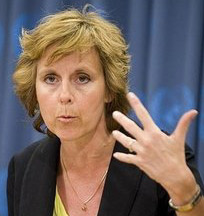
 Connie Hedegaard, the livewire Danish Minister for Climate and Energy (yes they are twinned in Denmark – would that they still were in NZ), will not be to blame if the Copenhagen talks, which she is to host, founder. I have been watching the BBC’s Hard Talk programme the last couple of evenings. Interviewer Stephen Sackur has been to Greenland, to Ilulissat, where Hedegaard had invited some 30 ministers on climate change to an informal conference at a place where the effects of global warming on Greenland ice flow are all too apparent. She explained to Sackur in the excerpt from this interview  (second clip down the page – the first is only introductory) her hope that, in remote and secluded Ilulissat, the ministers, working in the knowledge that everything was off the record, would find some trust and common ground. Continue reading “Ice concentrates ministerial minds”
Category: Climate politics
Tall trees
 Setting emissions targets means more than just making direct emissions cuts — it also means growing our carbon sinks. Climate change minister Nick Smith seems to want to ignore this, insisting (once more) in his interview with Kathryn Ryan this morning that because NZ’s emissions were now running 24% above 1990 levels, that a 40% target for 2020 would mean cutting emissions by 64%. That is, of course, nonsense, because it ignores the role played by our prolific forests. In a timely reminder of the carbon sink potential of forestry in NZ conditions, the Science Media Centre today released a paper by Associate Professor Euan Mason and senior lecturer Dr David Evison of the School of Forestry at the University of Canterbury. In their “Comment on forestry and climate change” [PDF here, available to HT readers by kind permission of the SMC] they say:
New forest planting is a very feasible and viable method to reduce New Zealand’s net emissions. New plantings will provide capacity for New Zealand to implement cost-effective reductions in industry and agricultural emissions, and possibly to develop new sequestration technologies.
They go on to look at ways of increasing the forestry sector’s contribution to emission mitigation (the very thing that Smith is ignoring):
With the right policy settings and with appropriate help for landowners, we could
markedly increase the GHG benefits of forestry by:1. increasing the rate of new forest establishment;
2. increasing sequestration in existing forests; and
3. increasing the use of wood as a construction material
And here’s the kicker: they quote Piers MacLaren on the true potential of afforestation:
… if we consistently achieved a new planting rate of 50,000 ha/year, it would take the best part of a century before we established forest on all our eroding landscapes, and meanwhile we would have carbon credits to sell to others on the international market.
That’s the real challenge, the true potential that Smith and the government are missing. I can only speculate that the forestry industry doesn’t vote National.
In the meantime, I urge anyone who wants the facts about forest carbon sequestration in NZ and its potential for the future (as well as a good discussion of the policy challenges) to read this paper.
Lions led by donkeys
 Climate change minister Nick Smith has been popping up all over the media in the last couple of days talking 2020 targets, on the back of the latest Infometrics/NZIER economic modelling [PDF] on the potential costs of different targets. And though he is refusing to commit to a number before next month, it’s becoming pretty clear that the wind is blowing in the direction of 15% by 2020, and no improvement on 50% by 2050. There’s a transcript of the interview he gave with Guyon Espiner on TV NZ’s Sunday morning Q+A programme here, and his discussion with Kathryn Ryan on RNZ’s Nine To Noon this morning is here. Espiner and Ryan do their best to pin him down, but the minister’s only clear on one thing — 40% is too expensive. From the Q+A transcript:
Well the government’s commissioned this report from Infometrics and NZEIR to try and get a feel for what those numbers would be if we went for the target that Greenpeace is promoting of minus 40, that indicates a cost of about you know 15 billion dollars per year at 2020, you know that’s more than the entire expense of our health system…
…that’s a cost of about three thousand dollars a year, 60 bucks a week…
Is that a fair summary of the likely costs? Time for a quick look under the hood…
Something for the weekend…
[youtube]-MZwMpQoqVM[/youtube]
Greenpeace have mastered the art of cool marketing, or marketing the need for cooling, or for loosening up a little, as Rhys Darby demonstrates… Sign on? You know it makes sense… 😉
To boldly go…
This article was first published in The Press on July 16. It’s a less technical version of my thoughts on where the government should pitch New Zealand’s emissions targets.
Climate change minister Nick Smith began his 2020 emissions target meeting in Christchurch last week by quoting Professor Ross Garnaut, the man who laid the foundations for Australia’s climate policy:
“Climate change is a diabolical policy problem. It is harder than any other issue of high importance that has come before our polity in living memoryâ€.
Garnaut was right. Global warming is certainly a big problem — there are none bigger — and there are three factors that make it so difficult to deal with. For a start, it’s a truly global problem. A solution is in no one country’s hands — it requires all the nations of the earth to work together, in itself a heroic challenge. Secondly, we have to act now to prevent the worst effects, even though we won’t see the benefit for decades. If we wait for climate change to bite, it will already be too late to stop terrible damage. And if that weren’t hard enough, we also have to make a fundamental change in the way we fuel our economies, ending our reliance on oil, coal and gas. The Devil’s own problem, indeed.