Who writes Rodney’s rubbish?

rodenymorph.gifWho’s this supporting the NZ C”S”C’s idiotic attempt to cast doubt on the NZ temperature record? Why, it’s none other than Rodney Hide, leader of the ACT Party, and Minister of Local Government, Associate Minister of Commerce, Minister of Regulatory Reform and Parliamentary principal climate crank. Hide has written to climate change minister Nick Smith, demanding that the NIWA release the temperature data:

There is only one process that is appropriate for matters of science, and that is to release all data, together with a detailed account of what adjustments have been made, with an account of the reasons for doing so, and the computer codes that have been used to adjust and smooth the final published series, together with details of which measurements have been discarded. All the data and the relevant computer codes should be available for scientific scrutiny.

Free the NIWA code! What a rallying cry. It’s a pity that he thinks the likes of Treadgold constitute independent scientific scrutiny. Hide’s also been taking instructions on the CRU hack, and is seemingly happy to completely misrepresent what’s been going on. Apparently the emails:

…reveal a systematic attempt to manipulate the historical time series data, together with what appear to be arbitrary adjustments to the computer codes which produce the averaged and smoothed temperature data…

Er, no. That’s not true. The Herald does a far better job than the Minister of Local Government of covering the stolen emails and what they actually say. But perhaps Rodney gets his “facts” from somewhere else. So, in the spirit of his letter to Nick, here’s mine to Rodney.

Continue reading “Who writes Rodney’s rubbish?”

Marvellous distempered: the Copenhagen diagnosis

The Copenhagen climate conference (COP15) opens its doors in a little under two weeks. To update participants on the science of climate a new assessment report, The Copenhagen Diagnosis, was released yesterday, and it makes grim reading. Designed to inform “a target readership of policy-makers, stakeholders, the media and the broader public” about the evidence that’s emerged since the 2005 cut-off for the IPCC’s Fourth Report, it is especially strong on the accumulating signs of climate change as it happens.

Evidence of melting of the Greenland and Antarctic ice sheets supports a revision of the expected sea level rise by the end of the century: it “may well exceed” a metre. The rapid sea ice loss in the Arctic in recent years highlights the risks of methane releases from permafrost, but the most direct message is that with global carbon emissions surging up to and beyond the highest of the IPCC’s scenarios, and with pretty strict limits on the amount of carbon we can add to the atmosphere and stay under a 2ºC rise, we need to start cutting emissions soon.

Here’s what the emissions growth looks like:

CopCO2emissions.jpg

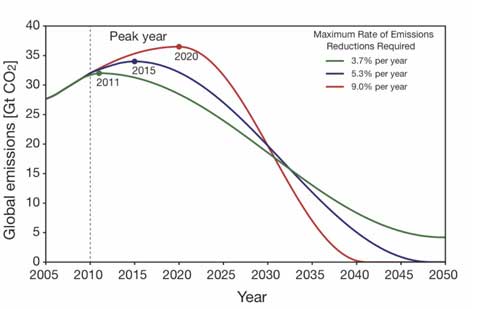
And here’s what we need to do to stay under 2ºC:

CopDiagtargets.jpg

It’s a simple enough message. The longer we leave it before starting to cut emissions, the steeper the cuts will need to be. And there’s an obvious corollary: steep cuts will be more expensive. Inaction now means more cost in the future. Where does that leave any government promising to “balance the economy and the environment”?

Below the fold: the full executive summary.

Continue reading “Marvellous distempered: the Copenhagen diagnosis”

Weakened ETS now law

The government’s amendments to the Emissions Trading Scheme became law this afternoon, thanks to support from the Maori Party [Stuff, Herald, Reuters]. Nick Smith called the changes “workable and affordable” and said that they struck “the right balance in protecting the future of our economy and our environment”, but Labour climate spokesman Charles Chauvel was scathing:

It is economically irrational, socially inequitable, environmentally counter-productive and fiscally unsustainable. And its hallmark has been one of poor procedure and hasty consideration.

But what does the new ETS mean for New Zealand’s emissions? The Science Media Centre is collating responses from the science community, and first out of the blocks is VUW associate professor Ralph Chapman:

The passing of today’s Climate Change Response amendment bill through the House is deeply disappointing. Every week, emerging climate science underlines the need for urgent action to cut emissions drastically, with developed countries especially needing to make cuts right now to avoid a global warming drift above 2 degrees, the guardrail against dangerous change. The Government’s amendment bill does way too little to bring down New Zealand’s emissions. The bill has good aspects (e.g. agriculture is included, eventually) but its overall weakness and lack of clarity about its impact on emissions will undermine New Zealand’s reputation and positioning for Copenhagen.

Deeply disappointing. Pretty much my reaction. NZ has now has a much steeper hill to climb in future than was necessary.

Update 28/11: Additional responses from science community, courtesy of the SMC:

Dr Jim Salinger, an Auckland-based climate scientist, comments:

“At present we appear to be bogged down in emission reduction schemes and targets. This thinking is short-term as the high emissions industries in the long run are doomed. We have the low-carbon technology –- which include many forms of renewable energy such as solar electric, solar thermal, wind, wave, tidal, geothermal and bio-energy. All we need to do is scale these technologies up rapidly and harvest the economies of scale.”

Suzie Greenhalgh, Senior economist in the Sustainability & Society team at Landcare Research, comments:

“The passing of the ETS ammendments sends positive signals about New Zealand’s desire to address global climate change, providing greater certainty to business and the population about the path New Zealand will follow. Given that most of the debate so far has been around the risks New Zealand faces with adopting the ETS, now perhaps the debate can switch to where potential opportunities may lie. The inclusion of agriculture, despite its omission in other national schemes, is also an important step for New Zealand’s management of greenhouse gas emissions and may just provide some of these opportunities.”

Associate Professor Euan Mason, of the School of Forestry at the University of Canterbury, comments:

“It is good that New Zealand has begun to address climate change, and if the energy sector is required to surrender credits earned from genuine CO2 sequestration then the ETS should begin to change our behaviour in helpful ways. In its deal with the Maori party the Government implicitly acknowledged that the ETS legislation markedly devalues pre-1990 forest land and that the few credits offered to owners of such land are inadequate compensation. Offering owners of pre-1990 forests the option of replanting elsewhere after land use conversion as an alternative to paying conversion tax would have gone some way to softening the impact on land values. As it stands only a proportion of these land owners have been adequately compensated, and the remainder, both Maori and Pakeha, no doubt feel a sense of injustice.”


Don’t let a thief steal into your heart

Quite a fuss about stolen emails over the weekend. Let’s review the story so far. Person or persons unknown hack into servers at the Climatic Research Unit of the University of East Anglia and steal lots of emails and other documents [BBC 1, 2, Times, Bob Ward at The Guardian]. This is a criminal offence in the UK, the USA, New Zealand and many other jurisdictions. The criminals then release edited highlights of these documents and emails by putting them up on a Russian web server, and let the news out via what Nature calls “a relatively obscure climate-sceptic blog” (The Air Vent which may have been Andrew Bolt’s blog in Australia). Within a matter of hours, the usual suspects are out in force, screaming data manipulation, conspiracy to exclude climate sceptics from publishing, and fraudulent behaviour. Criminals are portrayed as whistleblowers, quotes are pulled out of private emails and taken out of context, and the end of climate science is proclaimed.

I’ve been reluctant to weigh in on this issue, because commenting on stolen and possibly edited documents strikes me as unethical. In a courtroom, improperly obtained evidence is not allowed to influence proceedings, and I would prefer to apply the same standard here. That hasn’t stopped the likes of Wishart (peer review is broken, climate science is dead), propagandist in chief Marc Morano (continuously updated “Climategate” coverage at his Climate Depot), or even now well out of the closet denialist, the NZ blogger sometimes known as Poneke (warming stopped in 1998 (yet again)). However…

Continue reading “Don’t let a thief steal into your heart”

Oram on ETS debacle: Business Council for Sustainable Development ordered to shut up by big emitters; Nick Smith guilty of “breathtaking hypocrisy”

Fonterra and other big emitters have used their clout to silence the Business Council for Sustainable Development from commenting on National’s proposed changes to the emissions trading scheme, Rod Oram reveals in his Sunday Star Times column today.

…on November 5 Barry Harris, Fonterra’s head of milk supply and sustainability, delivered a withering speech to the council’s meeting. There were 31 other representatives of corporate members in attendance. Harris sharply criticised the council for what he considered its failure to represent the interests of members like Fonterra that “had a lot of skin in the game”.

The council’s insight into how opposed much of the public and some of business is to the ETS changes has clearly rattled some of its less sustainable members. According to some attendees, council chairman Bob Field, chairman of Toyota New Zealand, ordered council staff to stop making public statements on the ETS.

Perhaps Fonterra and Toyota believe that business can only be sustainable if it is protected from the costs of its polluting ways. The huge subsidies, of course, are their’s by right. Meanwhile, it remains to be seen if some of the less hypocritical members of the BCSD will make their voices heard.

In a coruscating column, Oram calls Nick Smith’s headlong rush in to bad legislation “breathtaking hypocrisy”, and quotes extensively from Smith’s comments a year ago when Labour’s ETS was being debated in Parliament.

Oram’s take on the current situation is right on the money:

National is making a dreadful mistake if it believes it can railroad through incompetent, damaging legislation hugely favouring heavy emitters.

At the next election, it will be easy for Labour and Greens to win support from the substantial number of voters who want an ETS that might actually cut emissions. Such an ETS would save the next government some $2 billion a year in subsidies to the heavy emitters, money voters would like spent instead on them and investment in new, clean technologies.

The whole column is worth a read. It’s Oram at his well-informed, combative best.